
C&C. SCIENCE CAFE. Religious Exemptions. CAFE is Out. Science and Medical Journals=BS.
December 4 | Posted by mrossol | Big Govt, CDC NIH, Childers, Kennedy, MAHA, ScienceHHS goes after parent-rights-smashing jab pushers; Trump strikes at runaway car prices; and we dismantle the $cience myth—plus what Secretary Kennedy plans to do about it; more.
Source: SCIENCE CAFE ☙ Thursday, December 4, 2025 ☙ C&C NEWS
WORLD NEWS AND COMMENTARY
💉 💉 💉
Like a grizzled Union artillery captain spotting rebels skulking in the treeline, Secretary Kennedy quietly rolled a cannon into place late yesterday—and let it rip straight over the bows of the meddling local officials still trying to jab other people’s kids without asking first.
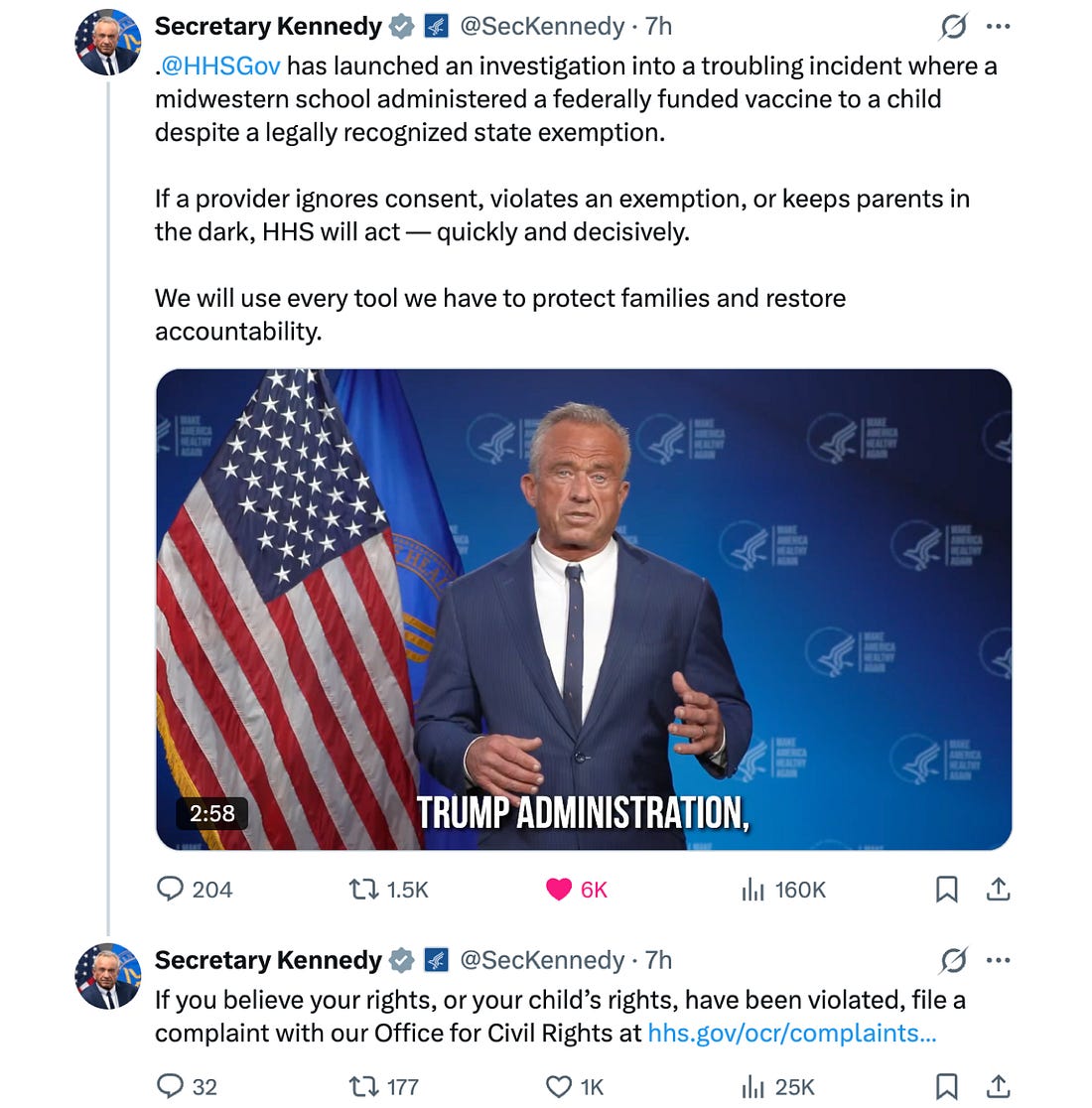 |
CLIP: HHS Secretary Kennedy declares war on meddling health bureaucrats (3:20).
“Today, we are putting pediatric medical professionals on notice: you cannot sideline parents,” HHS Secretary Kennedy said. “When providers ignore parental consent, violate exemptions to vaccine mandates, or keep parents in the dark about their children’s care, we will act decisively. We will use every tool at our disposal to protect families and restore accountability.”
He meant it. Apparently, some health bureaucrats think “parental consent” is just a decorative sticker on the syringe, like a mattress label or a “do not eat” warning on laundry detergent. Funny—these were the same people who once shrieked at us to follow federal guidance. Whoopsies! Now they’re acting like defiant jungle guerrillas, crouched in the foliage, ambushing stragglers in the lunchroom’s dark corners.
💉 Back in August, HHS —working through the DOJ’s Office of Civil Rights, now helmed by pandemic superlawyer Harmeet Dhillon— threatened to yank $1.37 billion in federal health funding from West Virginia for refusing to honor religious exemptions. That put the Mountain State’s simmering jab war on full boil.
West Virginia, famously stubborn, recognizes only medical exemptions for school shots. (It’s one of just five states that still refuses religious or philosophical opt-outs.) In January, Governor Patrick Morrisey signed Executive Order 7-25, creating a religious exemption based on the state’s brand-new Equal Protection for Religion Act (EPRA). A few schools grudgingly complied. Most dragged their feet like they were marching uphill in wet sand.
Then in June, the State Board of Education rebelled, voted unanimously to defy the governor, and ordered schools to resume jabbing any kid who dared raise religion as a shield. (It triggered me, since I waged a similar legal war against defiant Florida schools during covid over mandatory masking.) Cue chaos, lawsuits, and parental fury. In late November, a trial court sided with Morrisey and ordered schools to follow the law.
But two days ago, West Virginia’s Supreme Court executed a procedural bayonet charge—leapfrogging the appeals court to freeze the lower ruling. Within hours, the Board of Education blasted out new orders: stop honoring exemptions and start sticking students again. West Virginia watch, December 2nd:
 |
The fight isn’t over. The legislature tried —but failed— this year to pass a statutory religious exemption. Gov. Morrisey isn’t backing down. “Whether we prevail in the courts or prevail with the Legislature,” his office said, “West Virginia will ultimately join the other 45 states that protect and defend religious liberty.” So.
💉 Kennedy’s warning shot matters. Victimized parents keep reporting the same nightmare: kids coming home saying they were jabbed at schooldespite the parents opting out, invoking exemptions, or explicitly refusing. In places like West Virginia, county health departments have been known to swoop in like syringe-wielding SWAT teams and start sticking everything that moves.
These are the same schools that won’t give your kid an Advil without a notarized affidavit and two witnesses. But inject 72 doses of federally funded pharmaceuticals? Sure, no problem, please line up here.
But here’s the twist: those county-administered vaccines are federally funded, which means they’re subject to federal rules. And those rules require schools to honor exemptions. That’s the lever Kennedy is now yanking, hard.
In his clip, he twice directed parents to HHS’s revamped reporting page— effectively a national tip line for bureaucrats who can’t keep their needles to themselves: (HHS.gov/ocr/complaints.) “We will use every tool we have to protect parents and families,” Secretary Kennedy said. “Parents know their children best; parents love their children most,” he added.
Two especially bright flashes of good news: First, the national climate around school jabs has flipped faster than an exhausted general at Appomattox. Under Biden, federal agencies were shoving shots down every open hallway. Now, HHS keeps steadily rolling out policies, one after another, that strengthen parental authority and weaken compulsory vaccination culture.
It’s an exact inversion of the bizarro world we woke up in just a couple years ago.
Second, for anyone who doomscrolls too much and thinks Secretary Kennedy abandoned the vaccine battlefield to wage holy war only on seed oils and food dyes— nope. Not even close. Yesterday’s cannon blast —and the rest of the great stuff we’ve seen rolling out of HHS this week— should settle that question nicely.
💵 💵 💵
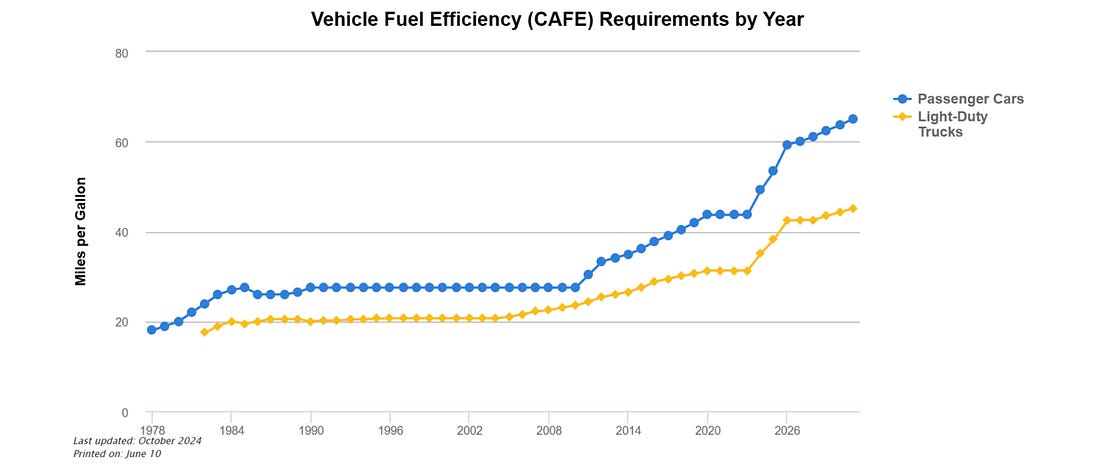
In affordability news, ABC ran an unexpectedly solid piece yesterday, headlined, “Trump announces roll back of Biden-era vehicle fuel efficiency rules: ‘Expensive restrictions.’” So-called CAFE standards —the ever-tightening “green new deal” fuel-efficiency edicts— have quietly forced automakers to build pricier, more complex cars every single year.
 |
At age fifteen, I bought my first car—a heavily used but loyal Ford Maverick, the Mustang’s unloved cousin—for $500 lawn-mowing money, from a Cambodian refugee with broken English and an irresistible sales pitch consisting mostly of shrugs. The seat covers hid both the shredded foam andthe missing lap belts. But it ran, and I adored it with the same protective endearment as people who love their scruffy, three-legged rescue dogs.
Fast-forward to today: kids can’t get a reliable used car for less than $5,000. And a genuinely decent new one? You’re lucky if you get off the lot without signing away less than $50,000.
In 2016, the Heritage Foundation estimated that the CAFE Standards added $6,200 to the average price of a new car. That was in 2016 dollars, and if you glance back at the chart above, it was before Biden cranked the regulatory vise so tightly you could almost hear the auto industry’s ribs cracking.
So yesterday, Trump cut the cord. He’s putting CAFE out of its misery.
“We’re officially terminating Joe Biden’s ridiculously burdensome, horrible, actually, CAFE (Corporate Average Fuel Economy) standards that impose expensive restrictions and all sorts of problems for automakers,” Trump said. “And we’re not only talking about here, we’re talking about outside of our country, too,” he added for good measure.
Outside the country, like California. All the special California “waivers” allowing the Golden State to impose even stricter emissions rules? Gone. Automakers hated those waivers because they forced everyone else to pay for California’s virtue-signaling, since manufacturers don’t want to produce one car for normal people and one car for the Church of the Sacred Prius.
Carmakers just grit their teeth, meet the harshest standard, and pass the ever-increasing costs on to all of us. But not anymore. Bam.
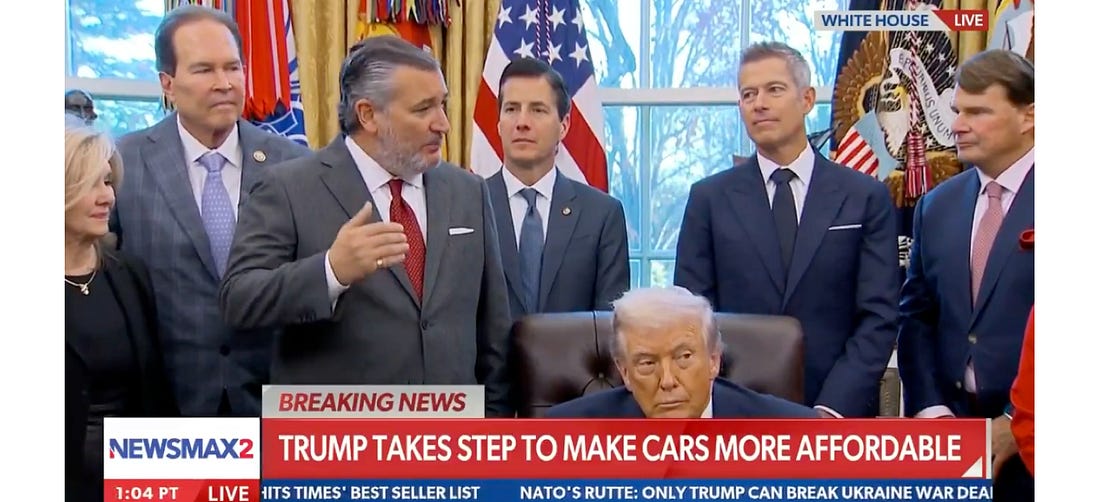 |
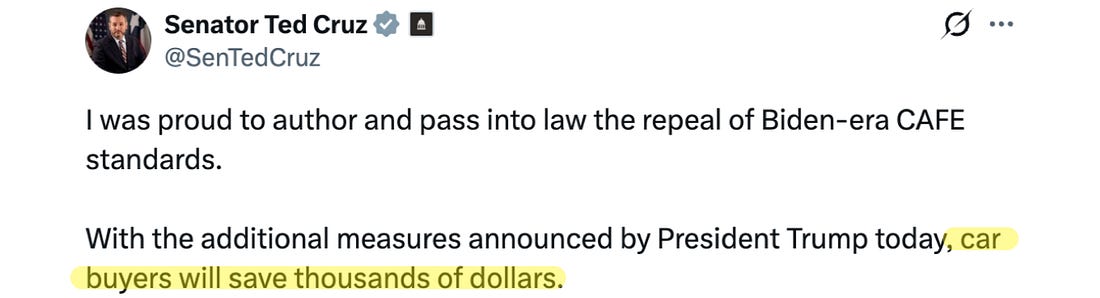
Senator Cruz, who attended the signing along with a small crowd of auto executives, focused on one thing— the cost of cars:
 |
Don’t miss this: The Democrats’ prized political issue was even in the name. Specifically, yesterday the White House and DOT launched the “Freedom Means Affordable Cars” initiative. Under it, NHTSA proposes resetting fuel-economy baselines for model years 2022–2031 and then inching them upward at a sane, human pace rather than Biden’s regulatory moonshot.
For example: under Trump’s proposal, average fuel economy targets would hit roughly 34.5 mpg by 2031, instead of Biden’s 50.4 mpg fever dream. NHTSA says that one change alone saves consumers around $109 billion—about $1,000 per car or truck.
Senator Cruz also noted that Trump’s Big Beautiful Bill already zeroed out all noncompliance penalties for failing to meet impossible CAFE targets. That was the helpful setup. Yesterday was the knockout punch.
The message discipline was tighter than a drum, and the automakers heard the beat. “We look forward to working with NHTSA on environmentally responsible policies that also allow us to offer customers the freedom to choose the vehicles they want at prices they can afford,” Stellantis CEO Antonio Filosa said. (They own Jeep and about thirteen more brands.)
What most pundits miss is that Democrats handed Trump an “affordability” katana— and he’s now swinging it around, with gusto.
Everyone focuses on money printing as the big driver of Bidenflation. And absolutely, that played the starring role. But the chart at the top of this post tells the other untold part of the story: regulations themselves quietly ratcheted prices upward. Biden’s team made everything more expensive on purpose. Trump is now dismantling that machinery— and racing down the political highway at 90 mph.
Cutting suffocating regulations is the lowest of low-hanging fruit, and Trump is shaking the whole tree.
Democrats might regret turning “affordability” into their rallying cry. It just gave Trump the political cover to bulldoze one of their most cherished regulatory temples—and hand working families cars they can actually afford again.
🔬 🔬 🔬
It’s hard to pick the most depressing part of Jan Jekielek’s most recent interview with independent investigative journalist Maryanne Demasi discussing the Paxil scandal— the forged numbers, the missing suicides, or the fact that the fake study was bought so brazenly you half expect it to show up listed on Zillow as “Two-Bedroom Bungalow, Recently Renovated, Includes Complimentary Journal Editors.”
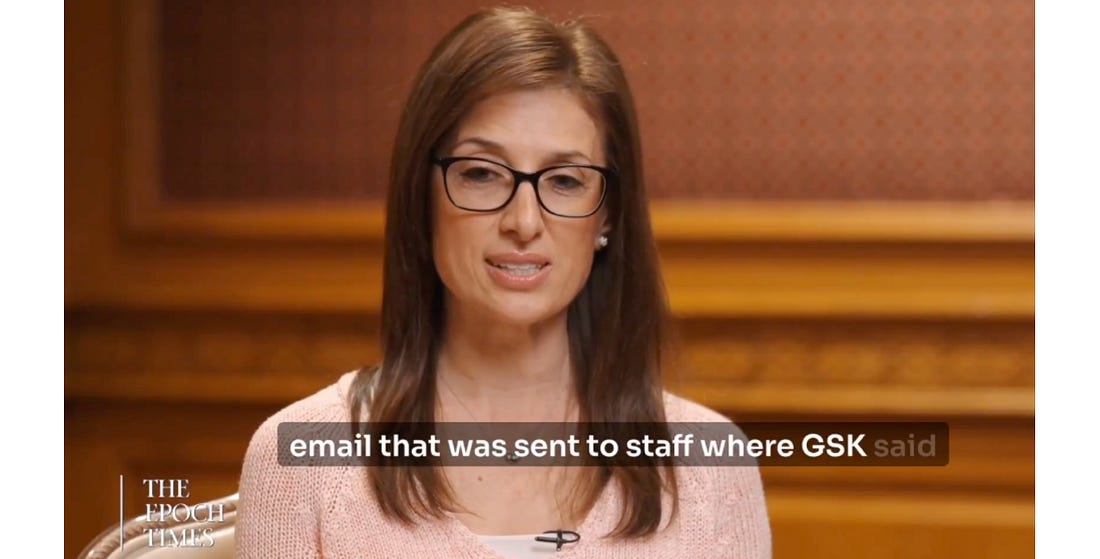 |
YOUTUBE: From Statins to Paxil, Here’s What’s Wrong With a Lot of Medical Research (52:05).
The story, which originally broke in 2015, is as old as “peer review” itself: a drug company (GlaxoSmithKline) wanted glowing results, so a helpful army of ghostwriters tweaked their study’s original results, massaged the incriminating data, and buried the bodies. Literally. The study’s authors either downplayed or outright concealed suicide attempts among teens taking Paxil.
The resulting paper —if you can call it that— created an entire generation of “unexpected adverse events,” otherwise known as dead kids.
And yet it had passed peer review. It was published in the BMJ. It had 21 co-authors— none of whom reviewed the raw data. It influenced medical guidelines. It made enormous sums of money. Then it exploded, leaving behind a familiar chalk outline: the corpse of scientific credibility.
“Prescriptions of antidepressants to young people surged in the wake of the study,” one New York Times article said, blandly.
In 2012, the DOJ got GSK to pay a $3 billion dollar fine —the biggest in medical history at the time— for falsely marketing Paxil to kids. Get this: to this day, in spite of the criminal fine and all the poor press, the BMJ has refused to retract the paper. (Just this year, a ‘notice of concern’ box was added to the top of the online version of the study.)
But this depressing anti-depressant story wasn’t any rogue case. It was the system working exactly how it has been designed.
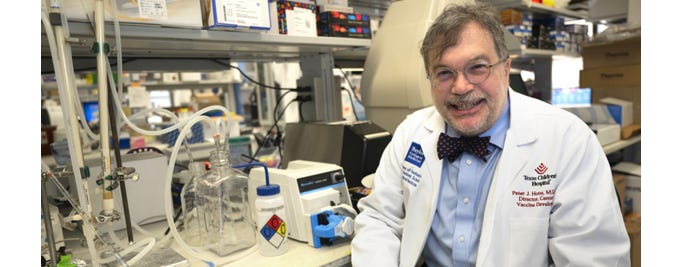 |
🔥 Don’t take my word for it. Take the word of the people who actually ran the journals. In 2015 —the same year the Paxil story broke— former LancetEditor-in-Chief Richard Horton finally snapped, and blurted out the truth like he was confessing to siphoning gas from his neighbor’s lawn mower:
“The case against science is straightforward: much of the scientific literature, perhaps half, may simply be untrue.”
Perhaps half. Half! That’s not a statistical signal or a confidence interval. It’s a crime scene report.
Even the BMJ’s own former head editor, Fiona Godlee, admitted the field is “corrupted.” And not in the cute, old-fashioned way where the guy at the lab sneaks home a spare beaker. She meant intellectually corrupted— results engineered, journals captive, entire fields shaped by whoever has the fattest budget for “research support.”
Third: former New England Journal of Medicine Editor Marcia Angell (who spent twenty years guarding the temple) finally conceded the high priests were selling edible miracles in bulk:
“It is simply no longer possible to believe much of the clinical research that is published… I take no pleasure in this conclusion.”
It’s not possible to believe the research! That’s from the editor of the New England Journal of Medicine, not some random TikTok alien theorist.
Finally, there’s controversial mathematician John Ioannidis, who coldly and logically ran the numbers. His famous 2005 paper, “Why Most Published Research Findings Are False” now has an eye-watering 3.3 million views and 9,000 citations. Ioannidis calmly proved, with data and statistics, and without sarcasm (showing heroic self-restraint), that modern research is structured so that false results are the expected output.
You don’t even need a conspiracy theory, when the trashy incentives mathematically guarantee “garbage out.”
Which brings us back to Paxil. New York Times headline, 2015:
 |
Now they tell us. “Retractions,” the Times reported, as though this kind of about-face were a regular occurrence, “are at an all-time high; recent cases of fraud have shaken fields as diverse as anesthesia and political science; and earlier this month, researchers reported that less than half of a sample of psychology papers held up.”
Richard Horton’s estimate might have been overly optimistic.
The Paxil story isn’t any aberration. It’s a smoking crater, along a winding road of smoking craters; a road lined with credible warning signs that the bowtied establishment types shrieked at us to ignore. Follow the science and shut up, morons!
The top journal editors tried to warn us. The statisticians tried to warn us. The whistleblowers tried to warn us. Even the retraction counts tried to warn us.
But the system kept on selling the provably false narrative that “science is self-correcting.” The fines do their job. Sure. The Titanic was self-correcting, too— right after it finished correcting itself at the bottom of the Atlantic.
Now, years later, we look back at the Paxil disaster like it was ancient history or something, the way astronomers study a distant supernova. But this is what happens when you mix industrial-strength money with scientific credentialism and silence skeptics by removing all the oxygen.
🔥 Critically, the children harmed by that scandal never got the benefit of the “self-correction.” The correction always comes later, in a politely worded retraction, in six-point type, long after the damage is irreversible and the bodies are cold in the ground. The market moved on. The bonuses were paid. The prescriptions were written. The parents found some way to keep going.
And yet— medical authorities still lecture the public about “trusting the science” like a drunk uncle insisting he can drive. Paxil isn’t a ghost of scandals past. It’s a preview of the operating system we all lived under during the pandemic.
 |
Bought studies. Captured journals. Silenced critics. Manufactured consensus. Same structure, bigger budget.
🔥 But the Paxil scandal may serve as more than a gruesome relic of the past. It could be a sign, an ignition point for a full-blown reckoning with what many now openly call “junk science.” More optimistically, just this year, Secretary Kennedy, FDA Commissioner Dr. Makary, and NIH Director Dr. Jay Bhattacharya all began pushing a radical overhaul of how medical science gets published. Inside Higher Ed, October:
 |
At the heart of their plan: dismantle the luxury-journal cartel that has long protected industry-funded papers, restricted publication to a tiny oligopoly of gatekeepers, and rewarded pro-pharma results over truth. Under the terrific Make America Healthy Again Commission (MAHA) report —chaired by RFK— the administration pledged to “realign incentives,” restore transparency, and prioritize “gold-standard science, not special interests.”
As part of that effort, the newly confirmed NIH director (Bhattacharya) and FDA chief (Makary) aren’t just going through the motions. One of the very first things they did, racing right out of the starting gate, was to launch a competing journal explicitly meant to challenge the gatekeepers. Politico Pro, February:

At the heart of their plan: dismantle the luxury-journal cartel that has long protected industry-funded papers, restricted publication to a tiny oligopoly of gatekeepers, and rewarded pro-pharma results over truth. Under the terrific Make America Healthy Again Commission (MAHA) report —chaired by RFK— the administration pledged to “realign incentives,” restore transparency, and prioritize “gold-standard science, not special interests.”
As part of that effort, the newly confirmed NIH director (Bhattacharya) and FDA chief (Makary) aren’t just going through the motions. One of the very first things they did, racing right out of the starting gate, was to launch a competing journalexplicitly meant to challenge the gatekeepers. Politico Pro, February:
It would be a massive understatement to say the big federal health agencies and their billions in annual grants direct the conversation. If nothing else, the impending shift in NIH standards at least threatens to end the corrupt old system, wherein pharmaceutical companies laundered regulatory influence using taxpayer-funded grant money, and top-tier journals translated that into prestige, citations, and sales pitches disguised as “clinical guidance.”
If anything, the pandemic proved how much worse things can get when you combine corrupted research with political power and real-time censorship. You might consider Paxil as the prototype.* Covid was the industrial release version. (* the catastrophe of Alzheimer’s research —scientific corruption’s Mount Everest— might be an even better example, but that’s for another day when I don’t have a plane to catch.)
Maybe the saddest part of all is how numb and unselfaware the establishment has become. Horton, Angell, Godlee, Ioannidis— they didn’t whisper. They shouted. And nobody with power wanted to hear it, because the money was good and the machine was running smoothly.
Until it wasn’t. Far below the news surface, Tectonic forces are shifting the scientific landscape in ways that are devilishly difficult to detect on the ground. They still cling to their old, failed system. But they aren’t getting away with it anymore.
Welcome to the Reckoning,™ and to the new age of reason.
Have a terrific Thursday! I’m headed to pre-Mamdani New York City, to take a final look around before the ‘revolution’ starts. And do some work. In the bitter cold. Come back tomorrow, for some fiesty, sarcastic hotel blogging on all the essential news and commentary.




Leave a Reply
You must be logged in to post a comment.