
C&C. NOT BORING. Will GOP Go To Work? 4.6%
December 17 | Posted by mrossol | American Thought, Childers, Congress, Incentives, Technology, Voting IssuesJohnson plans to codify Trump policies. [I will believe it when I see it. -mrossol] Grocery issues. GOP edges 2026. Jobs rise, unemployment up—media gloom. Musk backs Trump/GOP. Tesla self-driving; SpaceX IPO; Tunnels; and trillionaires.
Source: NOT BORING ☙ Wednesday, December 17, 2025 ☙ C&C NEWS
WORLD NEWS AND COMMENTARY
🔥🔥🔥
Ask, and ye shall receive. Early yesterday morning, I sniped at the House of Representatives and suggested they get busy passing bills to lock in Trump’s executive orders. Later the same day, during the weekly House Republican Leadership press conference, Speaker Mike Johnson teased an “aggressive” 2026 legislative agenda and vowed to do just as I’d asked.
Here’s the transcript from the terrific clip. Johnson was asked about Republicans’ legislative agenda, and he said:
“You’re going to see an aggressive affordability agenda, and we’re going to see continued codification of the President’s executive orders. He’s up to about 200 executive orders. Probably about 150 of them are codifiable by Congress— and we’re working steadily through that list.
A very aggressive legislative agenda coming right out of the gates in January. We’re going to continue to work, for example, on healthcare to continue to bring costs down for the American people, to bring down the cost of living overall.
You’re going to see us delivering for the American people while the effects of that giant piece of legislation signed on July 4th comes into implementation.
So much more. Much more yet to do. And the President and I talk about that almost every day.”
Oh, corporate media covered the press conference. But, demonstrating the professionalism and commitment to transparency of an above-average nocturnal rodent, reporters completely ignored this part of Speaker Johnson’s comments. Instead, they focused monomaniacally on his briefer announcement of non-news: that Republicans will not vote for more Obamacare subsidies, thereby pretty much triple-dog-daring the media to spend the next two weeks crying about healthcare affordability.
As they say in Portland, chatter is cheap. We’ll soon see whether Congress delivers, but Johnson’s explanation was a very good sign.
🔥 If Speaker Johnson’s timetable is accurate, and the GOP does plan a legislative surge in January, the schedule makes sense. The first year of Trump’s term was focused on maximalist use of presidential powers without Congress —with the notable exception of the OBBBA— giving President Trump room to rapidly capture territory. The second year, 2026, could be the year for legislation, now that Trump has painted all the road signs for lawmakers.
It might even be better to do them all at once. A rapid-fire surge of bills will confuse and confound Trump’s political enemies, including the media: what should they focus on? They’ll be overwhelmed.
Still, the Senate remains a major problem, since Republicans lack a 60-vote majority needed to defeat the filibuster. There are three possibilities. First, Republicans might make concessions for some Democrat priorities, to build consensus, and to pass some watered-down laws. That’s the usual way it works. Second, they could ‘nuke’ the silent filibuster. Seems unlikely, but you never know. Or, third, they could make a big show of trying to pass bills while Democrats unreasonably filibuster every single one, thereby energizing the base and spurring high turnout in the midterms.
In other words, let’s say Republicans roll out 100 great bills. There would be some bill in there for everyone. Everyone would have a good reason to vote for their local Republican, to get Trump’s agenda cemented into law. Every single GOP candidate could run on that platform: Elect me to ensure Trump’s agenda is secured and we don’t go backwards.
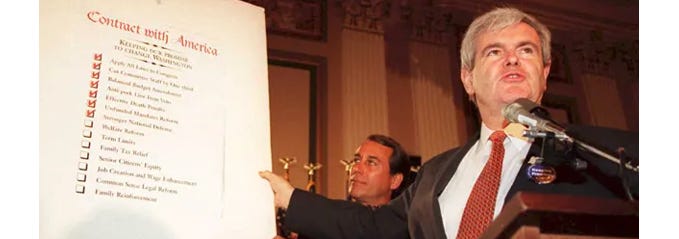 |
It could be a turbocharged version of the 1994 Contract for America (CWA). Then-Speaker Newt Gingrich unveiled a list of 10 specific bills that Republicans promised to vote on in the first 100 days if they took the House. Every GOP candidate used the same message: “Vote for me for the CWA!” The list of bills included fixes for all political groups: fiscal conservatives (spending cuts), social conservatives (crime/welfare reform), and moderates (government reforms).
The CWA energized the base, framed Democrats as obstructors, and it worked. The CWA helped flip the House after 40 straight years of uninterrupted Democrat control.
But what Johnson described yesterday is a CWA on steroids. Whereas the CWA was only ten bills, Johnson is teasing ten times that many. Unlike in 1994, when the new Republican House faced a hostile Bill Clinton, this time there’s a GOP president in the White House who penned the policies in the first place.
Remember— all Newt Gingrich could promise 1994 voters was to bring the ten bills to the floor for a vote. He couldn’t hope to promise passage, not with Clinton in the Oval Office playing hide the cigar. But this time, it’s different. If voters will help keep the House and give Trump only +7 more Republican Senators, the 100+ bills will pass.
To achieve that kind of reverse wave in the Senate —holding all 22 current GOP seats and capturing +7 swing or light-blue Senate seats in a midterm season— Republicans would need a single master issue, an 80/20 issue for everyone.
Fortunately, Democrats provided that issue: Affordability.
🔥 This morning, NPR ran a hit piece headlined, “Trump’s economic approval hits a new low at 36%, poll finds.” Set aside the poll’s result about Trump’s economic approval for a moment. Take a gander at the issue nearly half of Americans are fretting about— prices:
 |
“Nothing else came close,” NPR reported. “Housing was second at 18%, followed by tariffs at 15% and job security at 10%.” But affordability showed up even more strongly in the poll’s other questions. “Seven in 10 people surveyed said their expenses either match or exceed their income every month,” NPR added. Another 70% of Americans said the area where they live is either “not very affordable” or is “not affordable at all” for an average family.
Amusingly, NPR also polled people’s pessimism. “Among those most pessimistic were Democrats, white women with college degrees” —AWFLs— “independents, and Latinos.” Optimistic groups included Republicans, Christians (especially Evangelicals), people who don’t live in cities, and stupid white people (“whites without degrees”). I think it’s become pretty obvious that, if you want to be happy, stay away from college, the donkey party, and anxious women with gender studies degrees. Embrace God instead.
Hey, don’t blame me. That’s what NPR’s poll said.
Still, the 800-lb gorilla question is: can Republicans successfully co-opt the affordability issue?
🔥 Republicans enjoy some pretty significant structural advantages:
- This month’s Harvard/Maris poll found that, despite Trump’s low economic approval, 55% of voters still trusted the GOP more on economic issues than Democrats, for some reason.
- Though incumbents have to answer for current conditions, everyone knows that Bidenflation came from the cabbage patch.
- Gas prices are steadily dropping, with prices per gallon under two dollars in six states.
- Growth in US productivity, measured by GDP, is strong. Yesterday, the Atlanta Fed estimated Q3 growth at +3.5%, following an even stronger Q2 (+3.8%).
- Most importantly, growth in real wages —take-home pay— is now almost double the rate of inflation: +5% wage growth compared to 3% inflation. When real wages rise, it means the weekly paycheck buys more, especially when paired with falling gas prices.
- To all of that, add the fact that the 2026 Senate cycle favors Republicans. Most GOP seats up for election are in solid red states, whereas Democrats have to defend several purple-state seats. Republicans control more governorships and state legislatures. GOP fundraising is significantly ahead of Democrats. The recent gerrymandering wars strongly favor the elephant party, and Republicans have surged in party registrations, erasing longstanding Dem advantages in several swing states.
Republicans seem eager to take up the fight over affordability. “We’re going to continue to work,” Johnson said, “on health care to continue to bring costs down for the American people, to bring down the cost of living overall.”
Democrats’ choice of prices as their primary issue might actually be a Christmas gift for the GOP. Affordability —especially when measured in prices like the NPR poll suggests— is a master issue that wraps around everything else like a warm blanket. People who are totally disinterested in wonky discussions about reducing the size of government will start listening when shrinking government is framed as a way to prune tax burdens and grocery store prices.
 |
There is historical precedent. Reagan’s 1980s messaging successfully sold deregulation and tax reforms as anti-inflation tools that lowered “kitchen table costs” for families, broadening the GOP’s appeal beyond party partisans.
If Republicans can flip the affordability script, they can create the conditions for a rare midterm red wave. Don’t misunderstand me; there remains a tremendous amount of work to be done, especially to get Republican and independent voters energized to turn out in a non-presidential election cycle, and some good luck. But it is no longer a whimsical fantasy.
🔥 Prepare yourself. If I’m right, we are headed for several months of intense frustration, as House Republicans advance commonsense bills and Senate Democrats knock them down with silent filibustering. That painful road will then lead right into the midterms, where Democrat’s obstructionism will become a blessing, potentially provoking record midterm turnout.
With that working hypothesis in hand, we will watch events unfold and test our theory against what actually happens. Let’s check in on the economic reporting.
🔥 🔥 🔥
Yesterday, Axios ran a good news is bad news story headlined, “U.S. economy adds 64,000 jobs in November, unemployment rate at 4-year high.”
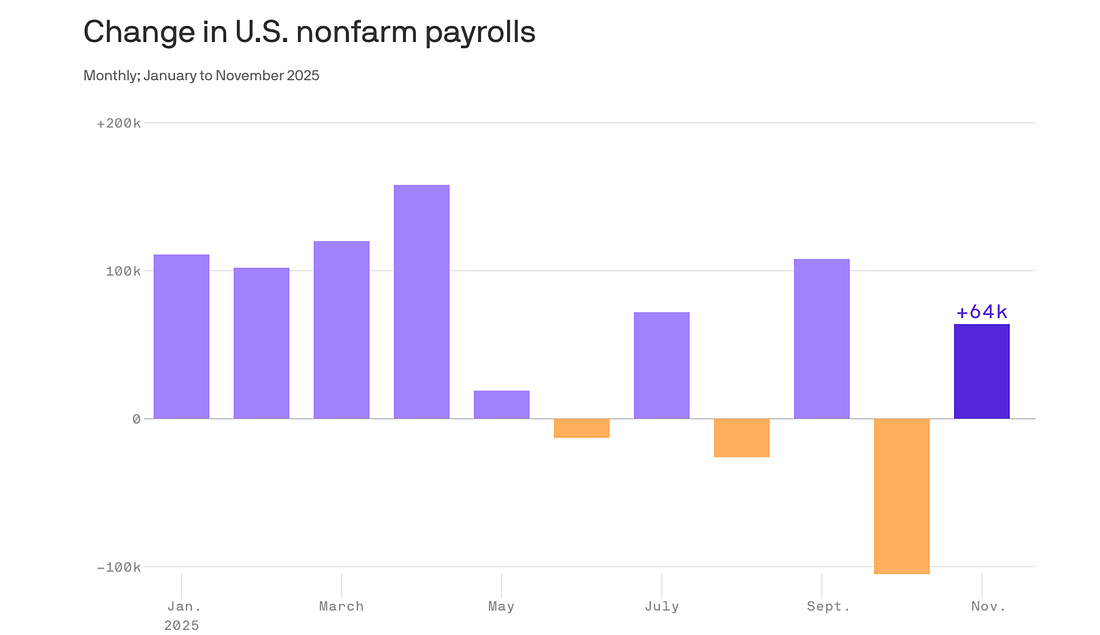 |
The first bit of good news was that in November —despite the government shutdown— job gains raced past experts’ predictions of +50,000 to a solid +64,000. Note that, since President Trump has now fired over 275,000 federal workers, and some number of illegals departed for sunnier shores, the net gains in employment are even more impressive.
The second bit of good news was the unemployment rate of 4.6%. Except when Republicans are in office, rates of unemployment below 5% are considered healthy. Of course, Axios (and the rest of corporate media) framed the 4.6% rate as apocalyptic. Note that, as economies begin to improve, unemployment often ticks up, as people who’ve been out of work a long time —thereby excluded from the figures— re-enter the workplace and start looking for a job. Not to mention the people on the welfare hustle, who can see the signs that gravy train is pulling into the station.
During the Cabbage years, media experts described unemployment rates in the 4’s as outstanding. Just saying.
🔥 Axios ran another unintentionally optimistic story yesterday, headlined, “Scoop: Elon Musk diving into 2026 midterms for the GOP.” The article explained, “The tech billionaire recently cut big checks to help Republicans win congressional races next year and indicated he’d give more throughout the 2026 cycle.”
Most of all, the far-left platform was fascinated by the emotional issuesbetween the world’s richest man and the world’s most powerful man, as if everything boils down to a bad Netflix special getting the Sex and the Citygals back together. “Musk has begun funding the GOP’s House and Senate campaigns for the 2026 midterms,” Axios gleefully dished, “an indication his relationship with President Trump has thawed since their messy breakup earlier this year.”
Please. The bromance was the least interesting part of the story.
Elon Musk is enjoying a moment. It’s becoming difficult to describe him as anything less than a modern-day Thomas Edison or, maybe more appropriately, Nikola Tesla.
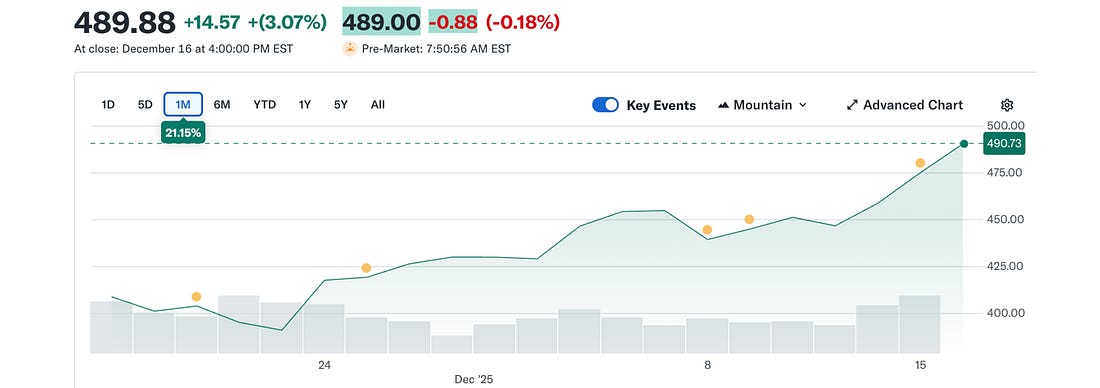
First, Tesla Corporation stock surged this week to a record high, up +21% over the last 30 days, after the carmaker quietly released an update to its self-driving platform that, by most accounts, is now mere inches from safe, fully automated driving. Say what you will about preferring driving yourself, but Tesla’s self-driving technology promises to revolutionize transportation, and nobody else is even close.
The latest release, for example, lets drivers talk to Grok AI, which can adjust the car’s navigation in real time. “Grok, I really need to go,” they can say, and the AI will find and route an emergency bathroom break in the nick of time— without reminding them they just had to stop forty minutes ago.
 |
But Tesla’s stock surge was mere pocket change. Musk is also preparing to take his next company public, and it will almost certainly smash all historic records. CNBC headline, yesterday:
 |
Commenters noticed that SpaceX’s conservative valuation of $800 billion (Elon owns 42%) will make the private rocket company bigger than the rest of the military-industrial complex put together:
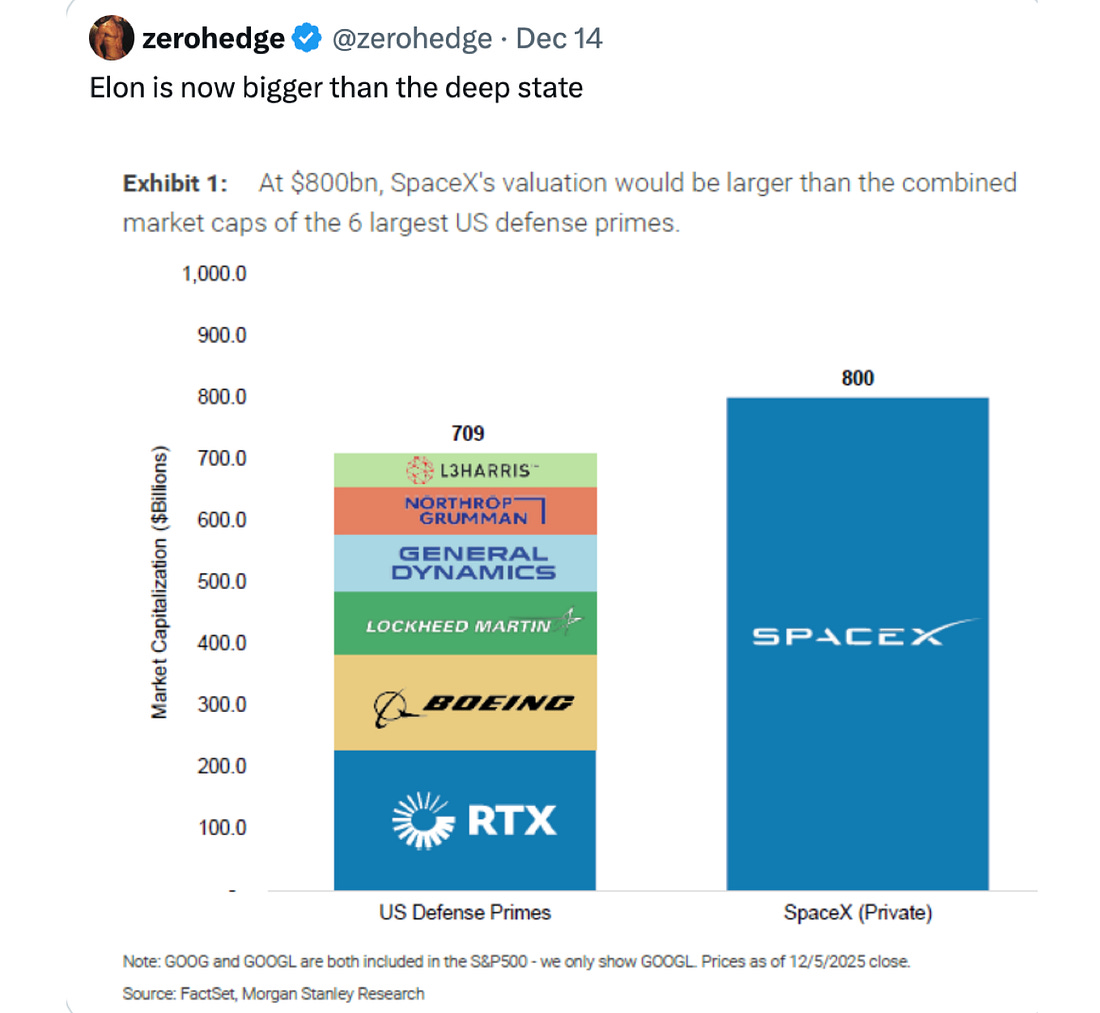 |
According to nearly every estimate, an $800 billion valuation is the low end.Note that it’s not just rockets. SpaceX owns the global satellite-based internet service, Starlink, which literally has every living human being as a potential customer. Some analysts predict SpaceX’s value could increase tenfold by 2030. There’s much I could say about this. We are living in a Jetson’s episode. Sometimes I feel like George Jetson: Jane, get me off this crazy thing!
But never mind that right now. There’s more.
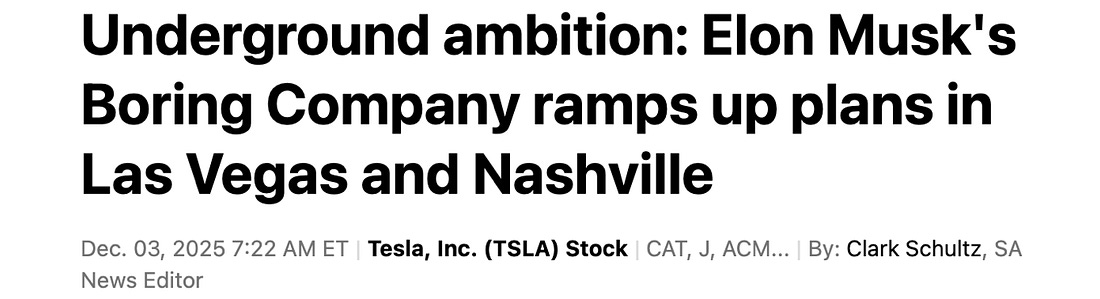
🔥 Elon’s quietest and “least interesting” company is softly starting to fill the back-page headlines. The company bears the tongue-in-cheek name, “The Boring Company,” and it makes digging robots. His robot diggers can tunnel through rock at a tenth of the cost, and ten times the speed, of traditional mining techniques, which still rely on technology considered unremarkable at the time of the Spanish Land Grant.
Two weeks ago, investment rag Seeking Alpha ran this fascinating headline:
 |
While you were distracted by useless corporate media that is only focused on politics and woke culture wars, a technological revolution has been tunneling its way under the dry desert sands of Las Vegas.
The best way to describe “The Loop” is as a kind of subway system beneath Sin City. The contract was awarded in 2019, and most of the work was completed in eighteen months between contract award to opening. I defy you to find any example of a subway being built that fast.
The Loop has continued expanding and by this year, the Boring Company has installed a series of stations for resort and conference guests that is currently completing —wait for it— around 32,000 trips per day. There are currently six operating stops on the Strip and downtown, with more scheduled to open next year, including between the Strip and the airport, with 90 more stations already permitted.
 |
The major innovation isn’t just the digging robots. Instead of subway cars, the Boring Company just uses Teslas. So it doesn’t need to build out a giant infrastructure of rails, trains, controllers, safety systems, fire suppression, and so forth. It’s just an underground roadway that runs in a circle. Passengers wait to board the next car that comes around. They each get their own private cars, which is nice and quiet but admittedly reduces opportunities for interacting with the local wildlife or getting stabbed in the neck.
The company just received a contract to start building a system in Nashville, with an initial dig between the airport and downtown. Rumored negotiations for other projects include Dubai, Houston, and Los Angeles. Traditional subway construction has slowed to a snail’s pace in the U.S., since the projects typically take 50 years and untold billions to complete. But around the world, subway construction is booming, providing fertile ground for Elon’s Boring Company once it gets its motorized spinners moving.
 |
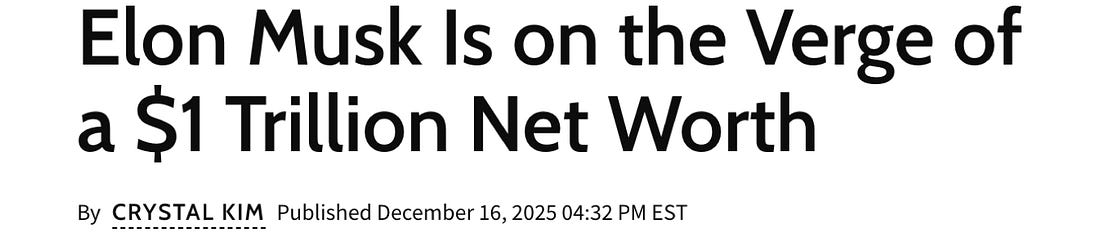
Can you see it yet? Elon is poised to own all three domains: ground transportation, the skies, and the underground. (The three companies, plus Tesla’s humanoid robots, are also what’s needed to terraform Mars, but that’s a different story.) In other words, the sky is literally the limit. No wonder media is speculating about Elon becoming the world’s first trillionaire. Headline from Investopedia, yesterday:
 |
And we haven’t even mentioned Twitter/X, xAI, or Neuralink. Those remain in the pipeline.
I spoke earlier about Republicans enjoying a major fundraising advantage for the 2026 midterms. That doesn’t even include the advantage of having the world’s richest and arguably smartest man —certainly the world’s most productive inventor— on the GOP’s side. And he’s just mobilized to support Republican candidates during the midterm elections.
It is impossible to oversell the radically transformative time that we are living in. Please remain seated with your safety belt firmly fastened at all times that the ride is in motion. Here we go.
Have a wonderful Wednesday! Loop back here tomorrow morning, as we dig into another day’s essential news and commentary that you’ll never find in corporate media.




Leave a Reply
You must be logged in to post a comment.