
C&C. PARDON ME. Christmas Faith Outrage-MSM. Crime Plummets.
December 27 | Posted by mrossol | American Thought, Childers, Law, Liberal Press, US ConstitutionHeadline date gaffes; Trump echoes zombie filibuster fix; jailed election whistleblower gets new hope; WaPo botches Xmas faith outrage; Obama judge backs $100K H-1B fee; crime plummets, media baffled.
Source: PARDON ME ☙ Saturday, December 27, 2025☙ C&C NEWS
WORLD NEWS AND COMMENTARY
🔥🔥🔥
It may soon be the Night of the Dying Filibuster. Yesterday, President Trump reposted Senator Mike Lee’s (R-Ut.) shambolic suggestion to end the silent filibuster —which he calls the ‘zombie filibuster from hell’— by requiring debate, which is what we’ve been saying for months now. In other words, we’re making slow progress toward burying the silent filibuster for good.
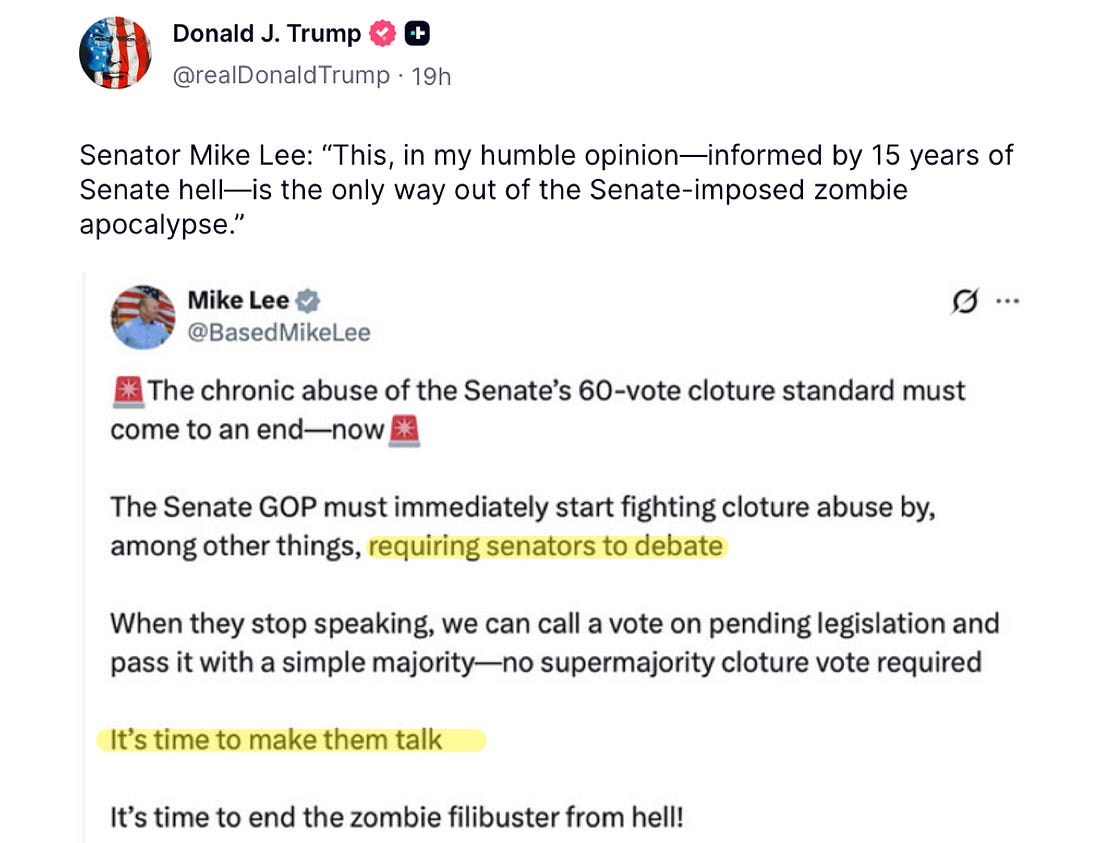 |
It’s nice that President Trump reanimated our idea. But to double-tap the practice, fifty Republican Senators must agree. I hope that Trump’s endorsement signals what’s stumbling toward us next month, once the House begins the legislative ‘surge’ that Speaker Johnson promised. They’ll have to do something to stop filibuster abuse.
Senator Lee isn’t far off. Zombies don’t debate anything. They don’t really even talk. It’s more moaning and grunting. Senators should stop acting like reanimated corpses and start debating things again. Let’s make the Senate more like what the Founders intended, and less like Zombieland.
 |
🔥 🔥 🔥
Speaking of things we thought were dead and buried but are showing new signs of life, courageous election whistleblower and political prisoner Tina Peters’s legal case is back on two feet. On Christmas Eve, ABC ran a promising story headlined, “Tina Peters asks Colorado appeals court to recognize Trump’s pardon, release her from prison.” When the story first broke about her pardon, I was skeptical it would effect anything better than showing support, since conventional wisdom is that presidential pardons don’t affect state crimes. For example, we’ve counted on that loophole to keep hope alive that some state attorney general would someday prosecute human cockroach Anthony Fauci. But Tina Peters’ lawyers have a different plan.
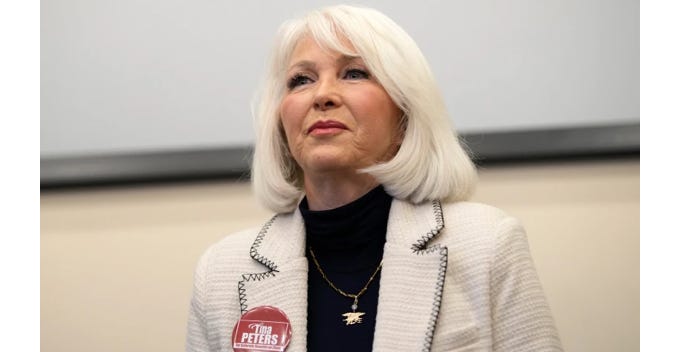 |
Tina Peters is the former Mesa County, Colorado, clerk who became one of the most polarizing figures in the post‑2020 election wars. She allowed an outside auditor connected to Mike Lindell into Mesa County’s election system during a “trusted build” process. Prosecutors and legacy media describe it as a “data breach scheme” fueled by “false claims” of voting‑machine fraud, and a Colorado jury ultimately convicted her on multiple counts for allowing the misuse of a security card, deceiving officials about the auditor’s identity, and “undermining confidence” in elections. It earned Tina a nine‑year state prison sentence and the unhinged judge’s label of “charlatan” and “danger to the community.”
About two weeks ago, President Trump pardoned Ms. Peters, along with dozens of other individuals charged in various state courts for challenging the 2020 election results. At the time, corporate media sneered at the pardons as “purely symbolic,” since nobody —including me— thought the pardons could have any legal effect under state law.
“The idea that a president could pardon someone tried and convicted in state court has no precedent in American law, would be an outrageous departure from what our constitution requires, and will not hold up,” Colorado’s attorney general said in a released statement.
🔥 But in a dramatic motion filed on Christmas Eve, Ms. Peters’ lawyers stretched all the way back to the 1795 Whiskey Rebellion, and pointed out that President George Washington had pardoned people convicted of bothstate and federal crimes. Proving how useless the corporate media is, it turns out that Ms. Peters’ lawyers do have a non-frivolous argument.
In the 1790s, our budding young republic nearly tore apart over … whiskey taxes. Frontier farmers in western Pennsylvania, already scraping by under an ‘affordability crisis,’ saw Alexander Hamilton’s new federal excise tax on their homemade whiskey as a direct attack on their personal livelihoods and an arrogant power grab by a distant federal government that failed to properly appreciate fermented mountain beverages.
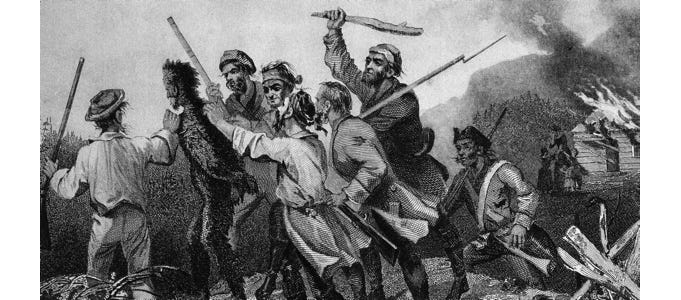
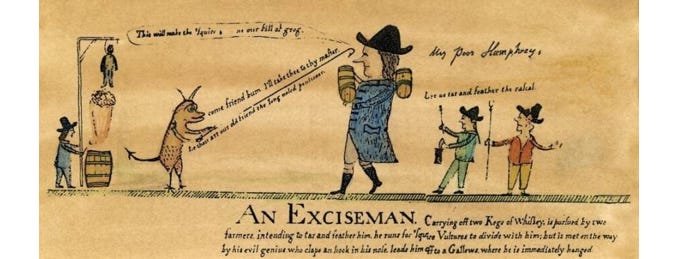
Soon, whiskey protests escalated into open defiance; tax collectors were bullied and chivvied to distraction. Some were tarred and feathered, an early American practice that quite effectively reined in official overreach. On September 11, 1791, a spirited group of whiskey distillers caught federal tax collector Robert Johnson. They stripped him, tarred and feathered him, and left him in the forest. When a sheriff tried to serve arrest warrants on the unruly protestors, they tarred and feathered him, too.
 |
Things were getting out of hand. So President George Washington mounted an overwhelming show of federal force, personally leading militia back across the Delaware and toward the conflict region, to prove that the federal Constitution was not merely a suggestion. After the ‘rebellion’ collapsed and a handful of mostly inebriated men were convicted of serious crimes —including some facing both state and federal criminal liability and hanging— Washington surprised everyone by issuing pardons, wisely using mercy to close the chapter and signal that the goal was restoring order and unity, not stacking up bottles of punishment against citizens who had already been broken by the weight of the federal response.
The Constitution states the presidential pardon power in a single, ultra-compact clause. It simply says that the president “shall have Power to grant Reprieves and Pardons for Offences against the United States, except in Cases of Impeachment.” Ms. Peters’ lawyers are trying to reframe the pardon power as an act of national reconciliation that can reach any criminal consequences tied to a particular episode of “offense” against the United States, regardless of which sovereign processed the conviction.
In other words, Ms. Peters’ lawyers argue that Washington’s pardons show that the president may, in moments of high drama like whiskey rebellions or stolen-election protests, wipe the slate clean across all national jurisdictions to restore civil peace and tranquility. (Old Fashioneds would be optional.) Her lawyers aren’t arguing for a broad pardon power like Colorado’s attorney general falsely implied. They’re saying pardons should kick in for any nationalpolitical controversies —like presidential election disputes— whenever they implicate core federal interests.
 |
It’s a good argument, but a heavy lift, like trying to pick up an entire crate of Buffalo Trace, or carry a tarred and feathered taxman into a forest. Colorado enjoys 230+ years of lower-court precedent reinforcing the oft-repeated notion that state crimes should be insulated from the federal pardon power as a matter of states’ rights (i.e., federalism). Governors, they’ll argue, can pardon state crimes, and presidents are limited to pardoning federal crimes. Colorado will probably also argue that Washington’s pardons never truly forgave the state-based whiskey crimes in 1795, but rather that the states just voluntarily “went along with” Washington’s federal pardons.
On the other hand, in Tina’s favor, oddly, or perhaps surprisingly, the U.S. Supreme Court has never actually confronted a direct collision between a federal pardon and state charges. I may have missed this creative angle the first time around, but I did note that Ms. Peters was well represented. Her alert lawyers found a non-frivolous, live constitutional issue, and it could be before the Supreme Court soon.
The Colorado Court of Appeals has already responded to Ms. Peter’s new motion. Yesterday it set an expedited briefing schedule. All briefs are due by January 8th. It’s a good sign. The Court of Appeals’ short order started by saying, “After a review of the motion to determine whether this court has jurisdiction, the court requires a response from the People.”
Game on.
🔥 🔥 🔥
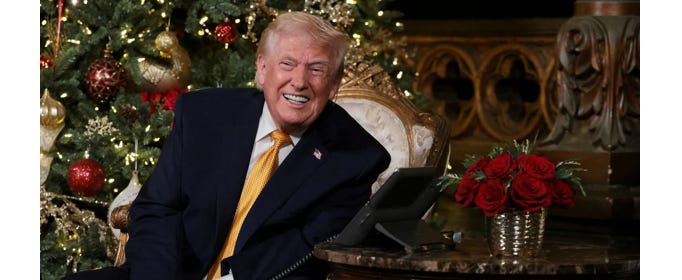
Yesterday, the Washington Post followed the New York Times into Scrooge territory, and ran a whiny story headlined, “Trump aides’ official religious messages for Christmas draw objections.” Like the Times, WaPo couldn’t find anything actually wrong with the religious messages about the religious holiday, so it leaned into complaints about customs. The sub-headline said, “Overtly sectarian posts on official social media accounts contrast with a tradition of secular holiday messages.”
 |
I won’t belabor the point, since I mocked the Times yesterday. But as I reviewed the WaPo story to see if there were anything new, and read example after example of officials posting genuine and meaningful Christmas wishes, it occurred to me that both stories —the New York Times’ and WaPo’s— actually platformed the original religious messages forcing their liberal readers to consider them.
In that sense, all this hand-wringing about authentic Christmas messaging is a variety of Streisand Effect, where the effort to criticize or suppress speech winds up dramatically amplifying its visibility and reach. Well done, WaPo. It’s a kind of Christmas miracle of its own.
Finally, in case you needed any more reason to discount whatever corporate media tells us, the complaint about “broken secular traditions” is a bad joke. Bland, secular holiday wishes are a recent innovation that broke with the much longer traditions of official religious messaging. If anything, Trump’s officials’ tweets and posts merely returned to the original “traditions.”
🔥 🔥 🔥
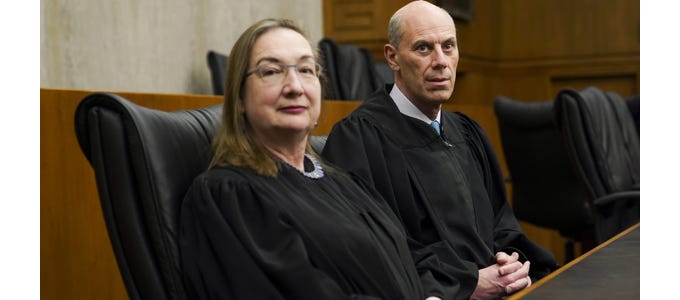
Just before Christmas, the Hill ran another terrific story headlined, “Judge rejects challenge to Trump’s $100K H-1B visa fee.” The Chamber of Commerce plus 18 Democrat states sued to block President Trump’s most significant policy intended to stop H1B abuse. Federal judge Beryl Howell —an Obama appointee— just denied their lawsuit.
 |
One of the biggest lies this Fall was that Republicans and President Trumpwere promoting Chinese students and pushing H1B visas. How some conservatives fell for this falsehood is beyond me. But they did, and it led to countless euphoric articles in corporate media about the “fracturing” of MAGA.
But H1Bs were actually being supported by Democrats. The so-called “workers’ party.” The party of the labor unions. But for some reason, Democrats are supporting big corporations that want access to cheap H1B foreign workers. This lawsuit proved it. The truth is that President Trump has done more to reform H1B visa abuse than any president in our lifetimes, and the Democrats (plus the Chamber of Commerce, but I repeat myself) opposed him at every step.
The Hill clung to hope, mentioning that Democrats can still appeal Judge Howell’s decision. But the fact that an Obama Appointee dismissed their arguments is what lawyers call
“a bad sign” for the appeal.
The article mentioned that on top of the $100K “fee” for most new H1B visa applications, even more reforms are about to kick in. For example, the Administration is ending the “lottery system” that prioritized applications in random order. Next month, DHS will replace the random lottery with a weighted selection process that prioritizes applications for positions actuallyrequiring specialized skills and which pay above-market wages.
Immigration Services spokesman Matthew Tragesser explained, “The existing random selection process of H-1B registrations was exploited and abused by U.S. employers who were primarily seeking to import foreign workers at lower wages than they would pay American workers.”
If your concerns include H1B reform, nobody has done more without Congress than President Trump. You’re welcome.
🔥 🔥 🔥
Earlier this week, Axios reported a morbid bit of good news in a story headlined, “U.S. murders on pace for largest one-year drop on record.” Well, thank goodness. But —of course— Axios buried the lede. The real story was: violent crime is down across the board, with murders reduced by a whopping -20% — which is “on pace” for the largest one-year drop in history.
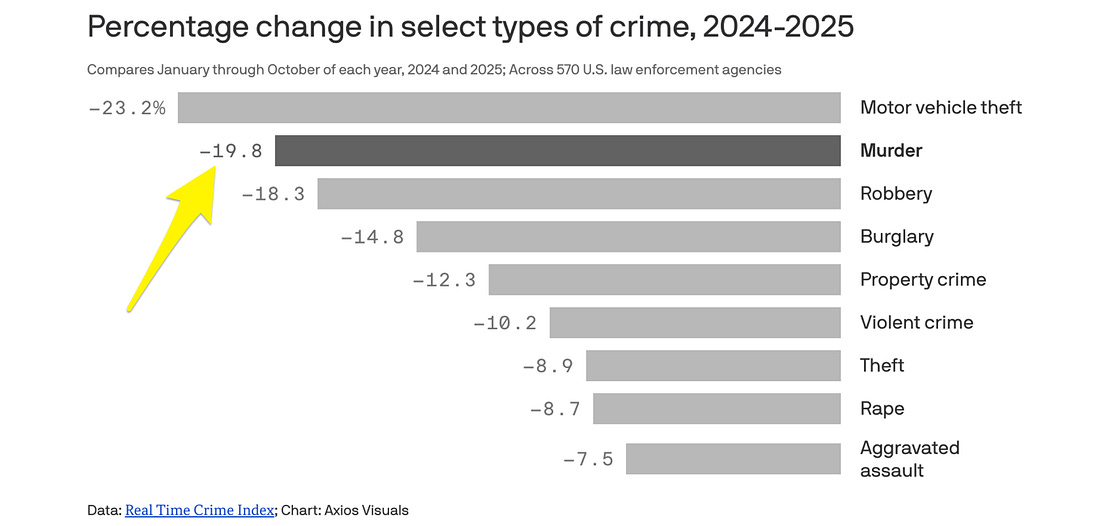 |
Axios was stingy with its praise. “President Trump,” it admitted, “has prioritized cracking down on violent crime in his second term, though there is no clear evidence linking his policies to the decline.” After all, the post-pandemic violent crime surge might have fixed itself.
Next, note Axios’ elevated goalposts. Axios didn’t claim there was “no evidence” that the historic crime drops were related to Trump’s policies. It used weasel words and said there was “no clear evidence.” ‘Clear’ is a subjective modifier.
Whether you will credit President Trump’s all-of-government crime crackdown —including massive immigration enforcement— the trend remains great news. And rates continue improving. Not that Axios will do more than notice the happy accident. It did, however, admit that murders in Washington, DC, where Trump has focused on crime, are down a historic -28%. So.
In other words, the plan is working. “Unexpectedly.” All this momentum will carry us into next year with a racing start. It will be glorious.
Have a wonderful weekend! We’ll be back on Monday morning, bright and early, to kick off the final week of 2025.
 Subscribed
Don’t race off! We cannot do it alone. Consider joining up with C&C to help move the nation’s needle and change minds. I could sure use your help getting the truth out and spreading optimism and hope, if you can:☕ Learn How to Get Involved 🦠
How to Donate to Coffee & Covid




Leave a Reply
You must be logged in to post a comment.