
What The Conversation Misses, Avoids, and Gets Wrong on Kennedy’s Plans for the Vaccine Schedule
December 31 | Posted by mrossol | CDC NIH, Disinformation, Medicine, VaccineDr. Scott has mastered the art of evidence selection, aka, “cherry picking”.
Source: What The Conversation Misses, Avoids, and Gets Wrong on Kennedy’s Plans for the Vaccine Schedule
Dr. Scott has mastered the art of evidence selection, aka, “cherry picking”.
|
|

By James Lyons-Weiler, PhD
The United States’ vaccine schedule has been misrepresented for decades as the unimpeachable output of dispassionate science. In reality, it is the cumulative product of patchworked trial data, modeling assumptions, political reaction, and institutional drift.
When Health and Human Services Secretary Robert F. Kennedy Jr. oversaw the modest revision of the hepatitis B birth dose recommendation—transitioning it to shared decision-making for infants born to hepatitis B-negative mothers—the outcry from establishment-linked voices was immediate. Nowhere was that defensive reflex more evident than in Jake Scott’s December 18, 2025 article for The Conversation, which deploys the well-worn rhetorical devices of institutional guardianship: vague affirmations of safety, selective timelines, and strategically incomplete science.
A byline on the article claims that new vaccine technologies use ‘‘fewer antigens”. With over 72 injections per child before Kennedy began his tenure at HHS, this baffling statement implies that Scott would have the public belief that one can adopt new vaccine technologies without changing the schedule, and that somehow the mere existence of new vaccine technologies makes the entire schedule now somehow safer, even though none have been adopted for pediatric use.
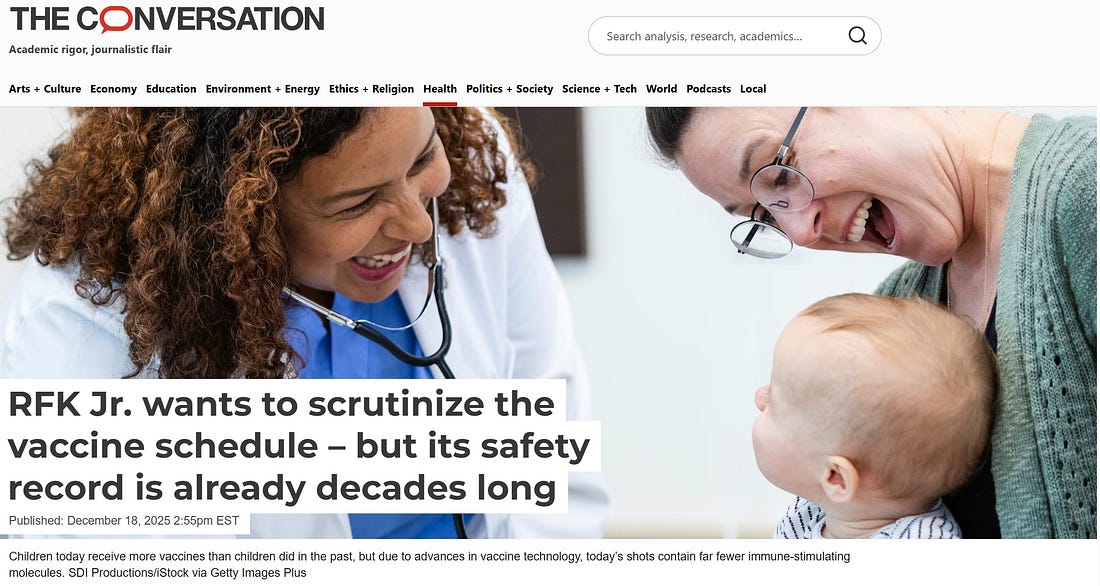 |
Figure. Screen cap of Jake Scott’s odd claim: “Due to advances in vaccine technology, today’s shots contain far fewer immune-stimulating molecules.” Fewer than when? Total antigens number across all shots is not counted; you have to know which parts of each protein are immunogenic (epitopes). This is a completely unqualified claim.
For the rest of the article, Scott’s framing of the schedule as a settled matter is not merely mistaken—it actively obscures how vaccine policy evolves, why re-examination is necessary, and how evidence has repeatedly outpaced legacy consensus. To understand what this article omits, manipulates, and gets flatly wrong, we must begin with the central conceit that the December 16 policy change was an unprecedented intrusion.
Contrary to the headline, Kennedy’s reform was not the first such change under his tenure. The CDC’s own published materials document a prior update to the immunization schedule on October 6, 2025. That update, which predated the hepatitis B change by two months, included a revised recommendation for pediatric COVID-19 vaccination and replaced combination varicella-MMRV administration with a standalone varicella dose for toddlers. These decisions reflected real-world risk-benefit reassessment and were clearly acknowledged by CDC. Scott’s decision to erase these from the narrative speaks either to editorial carelessness or a deliberate attempt to isolate the hepatitis B change as an aberration. It was not.
This pattern of strategic evasion continues. Scott repeats the industry-standard assurance that vaccines on the childhood schedule have been tested in “controlled trials involving millions of participants.” The implication is that the breadth and depth of these trials leave no room for safety concerns or policy reconsideration. But this is scientifically indefensible. While the aggregate number of participants across decades of vaccine trials may reach into the millions, individual licensure trials typically enroll between 3,000 and 20,000 subjects. Only a handful, such as the REST trial for rotavirus, approached the 70,000 mark, and that was in response to a prior failure of post-marketing safety surveillance.
This distinction matters because rare adverse events—those occurring at rates of 1 in 50,000 or even 1 in 10,000—are statistically invisible to trials of that size. Scott fails to mention this well-documented limitation, leaving readers with the false impression that current safety assessments are omniscient. They are not. That’s why systems like VAERS and the Vaccine Safety Datalink exist. That’s why trials alone never complete the safety profile. And that’s why it is dangerous to conflate trial size with long-term epidemiologic certainty.
Equally problematic is the invocation of “antigen burden” as a proxy for immune demand. Scott assures readers that although the number of vaccines has increased, the cumulative number of antigens has plummeted—from approximately 3,000 in the 1980s to under 160 today. He offers this as proof that today’s schedule is less demanding on children’s immune systems. This is immunologic nonsense. The body’s response to vaccination is not linearly dependent on antigen count. The nature of the antigens, the presence and type of adjuvants, the delivery method, the frequency and timing of exposure—all of these factors shape the immune system’s response, with outcomes that are non-trivial, nonlinear, and subject to biologic variation.
The clearest counterexample lies within Scott’s own narrative: pertussis. The older whole-cell DTP vaccine contained thousands of antigens and generated robust, lasting immunity, albeit with higher rates of short-term reactogenicity. The newer acellular vaccine contains just a few purified proteins. While touted as safer on paper, this formulation has demonstrably failed to control pertussis resurgence. Waning immunity, increased asymptomatic carriage, and strain evolution have undermined public health outcomes. This is not speculative—it is documented in CDC literature and peer-reviewed epidemiology. Scott mentions the antigen drop but neglects to mention the tradeoff. The omission is glaring.
The centerpiece of the article is Scott’s indictment of the hepatitis B policy change. His argument rests on three pillars: the high risk of chronic infection when acquired in infancy, the imperfection of maternal screening, and the necessity of a “safety net” birth dose. The biological premise is correct: infants infected at birth have a 90% risk of developing chronic infection. But from that point onward, the argument unravels.
The relevant question is not whether hepatitis B is dangerous when acquired at birth. It is whether a universal birth dose is justified when maternal status is known to be negative. Here, Scott entirely omits the CDC’s published rationale: high prenatal screening reliability and low incidence of perinatal transmission in the context of screened pregnancies. He ignores the fact that the only study that bothered to measure the additional efficacy from day-of-birth hepB vaccination could not detect any benefit of that dose to later immunity.
He also ignores that the change maintains vaccination within 12 hours for infants born to mothers who are positive or of unknown status. These children remain protected under the revised policy.
What has changed is the elevation of shared decision-making when risk is known to be vanishingly low. The CDC’s December 16 release explicitly stated that the policy brings the U.S. closer in alignment with peer countries, including Denmark, Norway, Finland, and others. Scott, instead of acknowledging this context, frames Kennedy’s move as idiosyncratic and dangerous. He never mentions that CDC staff themselves highlighted the United States as an outlier among wealthy nations with low HBV prevalence. Instead, he paints Denmark as a red herring—an exotic system that cannot be imitated due to the U.S. health care system’s fragmentation. This is disingenuous. Denmark’s policy is not based on its registry system. It is based on relative risk and justified selectivity. The U.S. now moves cautiously toward the same principle: protect when risk exists, permit discretion when it does not.
Scott also populates his piece with quantifications that appear precise but are impossible to verify. He claims 20,000 Hib meningitis cases annually pre-vaccine, 18,000 childhood hepatitis B infections per year, and “99% reductions” after vaccination. None of these figures are cited. None are qualified as modeled, confirmed, or estimated. Without denominators, date ranges, or definitional clarity, such statistics become rhetorical bludgeons, not scientific claims.
More broadly, Scott’s piece embodies a failure of the institutional knowledge economy. It insists on public trust without accountability, cloaks editorial framing in scientific robes, and actively suppresses any deviation from the narrative by caricaturing it as anti-science. But the real anti-science posture is the refusal to subject past decisions to present scrutiny.
Kennedy’s critics need to answer one question: If universal policies should remain unchanged even as the conditions that justified them vanish, what exactly is the role of evidence? If a recommendation persists despite low incidence, high screening fidelity, and international misalignment, is it still science—or is it ritual?
Public health must not be governed by legacy inertia. Policies must reflect evidence, not branding. The hepatitis B revision does not represent the beginning of chaos—it signals the return of proportion. It acknowledges that even sound policies must eventually be re-examined. That no schedule is sacred. That evidence is not a shield for bureaucracy, but a sword for reform.
It is time the public hears that science moves not when institutions defend themselves, but when they correct themselves. This is not the unraveling of public health. This is how you rebuild it.
Popular Rationalism does not have billions of dollars to promote our articles. So it’s up to you. Please engage kindly:




Leave a Reply
You must be logged in to post a comment.