
“Rolling Stone” Rolls in Fallacies to Criticize U.S. Department of Health and Human Services
January 21 | Posted by mrossol | Critical Thinking, Liberal Press, ScienceHow narrative journalism replaced evidentiary rigor in a gauche, retrofit, ill-conceived vaccine “exposé”
Source: “Rolling Stone” Rolls in Fallacies to Criticize U.S. Department of Health and Human Services
|
|

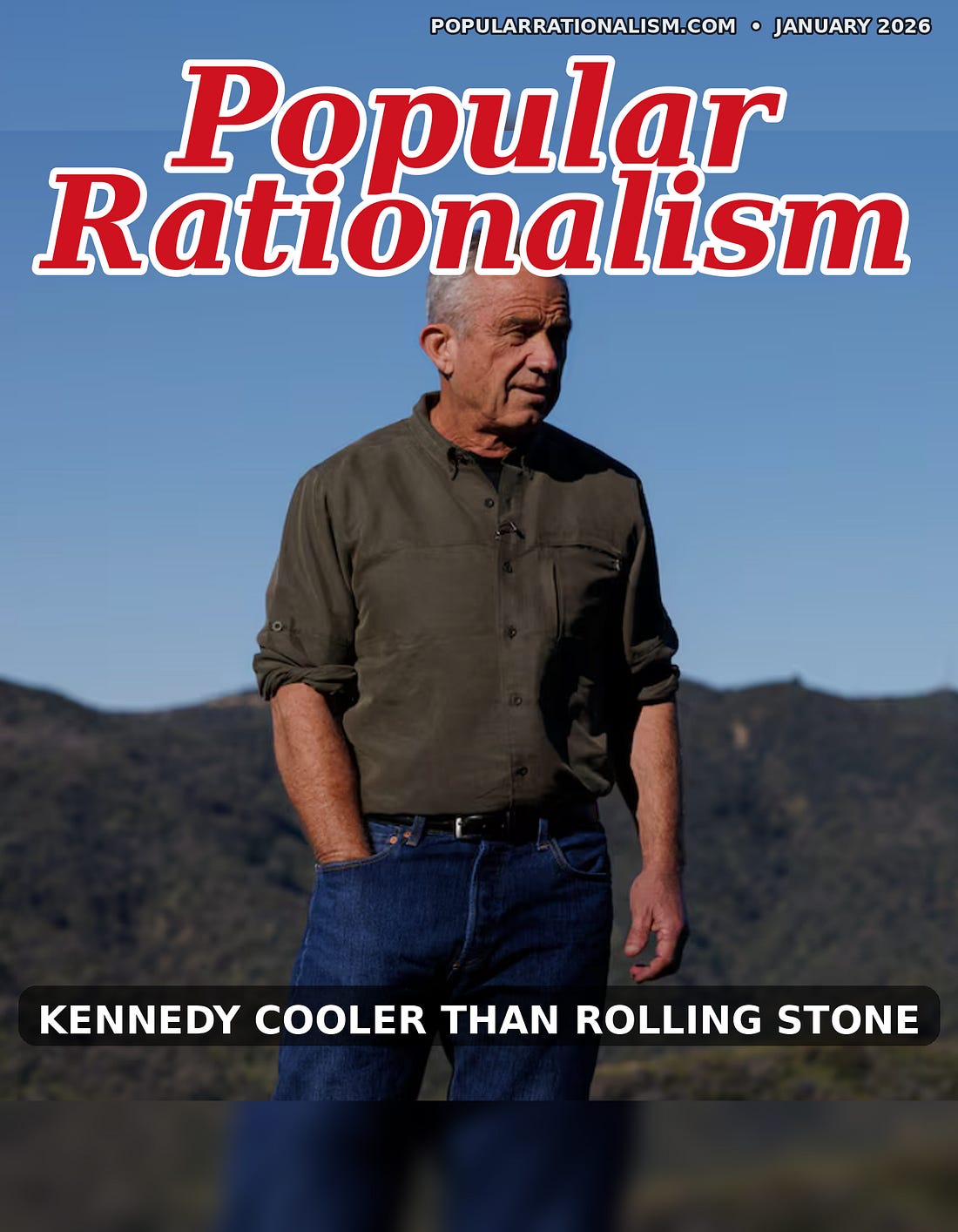
When it comes to Hepatitis B vaccines, there has never been a large study of vaccinated vs. unvaccinated infants and children. This HHS has has inherited a massive knowledge gap in vaccine safety, and Rolling Stone seems to think it knows more about how we know things in science than HHS. As HHS moves to fill the gap, Rolling Stone uses one-sided opinion statements by conflicted persons as their best evidence – the same people trying to give the old narrative CPR while it lay dying on that table. I remember when Rolling Stone was cool. They have my number. Why did they not interview someone like me?
On its face, Rolling Stone’s January 2026 piece titled “HHS Gave a $1.6 Million Grant to a Controversial Vaccine Study. These Emails Show How That Happened” presents as an investigative report. It showcases insider emails, policy timelines, and quotes from high-level critics. But once the rhetoric is stripped away, what remains is not a demonstration of procedural misconduct or ethical failure by HHS—but an exercise in insinuation, tired narrative recall, and awkward attempts at logical sleight-of-hand. It exemplifies a growing genre: advocacy journalism posing as investigative accountability.
This article applies a clear evidentiary standard: if HHS somehow violated it charter to fund gaps in the research record, that should be shown directly—not inferred from timing, association, or ideological framing. Rolling Stonefails this standard in nearly every dimension with drawn conclusions masquerading as new-found vigilance over how HHS chooses who will run its research projects.
Poisoning the Well: Priming the Reader to Distrust
The article opens by describing researchers Peter Aaby and Christine Stabell Benn as facing “career ruin,” a “veritable rap sheet,” and being under “attack” by Danish statisticians. None of these claims are connected to the study funded by HHS. The framing is reputational—a textbook case of poisoning the well. It ensures that any evidence offered later is read through a lens of pre-installed distrust.
A valid critique of the trial should begin with the proposal, endpoints, and ethical design. Instead, it begins with a character trial.
Guilt by Association: Ideological Contamination
The article repeatedly ties the researchers and the grant to Secretary Robert F. Kennedy Jr., Children’s Health Defense, and other allegedly “anti-vaccine” figures. But ideological adjacency is not evidence of procedural corruption. And Children’s Health Defense, along with many, many other organizations, have called for research to fill the gaps the HHS refused to fund for decades.
There is no document showing Kennedy directed the funding, wrote the study protocol, or will pressure outcomes.
Scientific ethics is not degraded by political interest, especially those that put the well-being of children first, unless accompanied by coercion or suppression—neither of which are demonstrated.
Post Hoc Fallacy: Timing Treated as Causation
Emails are cited that occurred days before ACIP meetings or HHS policy shifts. The implication: the study was engineered to justify a foregone policy change. But how many times have we been told that temporal proximity is not proof of causality. No email shows that the outcome of the study was predetermined or that policy decisions were contingent on funding this specific research.
Further, the research done in the future cannot reach back and influence the ACIP meeting Rolling Stone refers to. They are utterly confused.
Parallel deliberations are common in policymaking. To imply orchestration from calendar alignment is post hoc reasoning dressed as revelation.
False Analogy: Invoking Tuskegee Without Basis
Dr. Paul Offit’s comparison of the study to the Tuskegee syphilis experiment is included without scrutiny. This is false analogy of the highest order. Tuskegee involved knowingly withholding critical treatment from diagnosed patients, without informed consent. The Guinea-Bissau trial concerns the timing of a vaccine not yet standard in that setting. No known effective therapy is being withheld.
The comparison relies on emotional equivalence, not structural similarity—a disservice to both ethics and history.
Equivocation: Shifting Standards of Care
Rolling Stone asserts that the trial denies a “lifesaving intervention” to children. But it also admits that Guinea-Bissau’s health system would not implement hepatitis B birth dosing until 2027. This is a clear case of equivocation: it toggles between U.S. and local standards of care to generate outrage without ethical clarity.
How dare we collect data to determine the whole-health effects of the use of vaccine in a virgin soil population? We might learn something!
The Declaration of Helsinki requires that trials reflect locally relevant care contexts, not Pharma hegemony. Rolling Stone never engages that requirement.
Rhetorical Closure Without Evidentiary Sufficiency
By the end, the article leaves the reader with the impression that the study was ideologically motivated, scientifically unmoored, and ethically bankrupt. But none of these conclusions follow from the evidence provided. There are no revealed emails showing policy outcomes being pre-agreed. There is no documentation of ethics committee rejection. There is no violation of grant law cited.
The story feels complete because it is narratively closed. But narrative sufficiency is not evidentiary sufficiency.
Failure to Distinguish Between Policy-Relevant and Policy-Justifying Science
The article treats research – the results of which may or may not align with policy – as inherently suspicious. This conflates policy-relevant inquiry with post hoc justification. Science must be free to inform ongoing debates without the presumption that alignment equals corruption. Rolling Stonenever makes that distinction.
Authority as Argument: Experts Quoted Instead of Criteria Cited
Critics like Jernigan, Hviid, and Offit are quoted liberally. But ethical frameworks, not opinions, govern research ethics. Past evidence from similar studies from Aaby et al. are not included in the Rolling Stone article.
(See from “The Introduction of Diphtheria-Tetanus-Pertussis and Oral Polio Vaccine Among Young Infants in an Urban African Community: A Natural Experiment “Among 3–5-month-old children, having received DTP (± OPV) was associated with a mortality hazard ratio (HR) of 5.00 (95% CI 1.53–16.3) compared with not-yet-DTP-vaccinated children. Differences in background factors did not explain the effect. The negative effect was particularly strong for children who had received DTP-only and no OPV (HR = 10.0 (2.61–38.6)). All-cause infant mortality after 3 months of age increased after the introduction of these vaccines (HR = 2.12 (1.07–4.19)).”)
The article does not cite the Declaration of Helsinki, CIOMS guidelines, or U.S. federal research standards. It presents expert criticism as providing conclusive evidence rather than mere conflicted opinion and contestable claims.
Unexamined Norms Around Unsolicited Proposals
The article implies that an unsolicited grant request is inherently suspect. In reality, unsolicited proposals are routine in many federal science programs. Look at the history of the funding of HPV Vaccine Safety review by Cochrane Collaborative – the one that led to the destruction of its reputation. The merit lies of federally funded research studies is found in process compliance, not origin. No evidence is presented that CDC or HHS violated rules in evaluating or awarding the grant.
Ethical Complexity Reduced to a Binary
The article frames the trial as a simple matter: give the vaccine or not. But ethical analysis of vaccine trials requires assessment of equipoise, local standards, and risk/benefit calculations. These dimensions are ignored. Instead, the reader is led to believe that any study not giving a vaccine must be unethical.
That is not ethics. It is ideology.
Final Word: Journalism Must Do More Than Point
If the HHS grant to Peter Aaby and Stabell Benn violated the charter of HHS to fill research gaps, or federal rules or ethical norms, that case can be made.
Rolling Stone does none of this. It points. It suggests. It quotes. But it does not provide anything other than conflicted opinion.
It ignores the actions of Fauci et al. to fund those scientists willing to change their tune on laboratory origins of the SARS-CoV-2 virus.
It ignores the funding of Danish researcher to intentionally bury signals of vaccine harm (see numerous past articles here on Popular Rationalism).
In an age when public trust in science and journalism is both precious and fragile, articles like this do more to confuse than to clarify. They seek to train the public to distrust not by logic but by narrative—and then try to sell that as skepticism.
That is mere insinuation.
That is not cool.
This is cool.
 |
 |
Thank you for being a subscriber to Popular Rationalism. For the full experience, become a paying subscriber. And check out our awesome, in-depth, live full semester courses at IPAK-EDU. Hope to see you in class!
 |




Leave a Reply
You must be logged in to post a comment.