
C&C. AI EATING ITS OWN. Doing Old Science. Anti-ICE, No; J6, Yes.
February 11 | Posted by mrossol | AI, At War USA, Childers, Democrat Party, Economics, FDA, Incentives, Pharma, Ruling Class, Technology, Two Tier LawDC jury shields Democrats; FDA rejects Moderna’s mRNA flu shot; Dow hits another record; $2T vanishes from software stocks; AI nears singularity; and Zuckerberg does the most relatable thing ever.
Source: ROBOT SNAPPERS ☙ Wednesday, February 11, 2026 ☙ C&C NEWS
⛑️ C&C ARMY POST ⛑️
MULTIPLIER UPDATE: I spoke with Warner Mendenhall yesterday afternoon for about an hour. Considering the circumstances, and despite his persistent dry cough, he sounded great — especially considering that, two months ago, after never having spent a day in a hospital in his life, his first doctors told him he only had days to live. Without going into personal details, I can tell you he’s gotten connected with all the right people, the ones you’d want him to be talking to. So don’t worry on that front.
Warner asked me to pass along two things. First, he wanted you to know how deeply grateful he is for the multiplier and everything behind it. He said his wife cried when they saw it. Second, he said something that really stuck with me: how amazing it is that we — just ordinary Americans — have built this incredible movement of mutual support for each other. He said his cancer made him realize how important it is that we have each other’s backs, because the government sure isn’t going to do it for us.
He also mentioned that all his time away from his small law practice had created a genuine existential crisis — and that your generosity resolved it. Just like that. That’s the C&C Army in action. Great work, team.
ESSENTIAL NEWS AND COMMENTARY
🔥🔥🔥
Yesterday, the New York Times ran a story headlined, “Prosecutors Fail to Bring Charges Against Democrats Involved in Illegal Orders Video.” On the one hand, the DOJ brought charges against all six Democrats who made the infamous “disobey orders” video. On the other hand, the Washington, DC residents serving on the Grand Jury carefully considered the strong evidence and the clearly applicable laws, and concluded, “meh.”
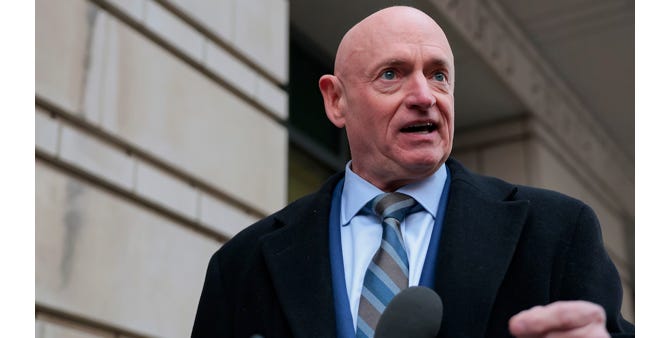 |
Imagine, if you will, a Republican senator filming a selfie video telling soldiers to disobey President Obama. That senator would be cooling it in Leavenworth before the upload finished buffering. But Senators Kelly and Slotkin get the DC jury treatment— the same jurisdiction that snappily convicted every J6 defendant who accidentally wandered past a velvet rope.
The Times was practically performing somersaults. “The rejection was a remarkable rebuke,” it gushed, “suggesting that ordinary citizens did not believe that the lawmakers had committed any crimes.” Calling DC residents ‘ordinary citizens’ is like saying Chris Christie has ‘average fitness.’
As I’ve said before, this was no surprise. The charges are intensely political. Legal surveys by J6 defense lawyers showed the DC locals are around 92% partisan progressives. You might as well ask the DNC’s leadership team to deliberate. Bringing a hyper-political case in an all-blue district is practically begging for a jury as stubborn as a Bolivian mule who’s already been tricked into taking two trips up the mountain and only got a shriveled carrot.
Granted, the “no bill” decision is intensely frustrating. Had I been on the Grand Jury, I’d have voted to indict and throw the book at them. The silver lining is that the government doesn’t get the final say in convicting citizens of crimes, and believe me, conservatives are learning the lesson the DC juries are teaching us.
I mention this story merely to underscore the difficulty of the DOJ’s job. It’s fine to demand arrests and prosecutions, but in our constitutional system, that’s not the end of the story. This result is appalling, but the mechanism itself is a healthy sign for the Republic. More troubling is the District’s politically lopsided population that makes it impossible for conservatives to get fair trials there.
Congress needs to make it easier for parties to seek a fair venue in cases like this, and slash the number of cases that can only be brought in DC.
The Times may be laughing this morning, but the optics are horrid. It looks like yet more two-tiered justice; rules for thee, but not for me. However, I suspect the DOJ isn’t finished yet— they can repackage the case and present it to a new Grand Jury, for instance. Plus, Senator Mark Kelly is still subject to military discipline, though he’s currently asking a federal judge to enjoin it.
We’ll see what DOJ does next.
💉💉💉
The New York Times reports all the news fit to print, plus vaccine commercials. Yesterday, the Grey Lady reported, “F.D.A. Refuses to Review Moderna’s MRNA Flu Vaccine.” The sub-headline promoted the new flu shots, bragging that “The vaccine maker’s shots involve the successful Covid vaccines’ RNA technology.” Well. The tech was successful, depending on how you measure success. It successfully transferred a trillion dollars from citizens to big pharma, for one thing.
Take this shot and shove it. Yesterday, the FDA summarily rejected Moderna’s application for approval of its mRNA-based flu vaccine. No reason was given except that the submitted trial “does not reflect the available standard of care.” In other words: nope. The Times growled that “only 4%” of applications receive summary denials. Apparently, the paper thinks no Moderna product could possibly fall into the deplorable 4% bin, whereas I think the rejection rate could be much higher. So there.
It was a fascinating statistic. Things that only happen 4% of the time include: getting struck by lightning, winning a decent prize in a scratch-off, and the FDA telling a pharma company “no.”
After four years of calling everyone who questioned their mRNA vaccines “anti-science,” Moderna officials were shocked —shocked— to discover that “science” apparently includes rigorous trial standards. Who knew? Moderna’s CEO, Stéphane “Le Pew” Bancel, whined that the rejection “does not further our shared goal of enhancing America’s leadership.”
Um, when did Moderna’s goal become “enhancing America?” And what does that even mean? Is that like male enhancement? If so, I don’t think it’s working.
Moderna is a public company. Their only goal is enhancing Moderna’s stock price. America is just the victim. Oops— I mean customer. No, wait. I domean victim.
The reasons for the summary rejection were obvious even from the biased article, and even though the Times and Moderna officials acted like it was a great mystery for the ages. First, Moderna submitted its own phase three trial, which it did not run against a placebo, but against another random flu shot that nobody has ever heard of. Second, it didn’t test for efficacy at preventing flu infection; the trial just measured antibody levels. Third, even against that low bar, the mRNA shot was only better than the cherry-picked shot at raising antibodies against flu A, but not flu B.
The Times omitted all the relevant context. The new FDA has repeatedly said it was changing the customary requirements and won’t approve any new vaccines that aren’t tested against placebos. Duh. It has also already said it won’t approve shots based on ‘markers’ like antibody levels without proof they are effective at their intended purposes, which in this case is preventing patients from getting the flu without making their hearts explode like M-80s.
These people think they are so smart. It literally took me ten seconds of Googling. Moderna should have reviewed this story from Pharma Voice, published in December:
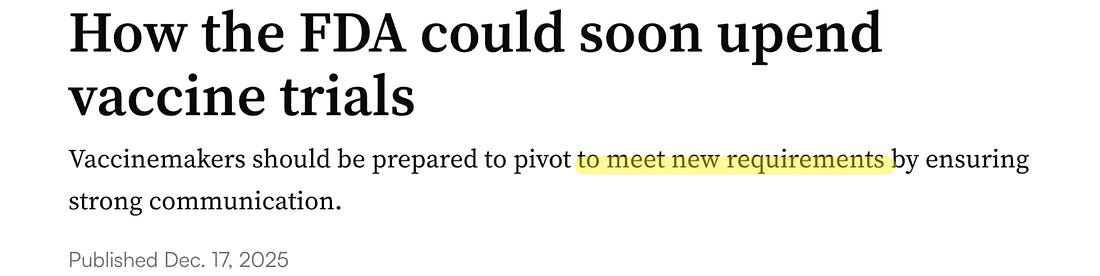 |
See that? How would you interpret the complicated phrase “new requirements?” For Pete’s sake, the subheadline even warns, in English (granted, Bancel’s English skills are marginal), that vaccine makers like Moderna “should be prepared to pivot.” But both Moderna and the Times reporters pretend like this never happened. What? You never said my curfew was changing. This is unfair!
I’m not exaggerating. “The complete stunner here,” Dr. Stephen Hoge, Moderna’s president said, “is at no point in any of this did anybody say that the trial was not adequate.” Maybe he can’t read. I blame public schools.
Maybe I am being unfair. After all, the Times’ job is to advertise vaccines, not report about them, so why should it include critical relevant context? 🤦♂️
Moderna’s stock dropped 7% on the news, which is what happens when investors suddenly realize the company’s entire business plan was just to “assume the FDA will never say no.” Though, for the previous four years, that was a pretty safe assumption.
📈📈📈
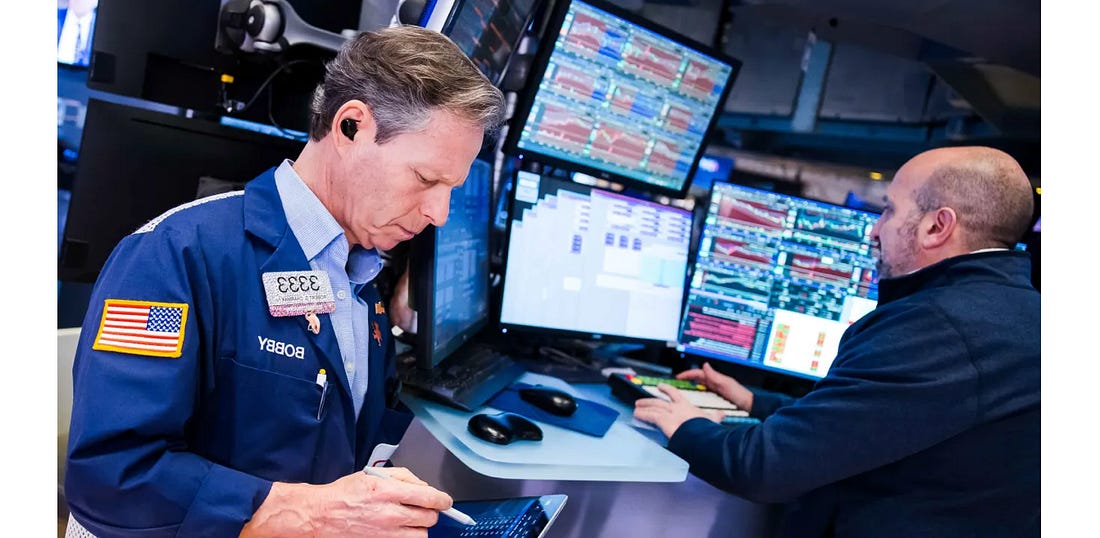
It was two big stories in one. Yesterday, CNBC ran a remarkable story headlined, “S&P 500 closes lower as AI fears weigh on financial stocks; Dow hits another record.” The tech-heavy S&P is getting sloshed around in the wake of breaking AI news, while the Dow is launching into space as the economy runs white-hot. Let’s take them in reverse order.
 |
Stupid experts. With all the 2025 numbers in, the U.S. economy roared in the second half of last year, with real GDP growing at an annualized rate of 4.4% in the third quarter —the strongest pace in two years— accelerating from an already brisk 3.8% in the second quarter. Richmond Fed President Tom Barkin called the economy “remarkably resilient,” noting that the 4.4% unemployment rate has only been this low three other times in our working lifetimes.
Trump’s tech-forward policies and tariffs are unarguably working. The single largest category of new U.S. investment is AI data center infrastructure, which has already reached a scale that dwarfs anything in recent industrial history. Amazon, Microsoft, Google, and Meta collectively poured an estimated $320 billion into AI infrastructure in 2025 alone —more than Finland’s entire gross domestic product— with CreditSights projecting combined capital expenditure nearly doubling to $602 billion in 2026.
The auto sector has also seen a wave of major investment announcements, driven mostly by tariff pressure and Presidential “encouragement.” The major players have all confirmed massive new expansions in the U.S.: Hyundai committed $21 billion from 2025 to 2028, including a $5.8 billion steel plant in Louisiana. Stellantis announced a $13 billion, four-year plan —the largest in its 100-year U.S. history— to expand production at plants in Illinois, Ohio, Michigan, and Indiana.
The U.S. is poised to reclaim its mantle as the world’s auto manufacturing capital. GM announced $4 billion in domestic plant upgrades, Toyota committed $10 billion over five years with $912 million across five states, and Honda shifted its next-generation Civic production from Mexico to Indiana.
 |
The U.S. steel sector surged in 2025 after the Trump administration doubled steel tariffs from 25% to 50% last June. Domestic production rose nearly 5% year-over-year by midsummer. On the investment side, approximately $20 billion in steel plant expansions are now underway.
These sector-specific investments are part of a much larger reshoring and reindustrialization trend. Between January and September 2025, private-sector companies announced a whopping $1.5 trillion in new U.S. manufacturing investments, doubling the $750 billion generated by Biden climate boondoggles that produced nothing but press releases and bankruptcies.
At this point, the Dow’s third consecutive historic high seems less like “breaking news” and more like “recurring appointment.”
📉 The S&P 500 is considered “tech heavy” in that its basket of sector-based stocks includes most of the big names in software and related services. This week, the S&P’s software and services sector has been in a freefall, shedding $2 trillion in market capitalization in days— in what J.P. Morgan analysts called “the largest non-recessionary 12-month drawdown in over 30 years.” Overall, the software and services sector saw a snap 34% decline.
The fear gripping investors is existential rather than cyclical: that the entire software-as-a-service business model —built on predictable annual recurring revenue, premium multiples, network effects, and deep competitive moats— is being devoured by swarms of rapacious AI agents that run on lithium batteries.
Vibe coding —using AI to write software from plain English instructions— has quickly moved from a nerdy novelty to a genuine competitive threat. Platforms like Anthropic’s Claude Code are becoming the de factodevelopment environment for many engineers and even non-engineers. Many of you can do it without any additional training (well, maybe not our Portlanders. We still love you though). You might want to look into it. Soon.
 |
Google’s Project Genie, which generates entire digital worlds from text prompts, hammered video game stocks last month, hammering Unity by 24% and slicing 9% off Take-Two Interactive in days, and raising uncomfortable questions about whether we might all exist as minor features of somebody else’s AI matrix universe. (But I digress.)
Just yesterday, a new tax-planning AI called ‘Hazel’ promised to generate personalized tax strategies “within minutes,” just by reading your 1040s, pay stubs, and account statements. Financial advisory services stocks immediately buckled; for example, Charles Schwab dropped 7.4% and Raymond James lost 8.75%, all helping crush the broader S&P 500.
🔥 Analysts are hotly debating whether the selloff is just a panic phenomenon —Nvidia’s Jensen Huang called it “the most illogical thing in the world” (pretty rich, coming from the guy selling the AI shovels)— or whether it’s just a smart transition back into safer hard goods. What is not in dispute is the speed and breadth of the disruption shock: in the span of ten days, a handful of AI product launches —not revenue misses, not recession fears, but mere demonstrations of new capabilities— erased two trillion dollars in market value and triggered a sector-wide crisis of confidence in the viability of software as a business model.
There’s a deeper irony here. The software industry created the AI revolution. The AI revolution is now eating the software industry. It’s like they built a robotic alligator that is contentedly munching engineers in the quality assurance department before crawling upstairs to the lab.
There’s much I could say. Maybe I’ll do a special AI edition soon. But for now, let’s pull on a single thread to prove the point. Two companies (Anthropic and OpenAI) just released new “vibe coding” features that are so advanced that engineers are saying they plan to give up old-style coding altogether. Consider this: those near-magical tools are being used right now to build the next generation of AI. And those tools will be used to build the next one after that, and so on, ad ultra.
In politics, the Epstein story is the biggest one going; and it might turn out to be one of the biggest stories in history. In technology and science, what happened last week with AI is the biggest story, hands down, in our lifetimes. It’s bigger than the introduction of the personal computer. And it is still surging.
🔥🔥🔥
The chickens have come home to roost— except in California, where even the chickens are moving to Florida. Yesterday, the UK Telegraph reported, “Zuckerberg joins California exodus in move to Florida’s ‘billionaire bunker.’” Cute headline.
 |
Mark Zuckerberg just did the most relatable thing of his entire career: he moved to Florida to dodge taxes. Welcome to the club, Zuck. Somebody get him a fishing license and some mosquito repellent.
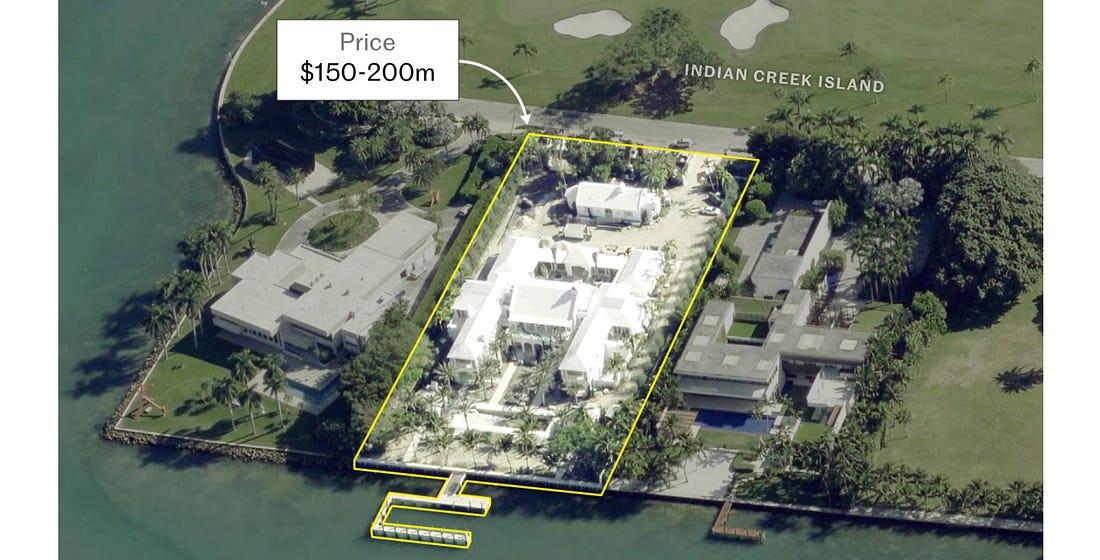
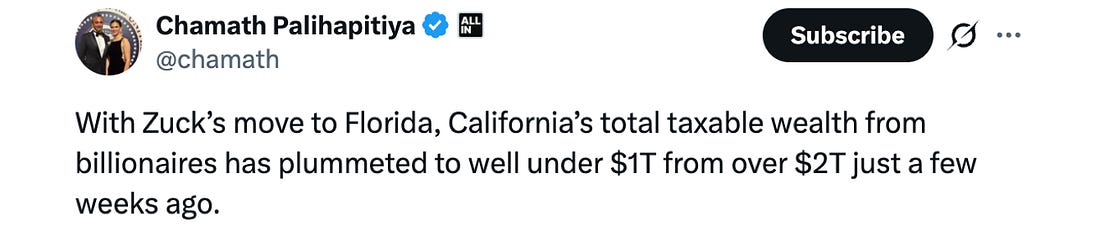
Mark Zuckerberg is buying a $150-200M mansion on Indian Creek Island (aka “Billionaire Bunker”) in Miami, fleeing California ahead of a proposed 5% wealth tax on billionaires. The tax would apply retroactively to anyone who was a California resident as of January 1st, 2026. Zuck joins Larry Page, Sergey Brin, Larry Ellison, Peter Thiel, and David Sacks in the exodus. Tech investor Chamath Palihapitiya and All-In podcaster reckoned that California’s taxable billionaire wealth has dropped from $2T to under $1T in weeks.
 |
Zuck’s new home sounds lovely, and it sits on an artificial island with gated bridge access and a private police force that includes its own water patrol. Billionaire problems. Even assuming Zuckerberg paid top dollar for the house, $200 million, that is a tiny fraction of the $11+ billion he’d have been taxed if California’s ballot resolution passes. (He bought it from the founder of the Jersey Mike’s sub franchise. Only in America does a sandwich mogul’s mansion become a tech titan’s tax shelter.)
California managed to lose a trillion dollars of taxable wealth in three months just by threatening to tax it. “Socialism sucks,” Senator Ted Cruz observed after hearing the news. “The problem with socialism,” Margaret Thatcher once said, “is that, sooner or later, you run out of other people’s money.”
Zuckerberg spent years helping California Democrats get elected. Now those Democrats want 5% of his net worth. You hate to see it. Actually —and I cannot stress this enough— you absolutely love to see it. The robot alligator is back! Maybe he’ll will learn something this time and stop funding socialists.
Have a wonderful Wednesday! Hump through humpday and then get back here tomorrow morning for more essential news and commentary.
 Subscribed



Leave a Reply
You must be logged in to post a comment.