
C&C. RAMPING UP. Missile Launches Down. Hormuz About-face. Measles Scare [Again]. Vax Effectiveness 22%.
March 15 | Posted by mrossol | Childers, Iran, Medicine, Real Fake News| JEFF CHILDERS. MAR 15, 2026 |
Good morning, loyal C&C supporters, it’s Sunday! Your bonus roundup includes: an epic Iran war update tracking the 95% collapse in drone attacks and what it means for the endgame; Iran’s embarrassing Strait of Hormuz about-face; Crown Prince Pahlavi’s surprisingly sophisticated Project 2025-style transition plan; DeSantis calling out the Florida House for choking on medical freedom; and the flu vaccine’s spectacular 22% effectiveness season— with a Cochrane Review chaser.
🚀 C&C ARMY BRIEFING — IRAN WAR UPDATE 🚀
On Friday, DefenseScoop reported, “Iran’s drone assaults ‘down 95%’ as Hegseth declares Operation Epic Fury is still ‘ramping up.’” Defense Secretary Pete Hegseth and Joint Chiefs Chairman General Dan Caine gave a presser painting a picture of a country being systematically disarmed. “Iran has no air defenses. Iran has no air force. Iran has no navy,” Hegseth announced. “Their missile volume is down 90%. Their one-way attack drones, yesterday, down 95%.”
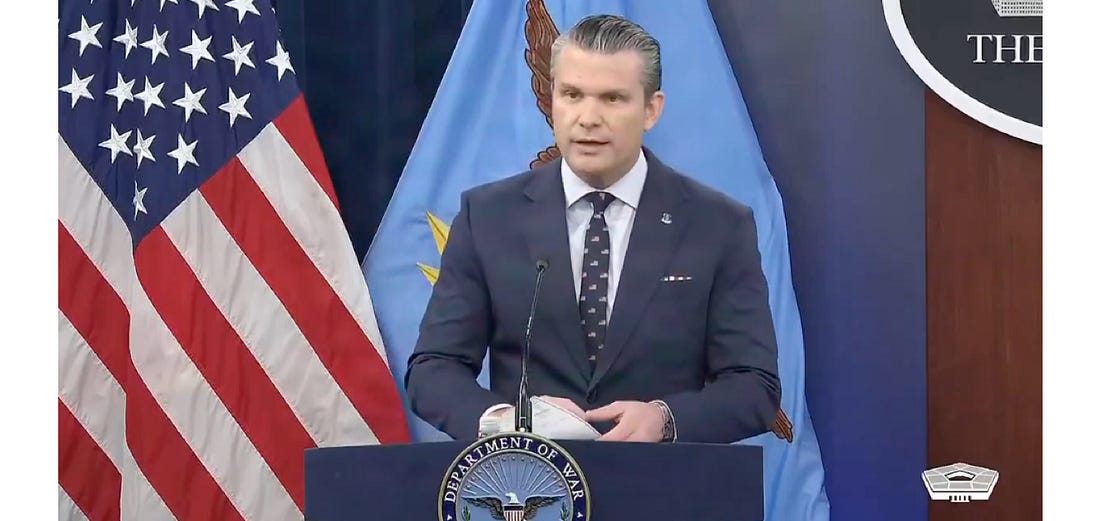
CLIP: War Secretary Hegseth delivers Iran performance review (0:42).
Ninety-five percent! On Day One of Epic Fury, Iran launched 480 ballistic missiles and 720 drones at targets across the Middle East. Two weeks later, that’s collapsed to roughly 40 missiles and 60 drones per day— and still falling. A Jerusalem Post analysis described Iran’s military trajectory as not just declining but “terminal.”
Several analysts compared these figures to last June’s Twelve-Day War, making the collapse even starker. During that conflict, Iran’s missile rate fell from about 100 per day to five per day over nine days. But this time, Iran started at five times the volume and cratered faster. By day ten of this operation, Iran was firing fewer missiles daily than at its worst point last June — despite entering 2026 with an estimated 2,500 ballistic missiles in the arsenal.
After two weeks, nearly all those missiles are gone. Fired, destroyed on the ground, or sitting on launchers that no longer exist.
The launchers are the real story. You can stockpile all the missiles you want, but they’re just expensive metal tubes without something to shoot them from. Western intelligence assessments say over 60% of Iran’s missile launchers have been neutralized— some estimates range up to 80% of total offensive capability destroyed. The IDF believes Iran retains somewhere between 100 and 200 active launchers. To add perspective, CENTCOM says it has struck over 6,000 targets across 30 of Iran’s 31 provinces, with “strike packages steadily launching every hour.”
Every hour. Twenty-four hours a day.
Think about it this way. Iran is a huge country. It’s about 1.6 million square kilometers— 2.7 times as big as Ukraine. It’s roughly the size of Texas, California, Montana, and Illinois combined. It’s taken Russia over four years trying to subdue around 20% of Ukraine— which is right next door. America is doing this from 8,000 miles away, including lunch breaks.
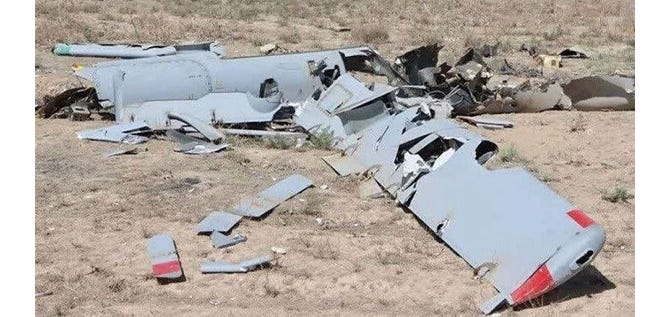
🚀 When the enemy is accurately destroying targets around the clock, in every province, and Iran can’t shoot back because their launchers keep bursting into flames, the math gets grim fast. As General Caine succinctly said, “CENTCOM is now persistently over the enemy.” It’s everywhere the IRGC is.
And then there’s the human factor. Vox Day reported that Iran’s degraded command structure has left individual missile commanders operating with “wide latitude to choose their targets when they don’t have word from Tehran.” Wide latitude is a euphemism for “the chain of command is completely broken.” Local commanders are essentially freelancing, because the people who used to give them orders are dead or unreachable. That doesn’t describe a military fighting a war. It describes a military disintegrating.
The IRGC’s aerospace force commander, Majid Mousavi, tried to creatively spin the situation last week, announcing Iran would only launch missiles with warheads weighing over one ton going forward. You have to admire the framing — turning “we’re almost out of missiles” into “we’re choosing to only use the really big ones.” It’s like a boxer with two broken hands announcing he’ll only throw his elbows from now on, or a restaurant that’s down to its last two steaks announcing it’s ‘pivoting to an exclusive dining experience.’
And it’s not only facing a launcher problem. On March 11th, CENTCOM commander Admiral Brad Cooper confirmed that heavy bombers “hit a large ballistic missile manufacturing facility.” They’re not just destroying what Iran has; they’re neutralizing Iran’s ability to build any more. In the same update, Admiral Cooper announced the last of Iran’s four Soleimani-class warships had been sunk. “That’s an entire class of Iranian ships now out of the fight,” he explained.
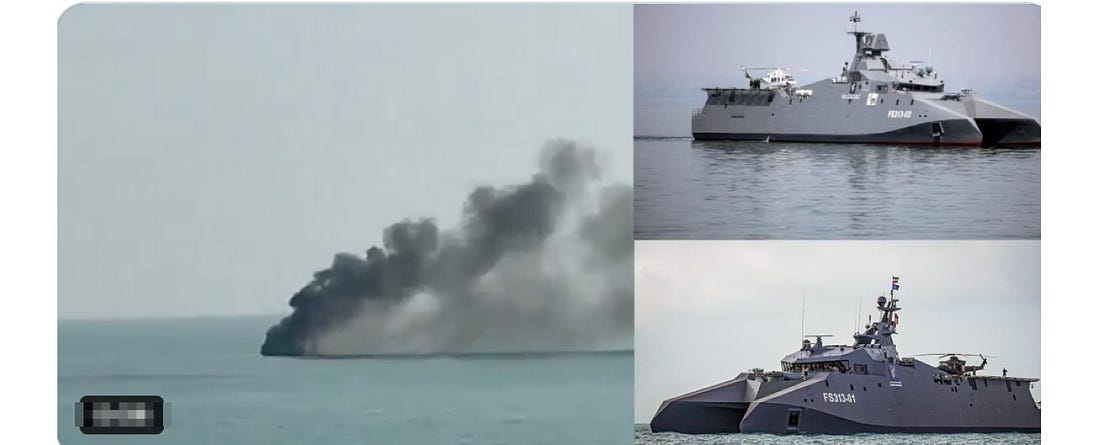
For strategic context, consider what Iran has already lost in just fifteen days: its navy (60 ships and 30+ minelaying vessels sunk or damaged), its air force, its air defenses (degraded 80%), its supreme leader, and now the vast majority of its missile capability— the one conventional weapon system that made it a regional threat. Iran entered this war as the Middle East’s most missile-rich nation. It will exit as something considerably diminished.
Iran is getting the Full Monty. No navy. No air force. No air defenses. No supreme leader. They’re basically down to their Aladdin-embroidered tighty whities. Cue the cringy dance music.
In other words, President Trump has not limited the military with long lists of “rules of engagement” that have hobbled nearly every military operation since Korea. As Hegseth said Friday, “Quantity has a quality of its own as we continue to ramp up every tool of AI, of cyber, of space, electronic warfare and counter-drone capabilities — you name it, we’re employing it.”
What appears clear is that this operation is the big one. The Administration means to win this war, and win it quickly. Even if ‘winning’ means degrading Iran’s military capability so conclusively that it will take 20 years to rebuild. Yesterday, the Institute for the Study of War reported that Iran’s fragmented leadership is now demanding rebuilding funds for its agreement to a ceasefire, even as Trump says it’s not yet time to negotiate.
The fog of war remains thick. The war won’t end next week. But we might be able to see the end of the war from here.
🚀 I’m not just saying that. I’ll give you two strong signs to consider. First, surprise, surprise, surprise, as Private Pyle used to say. On Friday, the Business Standard ran a story headlined, “Strait of Hormuz open to all except US, Israel: Iranian foreign minister.”
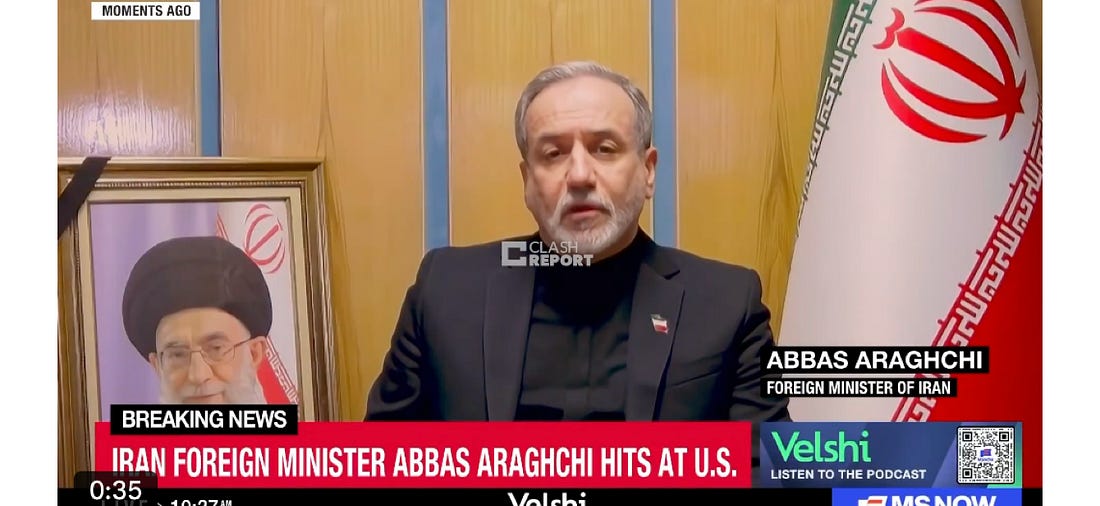
CLIP: Foreign Minister— the strait is open, it is not closed (0:46).
To remind you: On March 2nd, the first day of the war, Iran aggressively announced it was closing the Strait— the narrow neck of water threading between Iran and Oman, through which a big share of the world’s oil flows. It was Iran’s trump card (no pun intended), the threat the mullahs have held over the global economy for forty years: mess with us and we’ll shut off the oil. Cue Democrat and corporate media hysteria and panic.
On Thursday, Trump called the bluff. Fulfilling his 38-year-old threat, the U.S. struck over 90 military targets on Kharg Island, Iran’s main oil export hub— hitting missile facilities and mine storage while pointedly leaving the oil infrastructure intact. The Marines were dispatched. The message was clear: we can reach your oil whenever we want.
Then Trump publicly threatened to “wipe out” Kharg Island’s oil infrastructure entirely if Iran kept blocking the Strait, and called on affected coalition nations —China, France, Japan, South Korea, and the UK— to send warships to help patrol the waterway and keep it opened. Yesterday, President Trump told reporters he might bomb Kharg Island again “just for fun.”
Within hours, Iran’s Foreign Minister Abbas Araghchi announced that the Strait of Hormuz “remains open” to all international shipping —except for U.S. and Israel-flagged vessels, of course. (Now remember all the panicans who said the closed Strait would kill Trump’s presidency. Just saying.)
The new announcement was particularly awkward for Iran’s new Supreme Leader, Mojtaba Khamenei —Schrödinger’s Ayatollah, who hasn’t been seen publicly since his appointment, and who War Secretary Hegseth says is “wounded and likely disfigured.” Just days earlier, a statement in Mojtaba’s name declared that “the leverage of blocking the Strait of Hormuz must continue to be used.” Then his own foreign minister effectively un-blocked it. Then a Turkish tanker sailed through it.
Either the new Supreme Leader’s orders aren’t reaching his own cabinet, or they’re just being ignored as propaganda. Neither is a great option for projecting strength. Khamenei Jr.’s first official act was issuing an order that his own foreign minister reversed within 48 hours. That’s not a supreme leader. He’s a suggesting bot without legs.
Iran went from “closed to everyone” to “open to everyone except our enemies” in less than two weeks. That’s a world record, not a negotiating position. That’s a fig-leafed capitulation. And with 51 naval vessels destroyed, 30+ minelayers sunk, and fewer than ten mines actually deployed, Iran can’t enforce a blockade even if it wanted to.
You can’t close a strait when your navy is at the bottom of it. So, that concession was the first sign the war is sailing toward its close. Then, exiled Iranian Crown Prince Pahlavi popped up again like a jack-in-the-box.
🚀 Yesterday, Fox reported, “Exiled Iranian crown prince says he’s ready to lead Iran ‘as soon as the Islamic Republic falls.’” Pahlavi made a remarkable announcement Saturday. He’s ready to govern Iran “as soon as the Islamic Republic falls.” Not if or whenever. As soon as.
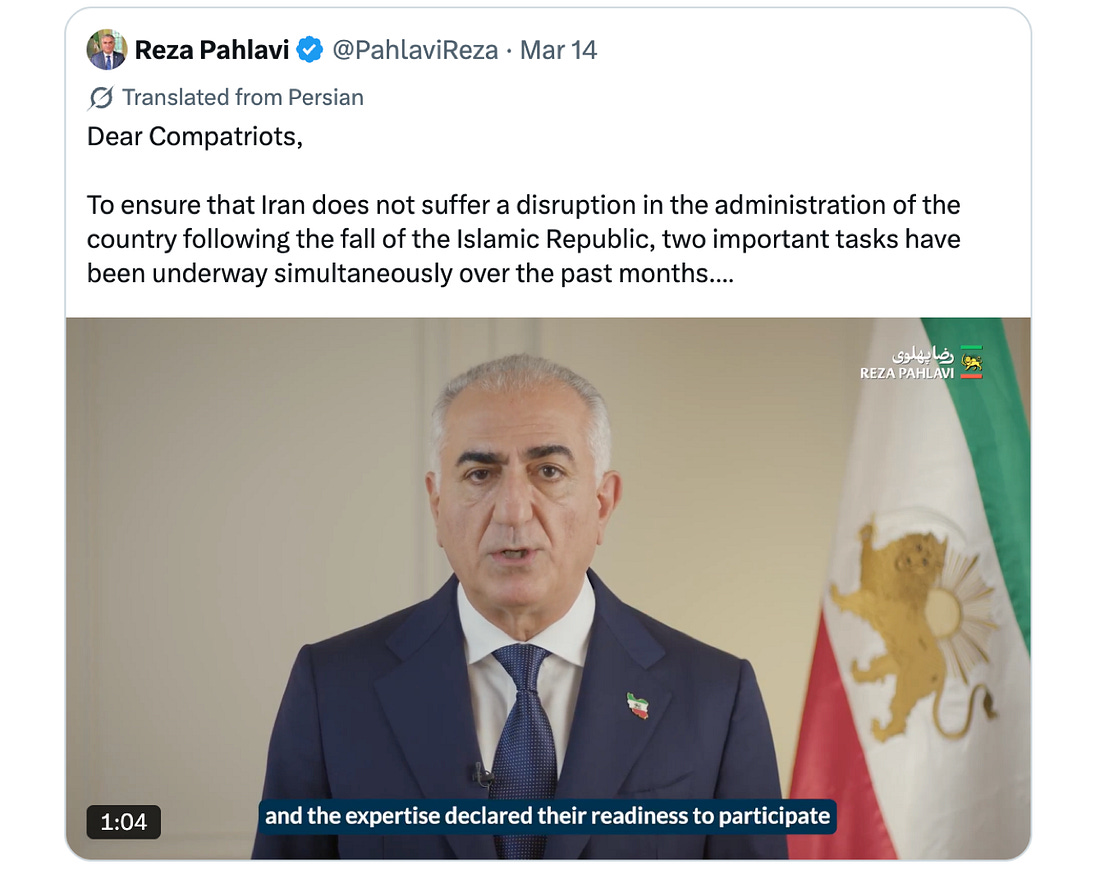
Normally, a statement like that would be filed under “exiled royalty says stuff.” But the timing and specificity suggest something much more interesting is going on. Pahlavi didn’t just express willingness. He, for the first time, revealed that for months, he and a network of experts have been quietly building a detailed transition plan called the “Iran Prosperity Project”— complete with a website, a temporary legislature, an executive branch, a transitional judiciary, and a phased timeline to democratic elections within 18 to 24 months.
In other words, it’s a government-in-a-box, ready to unpack.
The plan is surprisingly sophisticated. The Jerusalem Post got an inside look at the “Emergency Phase” blueprint, directed by Saeed Ghasseminejad at the National Union for Democracy in Iran (NUFDI). It describes governance structures for the first 180 days. It includes a transitional justice court for prosecuting regime abuses. It has a truth commission.
Most interestingly, like Trump’s Venezuela transition plan, it keeps existing Iranian law and the quasi-democratic side of its government temporarily in force to prevent chaos. But it also immediately abolishes the supreme leader’s office, the Guardian Council, the Assembly of Experts, and —critically— the IRGC itself, integrating its military components into a unified national force and dismantling its vast economic empire.
Pahlavi’s plan studiously avoids the monarchy-versus-republic question. No kings. Under the plan, Iranians would decide that issue for themselves, in a referendum held four months after the transition begins, with elections to follow in 18-24 months.

Pahlavi was careful to frame himself as “a bridge, rather than the destination.” That language is strategic. He’s positioning himself not as a king reclaiming a throne, but as a stabilizing figure— the adult in the room while democracy boots up.
But here is the most revealing part: The whole thing smells remarkably similar to Project 2025, the plan that paved the way to Trump 2.0.
Remember Heritage Foundation’s Project 2025? The one that drove the media absolutely bonkers last year? The whole concept was: don’t wait until you win to figure out what to do. Have the personnel pre-identified, the policies pre-drafted, the executive orders pre-written, and the org charts ready, so that when the transition happens, you can move instead of improvise.
And it worked like the Dickens.

Pahlavi’s Iran Prosperity Project is the same idea as Project 2025, in miniature. “Capable individuals” are already identified, both inside and outside Iran. Governance frameworks are drafted. Institutional reforms are sequenced. The whole 180-day playbook has been pre-written.
It’s the opposite of the usual regime-change handbook. Countries that improvise transitions in real time fail. Iraq 2003 proved that. Libya 2011 proved it again. The difference between a revolution and a catastrophe often boils down to whether someone had a plan in the filing cabinet. Fail to plan, and you plan to fail.
But my goodness— consider the timing! Just as Iran is running out of missiles and conceding the Strait, here comes Pahlavi, saying his work has been underway for months. He’s now going public during Week Three of Operation Epic Fury, with Iran’s military systematically disintegrating, its supreme leader dead, his harder-line (but cardboard) son installed as a replacement, and Trump openly talking about “unconditional surrender” and regime change.
Pahlavi didn’t suddenly make this announcement because he’s feeling optimistic in general. Timing is everything. He’s announcing it now because people who know stuff are telling him the window may be opening. You don’t announce a detailed transition plan while the old regime is stable. You announce it when you think the transition is coming soon. Otherwise, you just expose the plan to criticism and counter-propaganda.
Corporate media keeps hissing that Trump was “unprepared” and has “no plan” for Iran’s post-regime. Yesterday, Pahlavi confirmed he’s in contact with the Trump administration. And Trump, for his part, said Friday that regime change in Iran “will happen” but may not happen “immediately.”
What President Trump didn’t say was that the Administration is creating any post-regime plan. Maybe because the plan was already prepared months ago. Either way, Pahlavi’s Project 2025-like plan is more evidence, stacking up, suggesting that the war’s end is looming closer. It won’t be the first time the flat-footed media is caught by surprise. Or the last.
ESSENTIAL NEWS AND COMMENTARY
💉💉💉
Medical freedom encountered a disappointing setback on Friday. We were so close. The South Florida Sun Sentinel reported, “DeSantis criticizes House for not passing ‘medical freedom’ bill.” Apparently, House legislators got the heebie jeebies after the Florida DOH reported 132 measles cases so far for 2026— even though most were from a single ‘outbreak’ at Ave Maria College. Chillingly, in 2020, only 5 measles cases were reported nationwide. After the Orlando Sentinel warmed up its virus-dictionary-of-doom and ran pictures of third-world children dripping with measles, the House blinked.

The House didn’t blink because of a measles outbreak. It blinked because of a measles headline.
The Florida House let its legislative session expire on Friday without bringing the medical freedom bill —a bill that had already passed the state’s senate— to the floor for a vote. “It seems to me you’re fumbling right on the goal line here,” DeSantis said afterwards. “Punch it in for the touchdown and get it done,” he encouraged. “I know a lot of people in Florida really want to see these protections written into law.”
He was right. The bill was incredibly popular even though it had been watered down. The current version stopped short of what DeSantis and Surgeon General Joe Ladapo had originally asked for— repealing all vaccine mandates in the state. Instead, it would have expanded existing vaccine exemptions for public K-12 schools, and created a new “conscience” category for parents to opt out of immunizations without requiring them to invoke a religious objection.
It would have also made ivermectin available over the counter in Florida.
DeSantis said he would try again during the budget process, which comes next. DeSantis’ term expires in November, and he isn’t running for re-election, having termed out. Can he get it done before he leaves? If not, will his successor have the same spine?
💉 House lawmakers appear to have been spooked by the terrifying figure of 132 measles cases. In a March 5th Miami Herald op-ed, ‘conservative’ Editorial Board member Mary Anna Mancuso applauded the House’s decision to table the bill. “Like most conservatives,” she began, “I like my government limited and freedom abundant.” A good start, but apparently she doesn’t like her freedom that abundant: “But freedom without good judgment isn’t conservatism — it’s reckless.”
The measles statistic surfaces in every single story and op-ed about vaccines in Florida. It’s practically being dragged around on banners behind small planes. 132 cases! But we already know their tricks. Remember the great “covid cases” scam? First of all, what counts as a “case?” In this glorious age of hypersensitive PCR tests, they don’t even need symptoms for it to count as a ‘case.’ And the state does not currently track hospitalizations for measles, so we don’t know whether the 132 cases were mild, severe, or undetectable to the naked eye.
Zero measles deaths are currently reported. So.

They keep comparing the 132 “cases” to 2020’s “five national measles cases.” That is also a sham. 2020 was the lockdown year, schools were closed, and nobody cared about measles anyway. The five cases reported in 2020 were an absurd outlier, unmatched in years before or after. Critics of medical freedom also cite antique fatality figures from pre-vaccine eras, rather than the current U.S. measles case‑fatality rate, which has been on the order of 1 death out of many hundreds of cases.
Virus hysteria is back. The Orlando Sentinel op‑ed, for instance, explicitly and insanely framed measles vaccination as a “life and death responsibility,” and even equated easing jab exemptions with the “freedom to drink and drive,” as if any non‑maximal vaccine policy stance is homicidal recklessness.
By the Sentinel’s logic, letting parents choose their kids’ pediatrician is the ‘freedom to practice medicine without a license,’ and packing your own lunch is the ‘freedom to commit food safety violations.’ Give me a break.
Instead, if anything, Florida’s 2026 ‘surge’ so far —132 reported cases and zero reported deaths— portrays a risk profile that looks nothing like the 1950s pre‑vaccine era and everything like a localized outbreak in a largely immune population. It’s less remarkable how many cases there were, compared to how few. In other words, the ‘outbreak’ didn’t spread very far. That says something. Natural immunity works.
Florida legislators need to scrape their courage off the floor, buck up, and follow DeSantis’s lead. Did we learn nothing during covid about how easily disease statistics are manipulated? The biomedical fascist brigades are lying about measles risk and are reporting more aggressively to manufacture a case. Their budgets depend on it. Don’t be fooled again.
💉💉💉
There’s something else Florida’s legislators should consider. Vaccines often suck. Yesterday, ABC-7 New York ran a story below the deadpan headline, “Flu vaccines didn’t work that well in the US, officials find.” Ruh-roh. The most common vaccine in the country failed. Again.
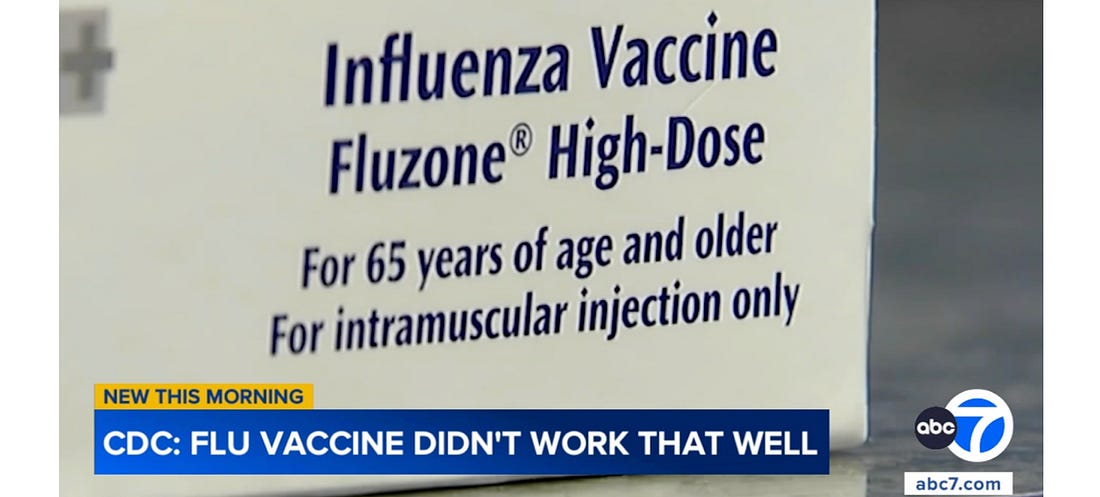
Well, we appreciate the candor, at least. Sort of. “Didn’t work that well” is doing some heroic lifting in that headline. That’s like describing the Hindenburg as a flight that ‘didn’t land that well,’ calling the Titanic a cruise that ‘ended a bit early,’ or describing Pompeii as a town that ‘had some rough weather.’
The truth is much worse than not working that well.
ABC reported that, among adults, the vaccine was only 22% to 34% effective at preventing doctor or hospital visits. For comparison, the CDC considers a good year to be at least 40-60% effectiveness. So this year crashed below the floor of what officials themselves define as adequate. It was one of the worst effectiveness rates in more than a decade— which is saying something, since effectiveness already dips below 50% in most years.
As ever, it was designed for the wrong variant. The culprit, according to the CDC, was a new H3N2 variant ominously labeled “subclade K.” Subclade K was found in 83% of the flu samples the CDC tested, and it was “antigenically distinct” from the strain the vaccine was built to fight. It’s like studying for a history exam and getting a pop quiz on calculus. Every year, for twenty years, and then being told this time, the teacher promises it will be on the test.
Good luck with your number two pencil.
The flu vaccine is reformulated every single year. That’s the sales pitch. Unlike childhood vaccinations, which used to be one-and-done, the flu shot is supposed to be annually upgraded to match whatever strains the World Health Organization predicts will circulate. It’s the one vaccine where they openly admit they’re just guessing.
And … they guessed wrong. Again. The ugly truth is, it’s never worked particularly well. No one can point to a single season where the flu vaccine was, say, 85%+ effective. Not one. The best claimed years max out at just over 50/50. In 2018, a gold-standard Cochrane Review published a study finding only a “modest” 1% decrease in the likelihood of catching the flu among patients who took the vaccine.
New York State declared this the most intense flu season in at least twenty years, recording over 71,000 positive cases in a single week in late December— the most ever recorded since flu became reportable in 2004. NYC alone topped 146,000 cases by February. Four children died of flu in New York City this season. (None died from measles, though. But sure, let’s get hysterical about measles.)
It’s almost like New York is suffering from some kind of immune suppression or something. Weird. But I digress.
Now, a reasonable person might wonder: if the vaccine is custom-built every year, and the effectiveness still bounces between 19% and 60% depending on whether the WHO’s crystal ball was having a good day, maybe the modelis the problem. We don’t tolerate 22% effectiveness in seatbelts, body armor, sunscreen, or restaurant hygiene inspections. (‘Come for the street tacos, stay for the Montezuma’s revenge!’)
We’d laugh a contractor out of the room if he told us the roof he just installed had a 34% chance of keeping the rain out. But for flu vaccines, we’re supposed to line up every October and hope this is one of the good years?
The pattern is always the same. In the fall: “Get your flu shot!” In the spring: “Well, it didn’t work that well, but you should still get it next year.” Rinse, repeat, and never question the model. Charlie Brown, meet Lucy. She promises she’ll hold the virus right this time.
Meanwhile, the agency that spent a decade insisting we were cuckoo for questioning vaccine effectiveness just published a study confirming that questioning vaccine effectiveness was entirely justified. Think they’ll update the misinformation guidelines to reflect that? Any minute now. Any minute.
🔥 Everything is ramping up — the end of the Iran war, the medical freedom fight, the evidence that the experts had it wrong all along. The question isn’t whether the truth catches up. The question is whether the establishment can keep up.
Have a blessed Sunday! Thank you, as always, for your continued loyal support of the C&C mission. Roll back tomorrow morning, as we kick off the brand-new week with humor, essential news, and steady (but realistic) optimism.
Don’t race off! We cannot do it alone. Consider joining up with C&C to help move the nation’s needle and change minds. I could sure use your help getting the truth out and spreading optimism and hope, if you can:☕ Learn How to Get Involved 🦠




Leave a Reply
You must be logged in to post a comment.