
Israel Offers 1A Advice; More On Trump’s Attack On Putin; Trump’s Agenda
January 3 | Posted by mrossol | 1st Amendment, American Thought, Censorship, Israel, Transparency[non], Trump, WauckAll three issues are disturbing. “If it walks like a duck, and smells like a duck, and swims like a duck…” mrossol
Source: Israel Offers 1A Advice; More On Trump’s Attack On Putin; Trump’s Agenda
|
|

Jewish Nationalism, the gift that keeps on giving. In the past it has given us Palestinian genocide and ethnic cleansing, nuclear espionage, the USS Liberty, Jonathan Pollard, endless Middle East wars, Rachel Corrie, more genocide and ethnic cleansing, AIPAC, a vast propaganda machine pushing for more US wars, a bought and paid for and thoroughly corrupted political establishment. Now comes the cherry on top: Jewish Nationalists—both in America and from Israel—are advising us to ditch the First Amendment. For our own good, mind you. Nobody in our Fourth Estate bothers to ask, What’s in it for the cause of Jewish Nationalism?
Here’s the latest:
“It’s time to limit the first amendment, in order to protect it!”
A top israeli defense official warned earlier this month that the world is heading toward its first cyber war, in which critical infrastructure will be the primary target. Joining us here at Post Nine, founder and CEO of Cato Networks, Shlomo Kramer, also one of the founders of Check Point, another big cyber company. Shlomo, it’s great to have you here. Welcome!
Shlomo: Thank you for having me.
Q: How is AI cyber warfare shaping geopolitics right now?
Shlomo: So AI is going to revolutionize cyber warfare, is revolutionize cyber warfare, from critical infrastructure to the fabric of society and politics and undermining it, giving unfair advantage to [? authoritarian?] governments against democratic countries, First Amendment type of, eh …
Q: That’s already happening?
Shlomo: That’s already happening. You’re seeing the polarization in countries that allow for the First Amendment and protect it, which is great. And I know it’s difficult to hear, but it’s time to limit the First Amendment in order to protect it. And quickly before it’s too late.
Q: What do you mean?
Shlomo: I mean that we need to control the platforms–all the social platforms. We need to stack, rank, the authenticity of every person that expresses themselves online and take control over what they are saying, based on that ranking.
Q: The government should control social media?
Shlomo: The government, yeah, should do that. And we need to educate people against lies. And governments need to develop cyber defense programs that are as sophisticated as the [sub?] attack. Today. it’s a 1 to 100 ratio. And really governments are not doing this today at any rate. And enterprises are left fending for themselves.
Q: The technology is moving much faster than the political system typically can to respond to it.
Shlomo: Right, so you need to use technology in order to stabilize the political system. And you need to put adjustments that are perhaps not [inaudible]
Q: I mean, we’re at a point though, right? i mean, I can go on Instagram or TikTok and frankly, it already is becoming unclear what is fake and what is real.
Shlomo: Exactly.
Q: And once you eliminate that ability to discern truth from fiction, what are you left with?
Shlomo: You are left to polarization of society and inner fighting, and you have to control that. And you see that already happening across the world. So this is an urgent need by the government to do that. And, until then, enterprises are buying by themselves more and more cybersecurity solutions, but they can’t afford all these solutions by themselves. So they are looking for ways to deliver more efficient consumption.
Q: And I assume you have some of those ways, obviously.
Shlomo: So. And that drives really the next generation of companies such as Wiz, Crowdstrike, Cato Networks on the network that are platforms and are able to deliver this extended need for security in an affordable way for enterprises.
Q: For enterprises, not for governments?
Shlomo: Not for government, but governments need to start building their programs, and the same tools can be used also by government.
Q: But the two leaders in AI–and one is China, which obviously already is using AI to control the population. And here we’re in an all out race with China. And so we’re not as interested in regulation right now,certainly not at the state level, for example.
Shlomo: And that’s a big mistake, because if China has a single narrative that protects its inner stability and the US has multiple–allows for multiple–narratives, it puts them [China] in an unfair advantage that long term is going to cost the stability of the nation [US]. So changes must be made.
So, as I understand it, the problem of distinguishing truth from fiction can be solved by allowing only one narrative. If the government controls all narratives and allows only one, then the whole question of truth vs. fiction just, like, goes away. Simple. It all boils down to who writes the narrative. Where would We the People be without our “closest ally”?
What ever happened to Venezuela? Are we still locked and loaded down in the Caribbean?
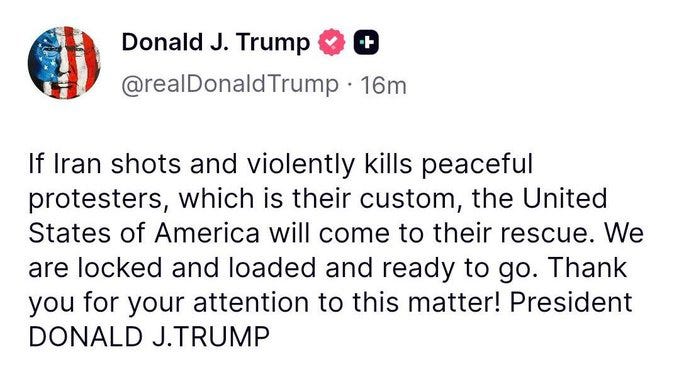 |
How, exactly, will the USA “come to their rescue”—by bombing them?
Megatron @Megatron_ron
6h
BREAKING:
The US Justice Department is hiring approximately 400 lawyers, including national security experts, to review and REDACT around 5.2 million pages of documents connected to the Jeffrey Epstein investigations – Reuters
Whole lotta redactin’ goin’ on!
Wait, Epstein—that’s another gift of Jewish Nationalism—because what they’re really hiding is The Connection. Just doesn’t stop. And I forgot about the Dancing Israelis and Charlie Kirk, too.
Curiouser and curiouser. First the CIA said there was no attack on “Putin’s residence,” then, well, …
Yulia Latynina @YLatynina
Jan 1
The most important take from this unnamed CIA official is: yes, Ukraine launched drones precisely at the moment Zelensky was meeting Trump, yes, these drones flew in the direction of Putin’s residence, but we think that the target was not the residence but somewhere nearby.
Two questions: Is it a good idea to launch drones in the direction of Putin’s residence right during the talks?
Second, how on Earth Russian air defence can deduce it’s not flying to the residence if it’s flying to the residence?
Just imagine a drone being shot down near Mar-a-Lago and the perpetrator claiming he was launching at a nearby mansion. Would seem pretty wild.
Fair enough, right? But it gets worse. Recall that the NYT has been telling us that Trump greenlit all those attacks on Russian tankers and oil facilities during “negotiations”.
Leonid Ragozin @leonidragozin
An unnamed CIA official confirms to the WSJ that the Ukrainian drone attack on Novgorod region indeed happened despite earlier attempts at denial, however the target was not Putin’s residence, but a military facility elsewhere in the region.
This is consistent with Arestovych’s earlier claim that the target was a command centre of the Russian nuclear forces. WSJ’s source didn’t name the facility – which makes one wonder why. A fuel depot or an airfield would have surely been named.
Not sure an attack on a nuclear command facility rather than presidential residence makes the situation any less dangerous, in fact more – this [is] a step beyond the framework of a regional conflict and towards a global war, especially since Moscow believes that Ukrainian strikes rely on Western intelligence and get coordinated with the Western military, specifically British.
Major Western governments have so far avoided rejecting Russian claims about an attack on Putin’s residence as a fake, despite online infowar content factories trying hard to make this point.
A statement by an anonymous CIA staffer has only so much value, especially in the light of the internal confrontation between the pro-Ukraine and anti-interventionist camps in the US NatSec community.
Besides, anonymous intelligence sources have been routinely laundering disinfo by feeding it to legacy media all through this conflict, devaluing any stories based exclusively on them.
But Russia’s threat to change its negotiating position following the attack reads in a very different light, if the target was indeed a secret nuclear command centre.
5:34 AM · Jan 1, 2026
Leonid Ragozin @leonidragozin
Jan 1
A non-paywalled summary of the WSJ story
U.S. Finds Ukraine Did Not Attack Putin’s Valdai Residence – WSJ
On Monday, U.S. President Donald Trump told reporters that he was “very angry” after Putin told him over the phone about the Ukrainian attempt to hit his home.
However, shortly before WSJ published its report, Trump, posting on Truth Social, appeared to play down Russia’s allegations by sharing a New York Post editorial titled “Putin ‘Attack’ Bluster Shows Russia Is the One Standing in the Way of Peace.”
Donald J. Trump @realDonaldTrump
Putin ‘attack’ bluster shows Russia is the one standing in the way of peace: nypost.com/2025/12/30/opinion/
The editorial argues that Russia is obstructing efforts to end the war and that any attack on Putin would be “more than justified” given alleged Russian assassination attempts on Ukrainian President Volodymyr Zelensky.
Let me repeat that. Trump just posted a link to a NYPost editorial that ends with this sentence:
Any attack on Putin is more than justified.
Does that mean that “we” are “locked and loaded and ready to go” after Putin, just like Venezuela and Iran? What am I missing in all this? Could it be a strong denial of any US involvement?
In the comments recently the subject of “Trump’s agenda” came up. It’s a complicated subject, but DD Geopolitics seems to be on to something (follow link for graphics). Not to diminish Trump’s genius, but it all kinda looks a bit like the Clinton Foundation on steroids. The same shameless grifting, but multiplied exponentially.
DD Geopolitics @DD_Geopolitics
 THREAD: Trump’s Web of Power, Profit & Policy
The NYT published a map of Donald Trump’s second-term business universe including crypto ventures, foreign governments, real estate deals, defense and A.I. interests, all orbiting the presidency.
Unlike his first term, Trump re-entered the White House without agreeing to halt new international business deals. Since then, his family and closest allies have accelerated projects that monetize the Trump name while intersecting directly with U.S. policy decisions.
We’ll walk through this map piece by piece:
• how crypto became the family’s most lucrative venture
• how foreign governments gained unprecedented access
• how policy rollbacks align with private profit
• and how American norms around conflicts of interest collapsed in real time
This diagram captures a single thread in a much larger web, but it’s one of the most revealing.
Just weeks before his second inauguration, Donald Trump and his partners launched a memecoin, $TRUMP, reversing years of public skepticism toward crypto. Trump personally promoted the coin, driving retail investors into the market.
As investors bought $TRUMP, trading fees were routed through a series of Trump-linked entities, including Fight Fight Fight and CIC Digital, before ultimately benefiting a trust tied to Trump himself. Every transaction generated revenue upstream, regardless of whether investors won or lost.
While rolling back crypto enforcement, easing SEC pressure, and publicly championing the industry from the Oval Office, Trump was also positioned to profit directly from crypto activity tied to his name. And then there was the rug pull(s)…..
This graphic zooms in on one of the clearest conflict-of-interest loops in Trump’s second term: cryptocurrency.
… As buyers piled in, trading fees flowed through a series of Trump-linked entities, ultimately benefiting Trump’s trust.
One of the largest buyers was Justin Sun, the founder of the Tron blockchain, who reportedly spent over $40 million acquiring $TRUMP. At the same time, Sun and Tron were facing regulatory scrutiny from the Securities and Exchange Commission.
Under Trump, the SEC has since eased crypto enforcement and frozen or slowed several high-profile cases, including actions affecting firms tied to major Trump-aligned investors. The visual shows how business actions (green), business ties (dotted), and government actions (orange) converge around the president himself.
In plain terms:
• Trump promotes a financial product
• Wealthy investors buy in
• Fees flow to Trump-linked entities
• Regulatory pressure on the industry eases
Ever wonder what a “special envoy” really does? Wonder no more. And don’t think Russian and Chinese and every other variety of intel aren’t following all this. They know what Trump’s America is all about. Now I wonder, would Trump allow foreign money to flow into these ventures?
In 2024, Donald Trump and his special envoy Steve Witkoff co-founded World Liberty Financial, a crypto venture launched with their sons and close partners. The firm issues its own token, $WLFI, and routes proceeds through a web of Trump- and Witkoff-linked entities.
Trump actively promotes the token while holding a financial stake through trusts and affiliated companies. His sons, Eric Trump and Donald Trump Jr., are listed beneficiaries of Trump-linked entities that receive cuts of crypto proceeds. Witkoff’s family entities also receive revenue shares, turning policy influence into private upside.
What makes this arrangement notable is the timing. Trump has rolled back Biden-era crypto enforcement, publicly championed digital assets, and signaled regulatory leniency while his own venture profits from increased trading, speculation, and institutional access.
It’s a closed loop: promotion → investment → fees → family-linked entities while the president reshapes the regulatory environment governing the same industry.
This graphic shows how U.S. national security policy, foreign governments, and private profit increasingly overlap in Trump’s second term.
At the center is a push to export advanced American-designed microchips to the United Arab Emirates, despite internal concerns about technology transfer and long-term security risks. The deal was helped along by Commerce Secretary Howard Lutnick and Trump’s A.I. and crypto czar David Sacks, while Trump’s special envoy Steve Witkoff played a key role in negotiations.
And rightly so. These guys are fanatical Jewish Nationalists and the UAE is a Jewish Nationalist client state.
On the Emirati side sits Sheikh Tahnoon, a senior royal figure and powerful intelligence and business broker. He chairs G42, a UAE tech firm involved in the chip deal and deeply embedded in the country’s state apparatus.
The same actors pushing U.S. policy are tied to private firms and families positioned to benefit financially from these decisions, blurring the line between public interest and private gain. The White House acknowledged internal debate, but the deal moved forward anyway.
Trump-linked crypto ventures are now intersecting directly with foreign capital and state actors.
Question answered.
In May, a UAE-connected firm purchased roughly $2 billion worth of stablecoins issued by World Liberty Financial. The deal routed profits back to World Liberty.
The buyer, MGX, is chaired by Sheikh Tahnoon, a senior Emirati power broker with deep ties to the UAE security state. The transaction positioned a foreign government-linked entity as a major financial participant in a Trump-connected crypto enterprise while Trump was actively reshaping U.S. crypto policy.
Stablecoins rely on regulatory confidence, dollar backing, and access to U.S. financial infrastructure. Under Trump, crypto enforcement has been loosened, and stablecoin regulation remains intentionally permissive, creating a favorable environment for precisely these kinds of deals.
Congress has begun scrutinizing the arrangement because it represents a new form of influence, foreign capital flowing into financial instruments that directly enrich a sitting president’s business network, without the guardrails that traditionally separate public office from private profit.
This map shows how Trump’s real estate business has become deeply intertwined with foreign governments, particularly Saudi Arabia and the Gulf.
Dar Global is now the Trump Organization’s most significant overseas partner. The firm is closely linked to Saudi state interests and has developed at least eight Trump-branded projects across Saudi Arabia, Dubai, Oman, Qatar, and the Maldives. These deals are not passive licensing arrangements. Trump branding fees generate millions per project, and Donald Trump continues to benefit financially while serving as president.
Several of these projects involve entities backed by Gulf sovereign wealth funds or governments themselves. Dar Global has worked directly with Saudi-connected developers on multiple large-scale luxury projects, including 4 Trump-branded developments inside Saudi Arabia.
At the same time these business relationships are expanding, Trump has re-engaged diplomatically with Gulf leaders, including Saudi officials, on sensitive regional and security matters. Unlike his first term, Trump did not agree to halt new foreign business deals upon returning to office.
The result is a blurred line between U.S. foreign policy and private profit. Decisions involving Gulf states now coincide with active Trump Organization deals in the same countries.
This visual captures one of the most striking conflicts in Trump’s second term.
While serving as president, Trump held sensitive national security talks with Saudi Arabia’s de facto ruler, Crown Prince Mohammed bin Salman. At the same time, the Saudi state was tied to a potential Trump-branded business dealthrough Diriyah Company, a Saudi government–backed developer chaired by the crown prince himself.
Diriyah Company is spearheading a multi-billion-dollar redevelopment project outside Riyadh and has been linked to discussions about Trump Organization branding and licensing. These talks took place while Trump remained financially connected to the Trump Organization, which continues to profit from overseas branding agreements.
In other words, the same foreign leader Trump was negotiating with on arms, security cooperation, and regional policy also sat at the center of a business entity positioned to enrich Trump personally through branding fees.
U.S. ethics norms traditionally require presidents to fully divest or place assets in blind trusts to avoid precisely this kind of overlap. Trump did neither. Instead, he re-entered office explicitly rejecting conflict-of-interest constraints, asserting they “do not apply” to him.
Trump-branded projects in Saudi Arabia, the UAE, and Qatar have already generated millions per deal, often through state-linked firms. The result is an unprecedented fusion of foreign policy, personal profit, and authoritarian governments, with no meaningful firewall between them.
This is what shattered norms actually look like.
So, in answer to the question of whether Trump has his own agenda, I’d say: Yes. And no. After all, if his own agenda coincides with the agenda of the people enriching him, it’s a distinction without a difference. Or am I wrong?




Leave a Reply
You must be logged in to post a comment.