
Bioethics and Freedom to Choose
January 21 | Posted by mrossol | CDC NIH, Malone, Mandates, VaccineStop vaccine mandates. They are unethical, unjustified, scientifically unsound historic artifacts. Just say no.
Source: Bioethics and Freedom to Choose – by Dr. Robert W. Malone
|
|

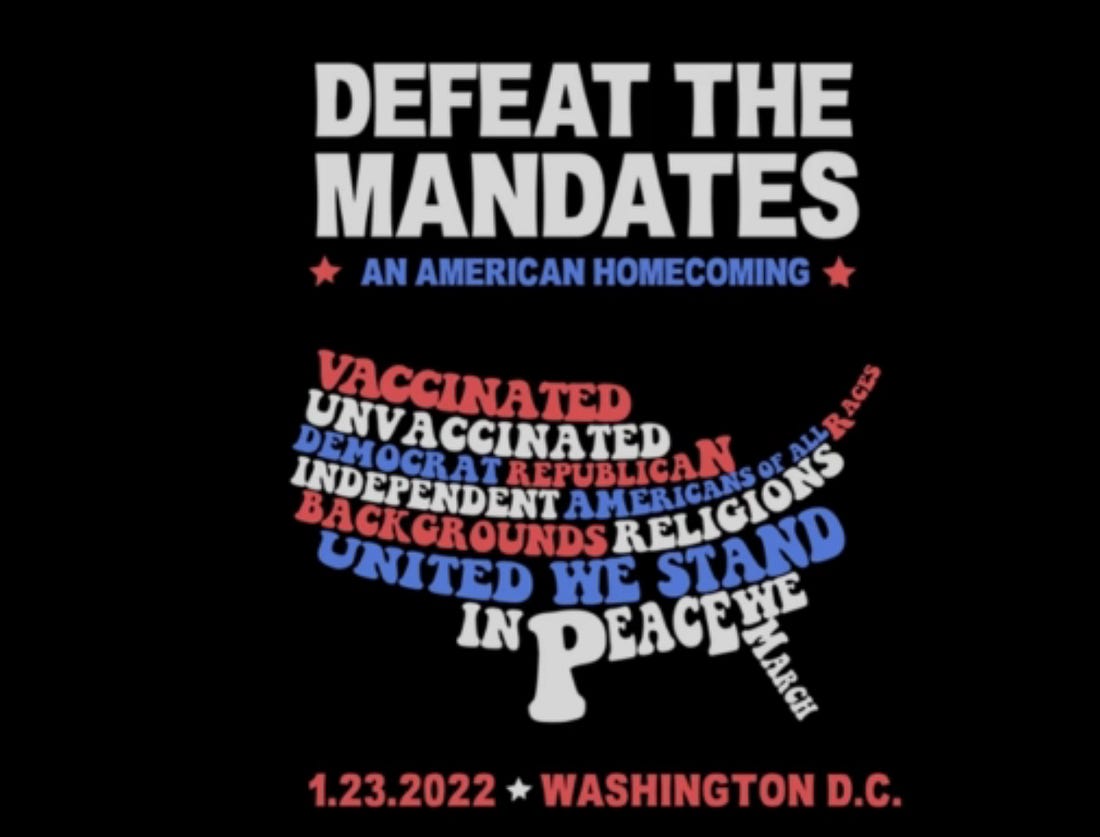 |
Tomorrow will make four long years since that bitterly cold day in Washington, D.C., when the medical freedom movement shocked the officious and unctuous Biden administration with the first major DC political rally since the infamous post-election events of January 06, 2021. And yet, what I find most stunning was not that we pulled it off with essentially no lawlessness – despite rumors of attendance by a variety of disruptive forces and the concerted efforts of various chaos agents- but that the core issues remain unresolved four years later.
The American Academy of Pediatrics and the West Coast Health Alliance continue to advocate for mandated COVID mRNA vaccines for children as young as 6 months old. In Hawaii, Governor Dr. Josh Green and his cronies have just introduced a bill in the legislature to repeal the current Hawaiian Childhood Vaccinations Exemption process, making compliance with state-imposed vaccine mandates for children a statewide policy without any opt-out clause.
Shortly after the DC “Defeat the Mandates” rally, the Washington Post labeled me a liar (in print, repeatedly) for claiming that the mRNA products were not working as intended, in that they did not prevent infection or disease caused by SARS-CoV-2. And yet that has now become a universally acknowledged truth. I guess that intentional, repeated defamation did not withstand the test of time. Suffice to say, I am not holding my breath for an apology. So much for the reliability of the “experts’” wisdom and insight. One might imagine a bit of introspection would be in order, perhaps a modicum of shame, and a pinch of humility. But that does not deter the same highly credentialed medical “experts” from insisting on mandating the most aggressive vaccine schedule in the entire world for our children. In jab they trust, and so we must.

But what do the medical Guilds have to say about mandates and informed consent?
In its Code of Medical Ethics, the American Medical Association states:
“Informed consent in medical treatment is fundamental in both ethics and law. Patients have the right to receive information and ask questions about recommended treatments so that they can make well-considered decisions about care. Successful communication in the patient-physician relationship fosters trust and supports shared decision making.”
American Medical Association. Code of Medical Ethics: Informed Consent. 2025.
Fundamental in both ethics and law. But apparently there is an unwritten and unspoken vaccines mandate exemption.
In its Public Health Code of Ethics, the American Public Health Association asserts:
“the effective and ethical practice of public health depends upon social and cultural conditions of respect for personal autonomy, self-determination, privacy, and the absence of domination in its many interpersonal and institutional forms.”
American Public Health Association. Public Health Code of Ethics. 2019.
“Absence of domination in its many interpersonal and institutional forms” is an interesting and relevant turn of phrase. If state-imposed vaccine mandates are not a form of institutional domination, I do not know what is.
Bioethics is the study and application of moral principles in medicine and the life sciences, built around four central pillars: autonomy, beneficence, non‑maleficence, and justice. Among these, informed consent stands as the cornerstone of ethical practice because it operationalizes respect for autonomy — the individual’s right to self‑determination. Informed consent requires that patients receive complete and transparent information about the purpose, benefits, risks, and alternatives of any proposed intervention, including the option to refuse treatment. True consent must be voluntary and free from coercion, deception, or informational manipulation. Without full disclosure and comprehension, consent becomes mere compliance, negating the principle of autonomy and transforming medicine into a form of technocratic control. Therefore, modern bioethics demands radical transparency, ensuring that individuals are empowered to make conscious, informed choices about their own bodies and health — a safeguard against institutional overreach and the unethical concealment of risks.
Vaccine mandates fundamentally conflict with the core principles of modern bioethics- autonomy, informed consent, beneficence, and non‑maleficence- because they prioritize state-imposed public health objectives over the individual’s right to bodily self‑determination. The doctrine of informed consent, established after the Nuremberg Code and reaffirmed in the Declaration of Helsinki, requires that all medical interventions be voluntary, based on full disclosure of benefits, risks, and alternatives, and free from coercion or undue pressure.
Mandates, by design, employ coercive mechanisms, such as loss of employment, education, or social participation, to compel compliance, thereby eroding meaningful consent. Furthermore, by applying one-size‑fits‑all policies to complex biological and genetic diversity, mandates ignore individual risk profiles, prior immunity, and potential susceptibility to adverse effects.
This undermines both beneficence (acting in the patient’s best interest) and non‑maleficence (avoiding harm), as the state substitutes population averages for individualized medical judgment. Ethically sound public health policy should uphold proportionality, balancing communal benefit against personal rights, but mandates invert this hierarchy, subjugating individual conscience to institutional authority. In doing so, they represent not progress but regression: a return to paternalistic medicine, where each human body is treated as a vessel of state interests and ownership rather than as personally sovereign.
The history of vaccine mandates traces back more than two centuries, emerging from the tension between public health authorities and individual autonomy. The first formal vaccine requirement arose in the early 19th century, following Edward Jenner’s smallpox vaccine (1796). England’s 1853 Vaccination Act made smallpox vaccination compulsory for infants, sparking fierce opposition and giving rise to the anti‑compulsory vaccination movement, an early civil‑liberties struggle. In the United States, mandates began at the local and state level in the late 1800s, primarily for smallpox control. The landmark 1905 Supreme Court case Jacobson v. Massachusetts upheld states’ right to enforce vaccination under the “police power” to protect public health, establishing the legal precedent that still underlies mandates today. Throughout the 20th century, compulsory vaccination expanded to school entry laws, particularly after the success of the polio and measles vaccines; by the 1980s, nearly every state mandated multiple immunizations for children. However, the rise of pharmaceutical influence, expanding vaccine schedules, and mounting evidence of adverse reactions reignited ethical debates around bodily autonomy and informed consent. The COVID‑19 era marked the most sweeping use of mandates in modern history, often enforced through employment and travel restrictions — reviving foundational questions about freedom, scientific transparency, and the limits of state power in matters of personal health.
Scientific arguments against vaccine mandates center on the recognition that immunization responses, disease risks, and susceptibility to adverse events vary widely among individuals, making blanket, coercive policies biologically unsound. Decades of immunology research show that genetic polymorphisms, prior infection history, microbiome variance, and immune system maturity all influence vaccine efficacy and safety; thus, uniform mandates ignore fundamental human variability. Population-level metrics like “herd immunity thresholds” oversimplify complex transmission dynamics and fail to account for naturally acquired immunity, which multiple studies show can confer broad and durable protection, often exceeding that conferred by vaccine-induced immunity.
Mandates also distort scientific inquiry by suppressing open debate and discouraging critical safety evaluation; when vaccination is compulsory, the incentive to rigorously measure long-term or non-specific effects, such as autoimmune or neuroinflammatory outcomes, diminishes, because compliance replaces evidence as the cornerstone of policy. Moreover, scientific integrity requires falsifiability and independent replication, yet current frameworks rely heavily on manufacturer-sponsored studies and refuse to release full trial data for scrutiny. By enforcing a single medical intervention as a condition of participation in society, mandates replace adaptive, evidence-based medicine with static policy dogma, an approach fundamentally incompatible with genuine scientific progress.
Not ethical. Based on antiquated logic. Not scientifically sound. Clear-cut authoritarian overreach. So please remind me, why are vaccine mandates still tolerated?
Malone News is a reader-supported publication. To receive new posts and support my work, consider becoming a free or paid subscriber.
 Subscribed




Leave a Reply
You must be logged in to post a comment.