
C&C. IS IT DEI OR JEDI? Disparate Impact. SAVE is Back.
June 11 | Posted by mrossol | Childers, DEI, DOJ, Pushing Back| JEFF CHILDERS JUN 11, 2026 |
Good morning, C&C, it’s Thursday! Your roundup includes: the DOJ quietly declaring “disparate impact” unconstitutional — the biggest civil-rights shakeup in fifty years, which corporate media has covered with all the enthusiasm of a teenager asked about his report card; a handy DEI-to-English phrasebook, compiled by me, free with your subscription; and the SAVE America Act’s dramatic return from the dead, now riding inside a $350 billion military package — but will this be the time the Republicans push it over the finish line?
🌍🇺🇸 ESSENTIAL NEWS AND COMMENTARY🇺🇸🌍
🔥🔥🔥
If there was a single issue that most rankled and annoyed ordinary Americans, even more than open borders or forever wars, it was the incomparably irksome D.E.I., the first in a series of progressive slogans so onerously periphrastic they require acronyms. “Diversity, Equity, and Inclusion” fooled no one; it was just more leftist wordplay, a sneaky shibboleth that actually meant its mirror opposite: uniformity, unfairness, and rejection.
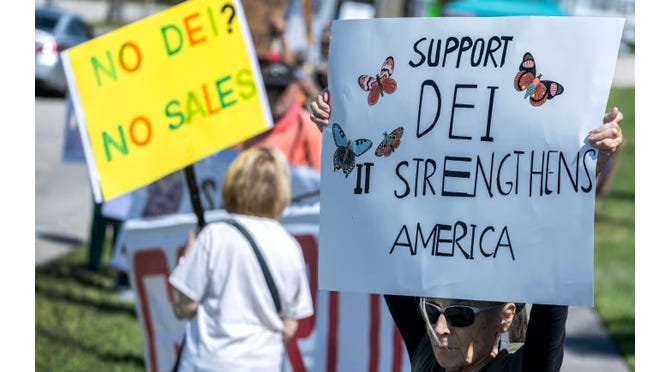
Specifically, in reality, DEI means uniformity of thought and speech, patent unfairness that a below-average fourth grader could spot from across the cafeteria, and the rejection of everyone who actually worked hard and earned their position. Most annoying of all, perhaps, was the smug conceit of the so-called “DEI Experts,” a moblike class of overpaid mids who hectored us to the brink of insanity with unintelligible progressive buzzwords and meaningless slogans like “allyship.”
They infested our jobs with the most offensive and absurd “DEI training” materials beyond anything George Orwell could possibly have imagined. And they otherwise basked their grotesque, body-positive selves in broad daylight for the last several decades.
Before we start, to keep things straight, here is a handy guide to DEI buzzwords that I have compiled:
- Allyship — complying without complaining
- Doing the work — agreeing faster
- Holding space — sitting quietly while being scolded
- Lived experience — an unlikely and unverifiable personal anecdote, but load-bearing
- Other ways of knowing — confidently not knowing
- Calling in (vs. calling out) — calling someone out while smiling
- Safe space — a separated space excluding you (who are the danger)
- Centering marginalized voices — the meeting has a new chairman
- Unpacking — what academics do instead of getting back to work
- Problematize — to discover a problem though none was reported
- Equity lens — special glasses that can find racial disparities in a takeout menu
- Positionality statement — virtue-signaling before the land acknowledgment
- Land acknowledgment — admitting the theft while keeping the land
- Cultural humility — humility, but billed hourly at confiscatory rates
- Restorative practices — like detention, but more boring and with a confession circle
As its cachet has boiled off —slowly at first, and then all at once— DEI tried to change its outfit, a sort of political looksmaxxing, by adding letters. DEI tested DEIB (belonging), and some institutions even went with JEDI (justice, equity, diversity, inclusion), until objections were raised that the term was problematic because Jedi —i.e., made-up sci-fi characters— are “inappropriately religious,” and anyway, too many Star Wars characters are white. That objection appeared in Scientific American. It even complained about phallic lightsabers. You can’t make this stuff up.

🔥 Well, my friends, during last year (the Year of Preparation), we were gratified to see the Trump Administration eject DEI from the federal government and pick fights with a small batch of wealthy, high-profile Ivy League universities (like Harvard) over their affirmative-action admissions policies. But 2026 is the Year of Action. So it’s time for a DEI update. Much has happened recently, and almost none of it has been reported anywhere near the level it deserves, especially given that until ten minutes ago, DEI was the basic operating system for the worst of our two major political parties.
Seriously, it is farcical how coldly corporate media is ignoring the biggest revolution in race and gender relations since the Civil Rights era. You’ll see that I had to source most of this story from legal journals and HR advisory newsletters.
Anyway, keep this in mind: The Administration’s most brilliant strategy was redefining DEI as itself discriminatory and reviving the concept of “merit-based” hiring as the solution— a blueprint first outlined in the Heritage Foundation’s Project 2025. Prepare to receive bushels of delicious fruit that are now maturing from the original crop.
🔥 Two days ago, CBS became the first and only corporate media platform to report the terrific news, “DOJ finds EEOC violated civil rights laws with guidelines that pressured employers to make race-based decisions.”This game-changing development was the direct result of Executive Order 14281, issued by President Trump over a year ago in April 2025, which directed federal agencies to eliminate the use of disparate impact liability “to the maximum degree possible.”
In other words, terminate it with prejudice.
Did you ever wonder where the bizarre idea came from that, if a school disciplines black students at higher rates than white students, the fix is to stop punishing black students? It sprang from a mind-numbing lefty buzzword called “disparate impact.” This is the same illogic that allows fire chiefs to be sued when female applicants are required to carry as much equipment as male applicants, and that holds if fewer black people have good credit scores, mortgage companies must stop using credit scores to decide whether to give loans (or, just give more loans to black folks and avoid the question in the first place). Hello, 2008 mortgage crisis!
In other words, “disparate impact analysis” flipped the traditional civil rights goal from preventing intentional bigotry to ensuring a statistically equivalent outcome. It was installed throughout America without Congress passing any law, or even a president issuing an executive order. It was first smuggled in through a terrible 1971 Supreme Court decision, which metastasized into dozens or hundreds of rules from various administrative agencies. Around 1990, in an effort to address the damage caused by the disastrous policy, Congress codified a version of disparate impact in Title VII and other statutes.
By the time President Trump took office for his second term, “disparate impact” was not just a goal or suggestion, but a mandate frozen in carbonite. Businesses were required to avoid statistical outcomes that produced different results for different races or genders, or face government Stormtroopers weilding devastating lawsuits.
Outside of schools, the litigation threat posed by disparate impact cases to everyday American companies came from the so-called “Equal Employment Opportunity Commission” (EEOC). I refer to it as so-called because it has traded “equality” for “fairness,” and replaced “equal opportunity” with “equal outcome.” (At least the acronym still works.)
Yesterday, Trump’s DOJ (now under the leadership of Acting AG Todd Blanche) pulled the carpet out from under the entire edifice, from the original SCOTUS decision to the forest of follow-on rules to the laws actually passed by Congress. It did this in a single document.
🔥 CBS’s story began: “The Justice Department on Tuesday accused the EEOC of violating federal civil rights laws by issuing guidelines that effectively pressured employers to make race-based considerations in hiring and promotions.” The “disparate impact rules,” DOJ said, “are unconstitutional.”
“The fundamental problem,” the DOJ’s opinion letter explained, “is that disparate-impact liability tends to incent — and even coerce — employers to make race-based decisions, to avoid liability or the threat of liability.” It got specific: “Employers can now use tools such as aptitude tests, criminal background checks and other metrics without fear that they could face discrimination claims based solely on the impact those tools may have.”
“Despite trying to promote equality, EEOC’s disparate impact liability interpretation under Title VII actually fosters the very discrimination its guidelines seek to address,” explained Acting Attorney General Todd Blanche. “This opinion will now allow businesses to hire based on performance, restoring equal opportunities in the American workplace,” he added.
The DOJ’s newest opinion attacked the plethora of agency rules—including EEOC’s—using recent Supreme Court law on non-delegation and the major questions doctrine. It attacked the 1990s-era changes to Title VII and other statutes as either facially unconstitutional or vague. It basically rejected wholesale an ocean of prior law, practice, and an X-wing fighter fleet of long-standing corporate HR policies.
In terms of its structural impact on American civil‑rights enforcement, this is potentially enormous— a wrecking ball on the order of the Supreme Court’s decision in Students for Fair Admissions, which struck down race-based college admissions, but this time for employment law. It rolls civil rights liability rules back to pre-1971 standards— a time where disparate impact statistics were merely a potential basis for evidence, rather than de-facto proof of illegal discriminatory intent.
Better, the entire federal government just lost its ability to “nudge” employers toward DEI. This restores real equal opportunity, for everyone, and lets employers once again hire based on performance, not skin color. Nobody knows how big the economic benefit to the nation’s productivity might be for letting companies fill positions with the best-qualified people.
Best of all, this flips the script. Companies that continue to use disparate impact analysis in their hiring and promotion policies are now the ones at risk from EEOC lawsuits. And as we’ll see, the DOJ can use the same disparate impact logic against DEI holdouts as evidence they aren’t following the rules.
Now is the time to remind you that this progress is great, necessary, and welcome, but it can be rolled right back by the next Democrat president. That’s why the next few election cycles are critical, and we can’t afford to fall asleep at the switch.
🔥 The fact that corporate media largely ignored the disparate impact story instead of squealing like prodded pigs is, perhaps, the best news of all. They are squashing the story because they realize that a majority of Americans are sick of the whole DEI grift, along with its clone armies of race-hustling advocates.
But there’s so much more. An unreported War On DEI is underway. The front line is already large and continues to expand. The Trump Administration is ripping DEI out of American life, root and branch. Here are a few example stories from the last month or so that you probably never heard of. A clear pattern is emerging. It’s just happening outside the corporate media bubble.
Our first example popped up last week in HR Grapevine, headlined “Employers warned as DOJ offers incentives to DEI whistleblowers.” In his first week in office last year, President Trump signed a series of executive orders purging DEI from federal offices, and —here’s the big one— requiring anyone who contracts with the federal government to certify “anti-discriminatory hiring practices.”
Last year, the DEI Industrial Complex became terrified after the Justice Department established a new task force to investigate federal contractors for alleged violations of the False Claims Act— meaning, falsely claiming to have complied with their anti-discrimination duties.
Well, the task force has stopped studying and has begun acting. “We’re already seeing the wheels in motion,” three employment lawyers reported at a recent Harvard Law conference. “The DOJ is trawling actively for complainants and whistleblowers.” David Glasgow, Executive Director of NYU Law’s DEI center said, “We’ll see more whistleblower actions given that the DOJ is strongly encouraging them.”
Strongly encouraging is one way of putting it. Under the False Claims Act, the DOJ can and has offered to pay whistleblowers up to 25% of any recovery for bringing cases. “Knowing that any employee in their business could take it upon themselves to sue means that organizational leaders have an incentive to be cautious,” Glasgow said, stating the obvious.
Twenty-five percent could be a lot. In late April, legal mag JD Supra reported, “$17 Million False Claims Act Settlement is Cautionary Tale for Federal Contractors with Diversity Initiatives.” In April, the DOJ brought its first lawsuit against a company for DEI violations under the False Claims Act. Twenty-five percent of $17 million would be (checks math) $4.25 million.
The DOJ’s target was high-profile: International Business Machines (IBM). The result: IBM coughed up $17 million almost immediately after the DOJ filed the lawsuit. The DOJ had alleged that, since 2019, IBM gave management bonuses for meeting race, sex, and gender hiring targets. In other words, quotas, driven by disparate impact analysis.
It almost seems unfair. For 25 years, companies were threatened by progressives if they didn’t discriminate in favor of preferred progressive voting blocs. Now it’s been flipped back around, and they’re being threatened if they did discriminate like Democrats wanted them to. Heads, we win. Tails, you lose.
“DEI programs,” the article blandly stated, “are particularly susceptible to False Claims Act scrutiny.” Then it added, “more high-profile settlements seem likely.”
Likely? How about certain.
🔥 There are so many similar stories working their way through the trade media. Here are a few sample headlines to make the point. First up, headline from Axios, just over a week ago:

In a press release, DOJ officials said secret videos taken by a conservative activist group showed that “Arizona State University denied equal treatment to students based on race, color, or national origin—while attempting to hide its discriminatory practices from federal scrutiny.” In one of the videos, an ASU DEI coordinator told a student the school had to strip words like “diversity” from the names of centers and programs, but don’t worry, “it isn’t changing the work.”
🔥 In our next example, three days ago, the New York Post reported that the DOJ is moving far beyond the Ivy League, drilling down to the level of public school districts:
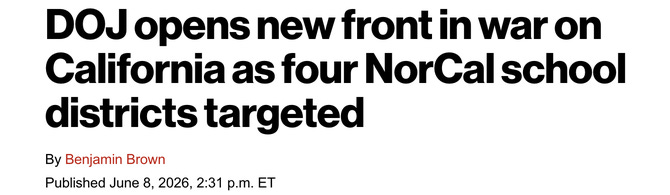
In this story, DOJ announced a “new front,” investigating four California public school districts, for teaching students about sexual orientation and gender ideology under the disguise of “LGBTQ history and social studies” while failing to notify parents.
“Further, each of these school districts appears to have implemented policies that mean students may unknowingly share sex-segregated bathrooms and locker rooms with the opposite sex, and biological males are allowed to compete on girls’ sports teams,” the DOJ’s Civil Rights Division chief Harmeet Dhillon explained.
Do not overlook the message this sends to every other goofy school district transing their girls’ sports and private areas.
🔥 Next, in April, the Missouri Independent published this encouraging headline above a story about DOJ suing a High School Sports Association— over denying a board position to white applicants:

The lawsuit focuses on a 2004 policy that reserved two seats on the association’s 10-member board of directors for “candidates representing the under-represented gender of the current board or an under-represented ethnicity.”
According to the organization’s lawyer, it created the 2004 policy after noticing a “striking pattern” that the board, with one exception, had never had “a minority or female board member.” In other words, disparate impact.
Last year, a white high-school district supervisor tried to run for one of the two reserved board seats and was summarily rejected. Cue the lawsuit. “Racial and sexual quotas are offensive, demeaning — and most importantly, illegal,” Civil Rights AG Dhillon, who seems to be everywhere these days, explained. “They are especially harmful when they exclude qualified candidates such as Superintendent Dr. Merlyn Johnson from public service.”

🔥 The feds are not finished with the Ivy League. Things are just getting more granular. About two weeks ago, Stat News reported that the DOJ was pursuing another “disparate impact” case, this time at Yale’s and UCLA’s medical schools:

In 2023, SCOTUS decided Students for Fair Admissions, which prohibited so-called “affirmative action” in college admission decisions. The DOJ is now accusing Yale and UCLA of stealthily taking their affirmative action programs underground. As evidence, the DOJ cited statistics showing lower average MCAT scores for black admissions than for white or asian admission.
In delicious irony, Stat reported that, “In targeting diversity initiatives, the Trump administration has embraced ‘disparate impact theory.’” Haha! Nowthey’re using scare quotes around ‘disparate impact theory.’
Yale and UCLA are baffled. After all, America doesn’t need the smartest medical students. What America needs most is DEI doctors. Cue eye roll.
🔥 Trust me, there are many more. But we’ll conclude today’s roundup with this story from last month, which was reported in Payments Dive, a trade mag for electronic payments processors:

Payment processing giant PayPal fell into the DOJ’s crosshairs over a 2020 “diversity investment fund,” which earmarked $530 million for “investments in Black and minority businesses.” Under the new settlement, PayPal will waive transaction fees for a billion dollars of transactions processed for small businesses in the manufacturing, technology, veteran-owned, and farming industries. (The net cost to PayPal is calculated at around $30 million.)
Acting Attorney General Todd Blanche said in the DOJ’s press release announcing the settlement that, “American corporations are on notice: you will face our aggressive enforcement if you use race or national origin to discriminate against qualified Americans.”
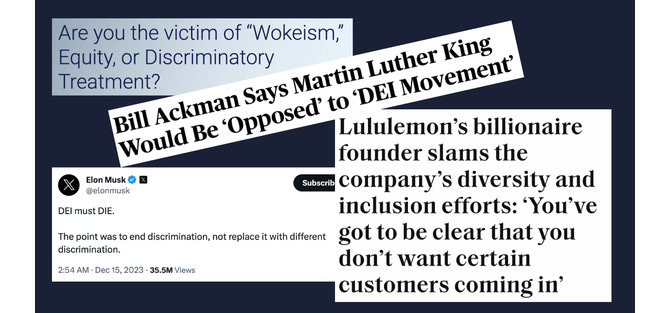
🔥 I hope you can begin to see the contours of DOJ’s broad anti-DEI strategy. All last year, beginning with Trump’s first week in office, the DOJ prepared the foundation for a vast anti-DEI crackdown, which is now underway and going full steam ahead. Best of all, corporate media is uncharacteristically quiet about the whole thing. They know it’s a losing issue.
Actually, the preparations for this massive effort started even before Trump’s first week in office. Over the last few years, the Supreme Court has issued a series of decisions reining in administrative agency powers and, in 2023, declared “affirmative action” to be unconstitutional in college admissions.
Consider that Heritage’s Project 2025 carefully built this strategy during the Biden years. Now it is in play, and the DOJ, in a flurry of furious activity, is actively ripping the DEI thumb from the scales, everywhere: the federal government, state governments, colleges, high schools, public schools, and now private businesses.
All Democrats —who are distracted by dozens of polycrisis problems— seem able to do is hunker down, try to wait it out, and avoid further inflaming an already aggravated public. Our job —yours and mine— is to make sure Republicans cement these changes into permanent law.
Who’s with me?
🔥🔥🔥
Even though I reported this week’s happy news that election reform is still moving forward under Plan B (and through postal service reforms over mail-in ballot handling), the SAVE America Act is not necessarily a dead letter. And the frustrated media doesn’t know whether it’s Plan A, Z, or even a plan at all. Within one 24-hour news cycle, Fox reported, “Trump’s SAVE America Act shows signs of life in the Senate despite Republican revolt.” And then Newsweek reported, “Trump’s SAVE Act plan for midterms is slipping away.”
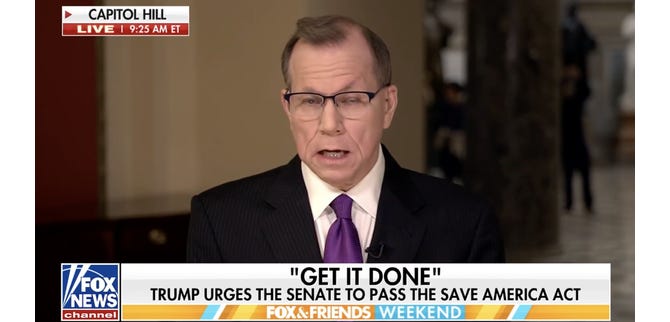
“It will pass,” Senator Mike Lee (R-UT) said on the Senate floor recently. But, “Everybody knows it’s not gonna pass,” Senator Cory Booker (D-NJ) responded to reporters.
Yesterday, President Trump submitted a new $350 billion military funding package that includes the SAVE America Act —it’s baaaack!— which requires proof of citizenship to register and a legitimate photo ID to vote in federal elections. He tweeted that he wants Republicans to pass it, for real this time:
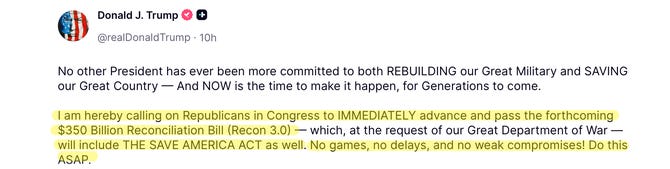
Unless the Senate parliamentarian rules it out of order, a budget reconciliation bill like this can pass with 50 votes instead of 60— entirely bypassing the silent filibuster. It’s up to one unelected parliamentarian and three wayward Republicans.
The Senators must be feeling a sense of deja vu. Just a few days ago, the SAVE America Act failed to pass in a similar budget reconciliation bill, which was aimed at funding ICE and Border Patrol through 2027. Four Republicans defected and joined Democrats in stripping out the SAVE Act. (Though mercifully, the ICE-funding part passed.) Antique Senator Chuck Schumer (D-NY) complained, “Nothing is more important than defeating this dagger to the heart of our democracy. It’s one of the most despicable pieces of legislation I’ve come across.” Cry harder, Chuck.
But despite the SAVE Act failing on Monday, Trump is already ready to try again. Twice in one week. You might call him relentless.
But why? What’s changed? For one thing, the LA mayoral race controversy has platformed one of the most obvious cases of rampant voter fraud, since (allegedly) LA’s homeless, drug-addled Skid Row population voted in greater rates than its productive citizens. Though Spencer Pratt has been robbed of his chance to run against incumbent Karen “Globetrotter” Bass —which nobody denies would at best be a long shot in LA— a furious national conversation is underway, and brand-new political permission structures now suddenly exist that didn’t four days ago,

And so, two days later, the White House is back. The President is seated at the SAVE America table again. The corporate media keeps quoting frantic Democrats who claim the ID requirement is intended to “disenfranchise minority voters”— voters who somehow navigate modern life without driver’s licenses, passports, birth certificates, or other forms of official ID.
Meanwhile, voter ID is another 80/20 issue, with the vast majority of Americans approving.
I don’t know what will happen with the SAVE Act. Nobody does. There is no consensus over whether it’s even possible. Predictions are more harmful than useful. The Newsweek story suggested that, even if it doesn’t pass, since it’s an 80/20 issue, the repeated and highly publicized efforts to push it through can only help Republicans’ midterm strategies.
Which is exactly the kind of strategic ambiguity this White House seems to prefer. Stay tuned.
Have a terrific Thursday! Coffee & Covid shall return tomorrow, with more need-to-know news and caffeinated commentary.
Don’t race off! We cannot do it alone. Consider joining up with C&C to help move the nation’s needle and change minds. I could sure use your help getting the truth out and spreading optimism and hope, if you can:☕ Learn How to Get Involved 🦠




Leave a Reply
You must be logged in to post a comment.