
C&C. INEVITABILITY. The Birthright Opportunity.
July 1 | Posted by mrossol | Childers, Congress, Kavanaugh, Law, SCOTUS| JEFF CHILDERS JUL 1, 2026 |
Where is Congress?? They can fix ‘birthright citizenship’ tomorrow if they had any balls. And sometimes its a bit tricking to try to determine who those b…less congress’people’ might be. mrossol.
🌍🇺🇸 ESSENTIAL NEWS AND COMMENTARY🇺🇸🌍
Last year, on Day One, President Trump signed an executive order limiting birthright citizenship to kids born in the USA to citizens, not illegals or foreign parents just passing through. Democrats sued. The case snaked its way to the Supremes, and yesterday they struck down the executive order in a 6-3 ruling that, being perfectly fair to all sides, was a hot mess. The Washington Post reported, “Trump calls on Congress to end birthright citizenship after court defeat.”
In his scathing dissent, Justice Alito wrote what we are all thinking: “This is one of the most important decisions in the history of the Court, and in my judgment, the Court has made a serious mistake.” Justice Thomas, known for his brevity, landed a massive, novella-length, 91-page dissent, which I believe to be the longest dissent of his extensive career— nearly twice his previous record.
As we dig in, remember this first, important fact: the majority did not change anything. In its dazed and discombobulated way, the majority only affirmed the long-standing logic of its 1898 Wong Kim Ark decision. Justice Roberts, writing for the majority, based the decision on feudal common law, the Court’s repudiation of the notorious Dred Scott decision, the Wong Kim precedent, and what appears to be a dangerous overdose of crazy pills.
And once again, the entire argument revolved around the meaning of simple dictionary words, in this case the 14th Amendment’s phrase “subject to the jurisdiction thereof.” Even more specifically, the word jurisdiction. Though they all delved into the ancient argument’s storied history, the conservatives mostly argued about that definition (with the three female liberal justices cheering on whoever supported automatic citizenship).
Dissenting Justices Thomas and Alito argued that the majority defined the word “jurisdiction” too broadly, erroneously treating it as a synonym for “within our borders.” Roberts shot back that the dissenters were adding requirements into the word —like domicile and allegiance— that aren’t explicitly there.
To give you a taste, Justice Thomas made this common-sense argument about the definition: “The country had just emerged from a civil war that cost the lives of over 600,000 men due to a treasonous denial of allegiance to the Union. Going forward, there would be no national citizenship absent a reasonable expectation of national allegiance.”
Different verse, same as the first. The country’s whole constitutional order apparently hinges on whether nine lawyers can agree on what an ordinary English word meant in 1868.

🔥 But this also reveals the silver thread in the septic tank. The Constitution gives one particular branch of the Federal government the authority to define jurisdictional limits in nearly every situation. Guess which branch? Congress.
As a general constitutional matter, Congress holds the primary power to define the scope of U.S. jurisdiction in nearly every domain. Article I gives Congress power to “establish a uniform Rule of Naturalization”— the citizenship-adjacent power. Congress defines which courts have jurisdiction over what issues. Congress defines who is subject to the draft, who must file taxes, and who is subject to U.S. criminal law abroad.
The executive enforces jurisdiction; the judiciary interprets it; but Congress draws the lines.
In a special concurrence, Justice Kavanaugh joined the majority— but for his different reasons. His reason was a blueprint. A strategic, clever blueprint for Congress. Here’s Kavanaugh’s nut graf:
“The Constitution’s Citizenship Clause may well be ambiguous on this precise question. But Congress resolved that ambiguity by codifying birthright citizenship broadly in 8 U.S.C. §1401(a). The executive order doesn’t violate the Constitution — it violates Congress’s statute. And Congress can change that statute.”
While Roberts’ majority opinion was a constitutional argument, Kavanaugh said no, there’s a deeper issue, one that relies on a statute. Get that? President Trump did. He practically heard Kavanaugh yelling through a bullhorn. As WaPo’s subheadline said, “The president asserted that lawmakers could ‘easily’ address the issue through legislation, defying years of congressional stalemates over immigration.”
This time, legislators can’t drag their feet claiming that Trump is asking them to do something unconstitutional, because Kavanaugh just green-lit it. They can’t complain it isn’t urgent, because Alito, Thomas, and Gorsuch called it critically important in their dissents. Half of the conservative justices would have supported Trump’s order, with one explaining how Congress can fix it.
That’s silver lining number one, the signal in the noise. Combine that with the original mitigation that SCOTUS did not do anything new or crazy. It conservatively hewed to precedent, as most people predicted it would. Nothing was changed or taken away. But three heartily endorsed Trump’s executive order, and Kavanaugh added a fix.
Dissents and concurrences are not binding or precedent, but they still matter. Recall, for example, that Southern District Judge Aileen Cannon dismissed Trump’s classified records case, relying on legal logic that Justice Thomas supplied in his concurrence in the unrelated presidential immunity case.

🔥 Now, just for fun, let’s revisit some of the political schizophrenia of the birthright issue. It has defied partisan definition over the years, with the politics flip-flopping like a gaffed salmon. In 2026, corporate media claims birth tourism practically doesn’t exist. But as recently as 2018, corporate media was complaining about birth tourism. Behold this astonishing NBC headline, from January 2018:

I will leave it to the comments to speculate why corporate media complains so loudly about Russian birth tourists but not Chinese ones. Which is not to say Chinese birth tourists are completely invisible. Headline from the Wall Street Journal, December 2025:

Also in 2018, corporate media was able to remember how Senate Majority Leader “Dingy Harry” Reid (D-NV) had in 1993 advanced a bill to outlaw birthright citizenship. Washington Post, October 2018:
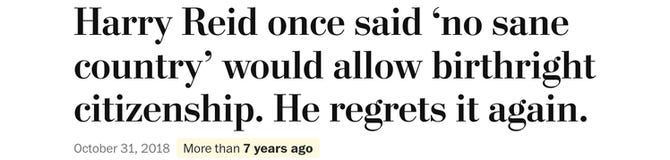
Isn’t it weird how corporate media has utterly failed to mention Harry Reid’s fascinating historical nugget? That time when Democrats opposed birthright citizenship?
Reid’s bill’s language was precise, legally sophisticated, and absolutely damning. It tracked the exact same jurisdictional argument that Thomas and Alito would make 33 years later, and is basically everything Kavanaugh suggested Congress could legally apply.
Here’s what the Democrats’ own bill said, back in 1993:
“Any person born after the date of enactment of this title to a mother who is neither a citizen of the United States nor admitted to the United States as a lawful permanent resident… shall be considered as born subject to the jurisdiction of that foreign country and not subject to the jurisdiction of the United States within the meaning of Section 1 of the 14th Amendment and shall therefore not be a citizen of the United States.”
You guys following me? All Republicans need to do now is reintroduce the same Democrat-written bill that was never defeated but quietly expired in committee in 1993.
🔥 Well, guess what happened late yesterday? Senator Bernie Moreno (R-OH) said he will reintroduce Reid’s 1993 bill:
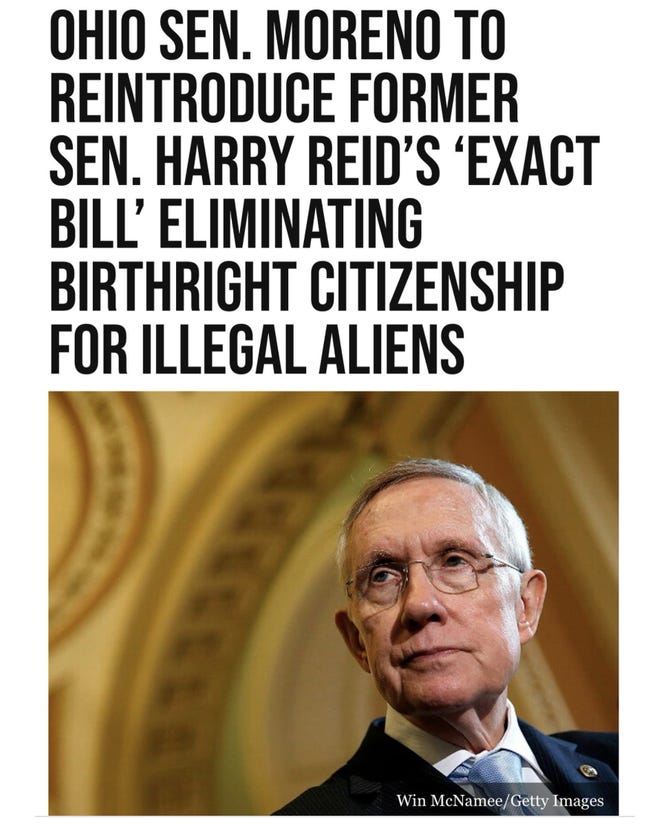
“Before far-left radicals took over the Democrat Party, their leader, Harry Reid, introduced a great bill to end birthright citizenship, ensure no illegals could abuse our system, and protect American sovereignty.” He added, “If it was good enough for Democrat leader Sen. Harry Reid, it should be good enough for all Democrats,” Moreno tweeted. “Let’s roll. 🇺🇸🇺🇸”
That’s not all. As if primed and ready to go, the DOJ issued new orders to all districts yesterday, prioritizing prosecution of birth tourism, which is already illegal under federal law. This morning, USA Today reported, “Trump’s DOJ takes aim at ‘birth tourism in wake of birthright ruling.”

Colin McDonald, a senior DOJ official, reminded agency employees in a directive that people who come to the United States under “false pretenses” to give birth and secure citizenship for their child could be criminally charged under laws barring visa fraud, money laundering, identity theft and wire fraud.
That was fast.
🔥 The debate isn’t new. It has been raging ever since Wong Kim Ark.

The whole birthright citizenship issue is itself a hot mess, stuffed inside a burning dumpster out back of a fireworks factory. And yesterday, that burning dumpster exploded onto social media with blackpilling and dark accusations of betrayal.
As an aside, this exact same reaction pattern happens every single time. It is nothing but destructive for conservatives to howl for civil war every time something seems to fall short of an absolute victory. Personally, I am convinced this is a psyop run by Democrats, and they will keep on doing it so long as it keeps working. But I digress.
I’ll offer one more silver lining. Before 2026, birthright citizenship was a wonky, fringe argument that had not captured the American public’s attention. Now the issue is all over social media. For the first time since 1898, the public is engaged.
Before this case: the executive order was blocked by every lower court, the constitutional question was treated as settled, and the political consensus was that any challenge was frivolous.
After this case: the three smartest justices wrote at length —91 pages in Thomas’s case— laying out a fully developed alternative constitutional framework and calling birthright citizenship the Supreme Court’s “most important issue.” Kavanaugh supplied a roadmap for Congress. A Republican senator introduced the Dingy Harry bill within hours of the ruling. The DOJ platformed investigations into birth tourism fraud.
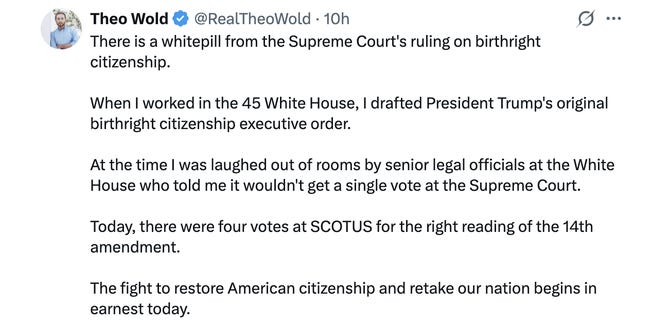
The question is now officially unsettled in the minds of four members of the Court’s majority. As Special Assistant to the President during Trump 1.0, Theo Wold drafted the original executive order on birthright citizenship, which was never signed. Like me, Theo encourages taking a broader perspective:
Not just Theo. Conservative columnist Kurt Schlichter, writing for Townhall, also advised stepping back from the blackpill precipice:
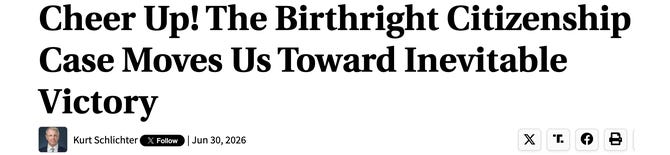
If you view the Trump v. Barbara decision in absolute, one-and-done terms, then it was a stinging loss. But if you see it as a step forward, a necessary, stepwise increment toward reversing a schizophrenic, controversial, 128-year-old law —the long way, just as Roe v. Wade was reversed— then it is a real win. And you don’t even have to stretch to find it.
Let Congress do its job. Yesterday’s decision provided another good reason to end the silly silent filibuster. It’s time to get to work.
Have a wonderful Wednesday! Tomorrow, we will round up all the other great and fascinating essential news that the Supreme Court has eclipsed this week, along with extra caffeinated commentary. Don’t miss it.




Leave a Reply
You must be logged in to post a comment.