
C&C. SPRINT TO THE BAR-CODES. H-1B Fee. Public Ed Unconstitutional?
August 25 | Posted by mrossol | American Thought, Childers, Education, Illegal Aliens, Immigration, SCOTUS, US Constitution| JEFF CHILDERSAUG 25 |
Good morning, C&C, it’s Tuesday! Your roundup includes: how nine blue states and the ACLU sprinted to the Supreme Court to stop an envelope, and lost 6-3 in a ten-page order that dropped after quitting time; the barcode the Postal Service will print on that envelope, which requires the states to produce a list of their eligible voters, a request they are treating roughly the way a teenager treats “let me see your phone”; the 200,000 visitors who came for the long weekend and stayed for the asylum hearing, now getting the largest mass visa revocation in American history; the H-1B application fee going from $2,300 to $103,265, which is either an outrage or the going rate for an American job, depending on who signs your paycheck; and the Washington Post — the paper that has never met a school-choice argument it wouldn’t strangle in the second paragraph — running a Heritage fellow’s case that public schools are unconstitutional, un-rebutted, above a comment section that currently reads like a Thanksgiving table with an open bar.
🌍🇺🇸 ESSENTIAL NEWS AND COMMENTARY 🇺🇸🌍
🗳️🗳️🗳️
It’s go time! This week brings a high-drama election-integrity Derecho, with a loudly ticking clock counting down to a critical deadline, a flurry of high-speed litigation erupting across the country, a Supreme Court emergency-order merry-go-round in a courtroom tornado, and the highest stakes for America since the November 2024 election. With barely over two months to go before this November’s elections, yesterday, the New York Times reported, “Supreme Court Allows Trump to Pursue Mail Voting Limits, for Now.” It was one of several alarmed articles published the same day on a topic the Times has largely ignored.
Strip away the apocalyptic rhetoric, and the immediate controversy is a proposed Postal Service rule establishing a uniform national standard for official mail-ballot envelopes. You couldn’t imagine a less interesting-sounding topic. But Democrats are now suddenly treating the Ballot Envelope Standards as an existential federal takeover of state elections. So.
Late yesterday —after 5pm— the full U.S. Supreme Court issued a 10-page emergency order overriding a federal district judge along party lines (6-3). The order allows President Trump’s preliminary envelope standards to move forward— for now. (The Times correctly applyied “for now” in this instance, since this time the Court explicitly said it would review any final rules later.)
The Big Blue Response rocketed, pinball-like, between fury, hysteria, and clinical depression. New York Attorney General Letitia James, who leads the resisting blue states, croaked that SCOTUS’s emergency ruling was a “painful setback.” But she vowed to soldier on after checking on her rental units. She said only, “We are exploring our legal options.” (Letitia didn’t explain where she’ll go from the nation’s highest court.)
Meanwhile, the blue states’ legal team, plus the American Civil Liberties Union, dramatically called the Ballot Envelope Standards an “attempt to seize control of election rules from the states and Congress” that was “clearly unconstitutional and unlawful.”
🗳️ You’d think mind-numbing Ballot Envelope Standards would be the lastthing liberals would worry about this month, given the Iran War, the Canada Trade War, the DSA civil war, and the outbreak of ugly transphobia among Women’s NBA league fans. Beyond various misleading paraphrases, the Times never actually described the new envelope standards. But here’s a one-page summary that I came up with. It’s not complicated:
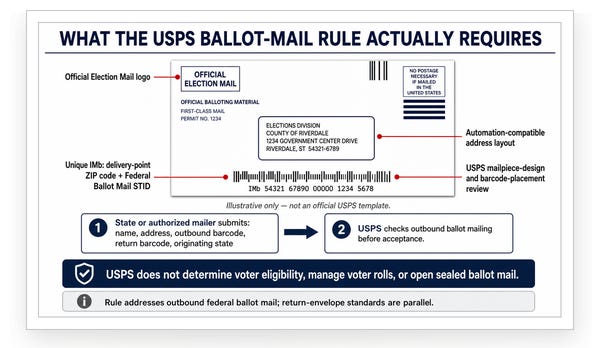
At bottom, the Ballot Envelope Standard is simple: USPS won’t pick it up till the envelope matches the form. That’s it. That’s the rule. If you shove your mail-in ballot in a Wild Berry Doritos bag and duct tape it shut, the mailman will just leave it in your mailbox, even if you shook most of the crumbs out.
That, apparently, is earth-shattering.
The controversy swirls around that mandatory barcode. The USPS rule requires a unique USPS-issued barcode to be printed on every ballot envelope. The barcode can only be issued for confirmed U.S. citizens, and enables tracking the envelope’s postal journey from the Supervisor of Elections’ office to its arrival at the voter’s address, then again for its return trip to the counting center, leaving little wiggle room for ‘accidents’ or ‘misunderstandings.’
That damnable barcode! Under the rule, states would electronically request the barcodes, and the USPS would confirm each request against a list of confirmed eligible voters provided by the states themselves. The final rule calls it the Mail-In and Absentee Participation List, which sounds perfectly uncontroversial, except that it threatens to collapse the house of fraud.
Behold, the problem: For various and sundry stated reasons, the blue states do not want to provide lists of their eligible voters. Some people think the real reason is that the blue states cannot cough up eligible voter lists.
The laundry list of blue-state stated complaints is, well, long. There isn’t one single issue. The Times (falsely) complained it “directed the U.S. Postal Service to help decide which voters should receive mail-in ballots.” (All states have to do is put voters on the list.) The plaintiff states griped that the envelope standard risks “erroneous exclusion,” imposes immediate “logistical burdens,” and invades state jurisdiction over voter registration and ballot-distribution systems. Whew.
🗳️ The Times went so far as to describe it as nefarious blackmail. It warned darkly that “the Postal Service said that it would not deliver mail ballots in states that do not share voter data with the federal agency.” In the Times’ view, if states won’t “share their voter data,” the Postal Service will automatically fold, bend, spindle, and perforate the ballots.
That was a Times paraphrase, not a quote of the actual rules or even anything any named official said. “The Postal Service said”— classic journalistic ventriloquism. (Portlanders: USPS can’t actually talk. It’s an agency.) But, contrary to the Times’ description, the final rule does notannounce a state-by-state ballot-delivery embargo.
It just sets conditions for accepting ballot mail, provided only that the envelopes comply with USPS standards.
As if that weren’t enough high drama, on August 21st —three days before the decision— the USPS did issue its final rule package. But the injunction the Supreme Court just vacated was issued before that, based on the preliminary rule. So, the Court reasoned, Judge Indira Talwani based her injunction on a preliminary, ‘hypothetical’ rule, which is not allowed:
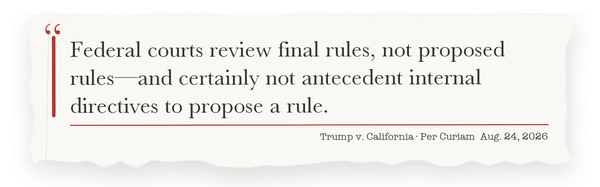
So in essence, SCOTUS said come back if the final rule harms you— even though the final rule had already been published at the time. It just wasn’t part of this case. Which must have been keenly frustrating for the suing blue states. Now they have to start over, and the clock is ticking louder than ever.
Blue states must now weigh whether to comply by providing the government with their confirmed voter lists for now, or continue to refuse, raising the possibility that they won’t have the barcodes needed to make compliant envelopes in time for the midterms.
🗳️ What has most gotten everyone so exercised at this particular point is something called the Purcell rule. It is a Supreme Court doctrine holding that courts should refrain from tinkering with election laws right before elections, because late changes can create chaos. In short, the Supreme Court could—but does not have to— defer ruling, keep the USPS rule for the midterm elections, and punt any final decision until afterward.
Which would mean the blue states would be required to hand over their confirmed voter lists, a prospect they seem to view as catastrophic. They don’t want to let the list out of the bag.
🗳️ In her stinging dissent, Justice Ketanji Brown Jackson cried that the majority “needlessly injects chaos and uncertainty into the upcoming midterm elections.” The next round of arguments when the case comes back will inevitably include whether applying Purcell would increase or reduce “chaos and uncertainty.”
Further muddying the electoral waters is that there is another Talwani injunction percolating toward SCOTUS that stops parts of the Envelope Standard— which the Times noted may also be rapidly headed for the Supreme Court. Yesterday’s decision suggests the Court would vacate that one, too.
Late last night, right after the new decision came down, the Trump Administration filed an emergency motion asking Judge Talwani to lift that other injunction based on the Supreme Court’s decision on her first one. If she refuses— back to SCOTUS.
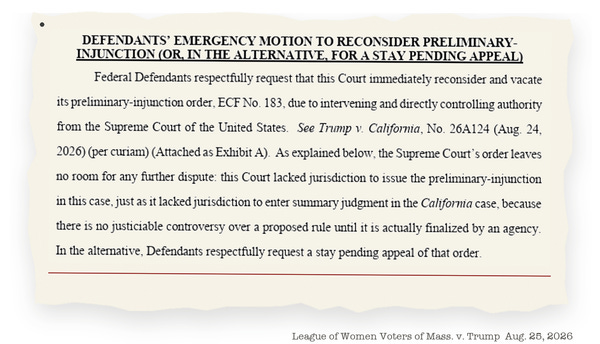
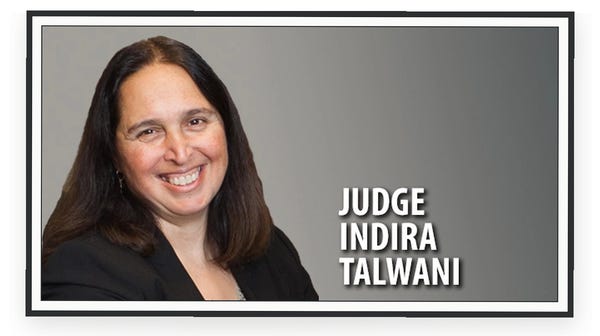
My bet is that Judge Talwani will vacate her earlier injunction, but then issue a whole new injunction, this one properly based on the August 21st Final Rule. And then the dispute will be right back at SCOTUS for more emergency review. The Supremes will then be required to consider the merits. Meanwhile, the midterms are rolling toward us like a high-speed train in China (not California).
I’ve previously argued that the theatrical drama over the SAVE America Act was largely a distraction— a Senate blockade and a head fake that gave Democrats a false sense of midterm security. The real action, I said, was always with this quiet Ballot Envelope Standard, which threatened to upend the blue states’ mail-in ballot strategy and ensure only citizens with confirmed addresses can vote by mail.
Just like that, nobody’s talking about the SAVE Act anymore. Now we have emergency Supreme Court litigation, a slate of competing injunctions, and a rapidly approaching election deadline— ironically, the very chaos Democrats keep saying they are trying to avoid.
Hang onto your hats and get your barcodes ready. This one is going down to the wire.
🔥🔥🔥
At the intersection of election chaos street and mass deportation avenue, yesterday Axios reported, “Trump administration to revoke up to 200,000 visas of asylum seekers.” Ruh roh! Once again, the Administration is doing stuff that nobody does.
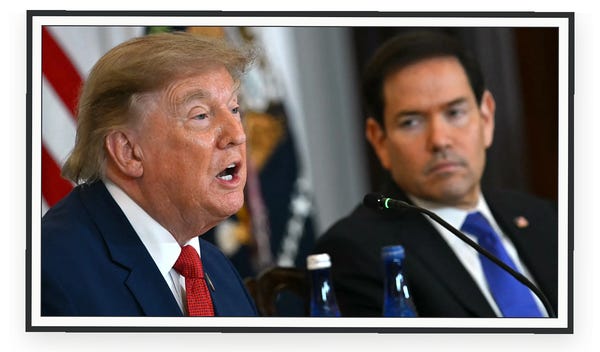
The Trump administration plans to revoke up to 200,000 business and tourist visas held by people who originally entered the United States as short-term visitors and later claimed asylum. 200,000 is a lot. Axios reported that, if carried out at that scale, it would be the largest mass visa revocation in U.S. history.
Yesterday, U.S. Deputy Secretary of State Christopher Landau tweeted that the American immigration system “has long been swamped by frivolous asylum claims.” That is true. Activists do not disagree, but they complain the visa crackdown has violated free speech and due process rights and created an unsafe environment, particularly for ethnic minorities like Somalians, who have “raised concerns” about racial profiling.
Racism! Xenophobia! How would we run a country without constant vigilance against isms and phobias? But I digress.
Under the newly proposed plan, the State Department will revoke so-called B1 and B2 visas issued between 2016 and 2026 whose holders have sought or are now seeking asylum, an AP report explained.
Axios, pressing the limits of its intellectual capabilities, predicted this is “likely to face legal challenges.” No duh. We’ll have to wait and see whether the court system authorizes the State Department to void visas in bulk rather than one by one, despite the Executive Branch’s broad constitutional and statutory authority over immigration enforcement.
Either way, chalk up another record-setting move by the Trump Administration. That’s not all.
🔥🔥🔥
Speaking of historic and unprecedented immigration enforcement, yesterday the Wall Street Journal reported, “Government Proposes New Six-Figure Fee for H1-B Visas.” It’s round two. TAW.
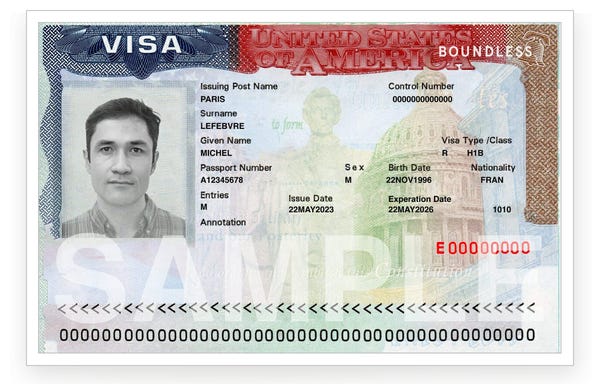
Last year, the Trump Administration passed a one-year-only fee for new H-1B visa applications. H-1Bs are the much-criticized visa that allows tech companies and universities to hire foreign workers at cheaper salaries than American workers and under rules that amount to indentured servitude. A Boston federal court struck down Trump’s fee not because it was illegal but because the State Department didn’t follow the proper process.
Now the State Department is back, this time following the procedure that the Boston judge said it had to, and this time with a higher fee that covers all H-1B visas, rather than just new ones. For example, the prior rule would have exempted foreigners already in the U.S. on prior H-1Bs or student visas. Last year’s rule also exempted universities, hospitals, NGOs, and other ‘nonprofits.’
This one doesn’t. Nor does it end in one year. Be careful what you wish for. The Journal noted that the Administration is also considering attaching a $100,000 fee to ‘optional practical training,’ or OPT, a similar program that allows international students to work while here on their student visas.
Specifically, any employer applying for an H-1B visa, whether the employee is here or abroad, whether it’s a new visa or a renewal of an existing one, would have to pay a fee of $103,265. For comparison, the existing fee is around $2,300. The new fee would go a long way toward eliminating the cost advantage of hiring a foreign worker over an American.
President Trump has pointed out that, if the need is truly urgent, employers should be happy to pay the higher fees, which will fund immigration enforcement.
Like I keep saying, when the courts close a door, the president opens the garage.
🔥🔥🔥
Finally, what might be the week’s most interesting story. This morning the Washington Post —the paper where Democracy is Perpetually Dying in Darkness— published an op-ed arguing that the American public school system is unconstitutional. It was titled, “Are public schools unconstitutional? A Nebraska court will decide.” The subheadline added, “The challenge to compulsory education combined with public-school-only funding could lead to universal school choice.”
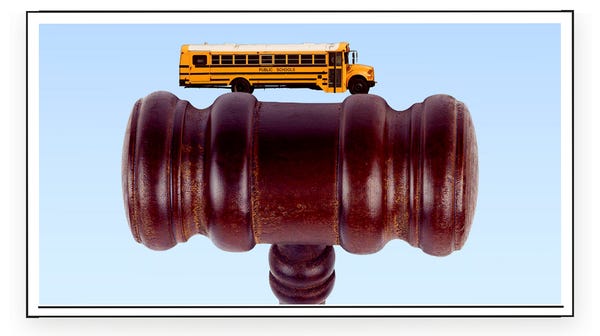
WaPo did not run it as a curiosity. They did not run it under one of those headlines where the question mark is applied as a disclaimer, and the first paragraph quietly strangles the premise. They ran it straight on their own opinion page, with an illustration commissioned by their own art department for the occasion.
The byline is Corey DeAngelis, described by the Post as “a research fellow at the Heritage Foundation and a senior fellow at Americans for Fair Treatment.” So: the Washington Post just handed the top of its opinion page to a Heritage fellow to argue that public schools violate the First Amendment, and —so far as I could find— ran no counterpoint alongside it.
Now, I have been struggling to read this newspaper for a long time, mostly for the same reason people slow down for highway accidents. Two years ago this piece would never have seen print there. Two years ago, at best, this piece would have been a fundraising email that the Post writes an article about, in the same wacky tone you’d reserve for a story about a raccoon invading a daycare.
Let’s discuss what’s actually in the lawsuit, what happens to the country if it wins, why it could easily lose (and why it still matters), and what the Post’s own readers did to the comment section, which currently resembles a Waffle House riot at 3 a.m.
🗳️ On August 13th, the New Civil Liberties Alliance filed Jacobsen v. Spellerberg in Lancaster County District Court in Nebraska. The plaintiffs are two families in the Lincoln Public Schools district: Justin Jacobsen, and Timothy and Joanna Menter. The defendants are a nine-headed hydra of Nebraska agencies— the State Treasurer, the Commissioner of Education, the president of the State Board of Education, the Attorney General, the Lancaster County Treasurer, the president of the Lincoln school board, the City of Lincoln, Lancaster County, and Lincoln Public Schools itself.
The complaint was not coy. Paragraph one began, “Formal education occurs through speech.” NCLA is not a bit player. This is the conservative legal team that won Relentless —the companion case that killed Chevron alongside Loper Bright— and Garland v. Cargill (a Second Amendment ‘bump stock’ case). They are a repeat player before the Supreme’s bench, and repeat players happily file the first version of a lawsuit even knowing it’s a dead loser— because somebody has to start somewhere.
I pulled the 34-page complaint and read it before dawn, with great interest, which is the kind of thing that happens to a man who went to law school and never fully recovered. Paragraph 78 alleges that Lincoln Public Schools produced a sticker “endorsing alternative sexuality and transgendered ideologies” that was “prominently displayed on many classroom doors”— i.e., not just a rogue teacher, but an official all-district product.
Then, a school librarian recommended one of the Menter kids check out some great books promoting transgender ideology. The Jacobsen family alleges one of their daughters was told she must accommodate biological males in the girls’ bathroom and locker room, and could simply remove herself from those spaces if the arrangement made her uncomfortable— which is a ‘solution’ in roughly the way that moving to Canada is a solution to your neighbor’s barking dog.
And then there was paragraph 84, perhaps the worst of all, and it made me ask myself just what in Hades is happening in Nebraska:
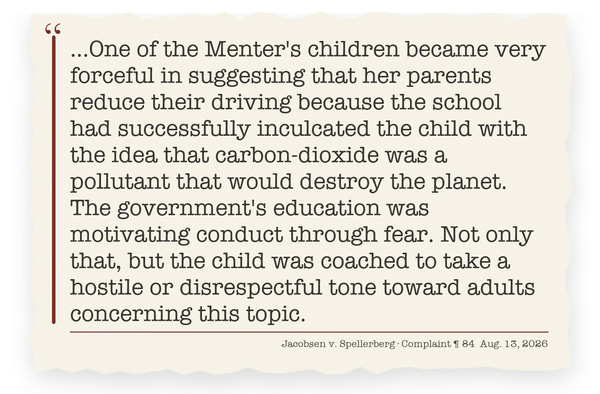
In other words, a Nebraska elementary school taught a little girl that the family car was killing the planet, and —this is the part the NCLA lawyers underlined in their complaint— taught the little girl how to talk to her parents about it: Rudely.
Both families pulled their kids out. The Menters homeschool now. The Jacobsens homeschool one, send two to a private elementary school, and still have one in a Lincoln public high school, which tells you these are not homeschool zealots— they’re people who tried the government product and are now doing triage.
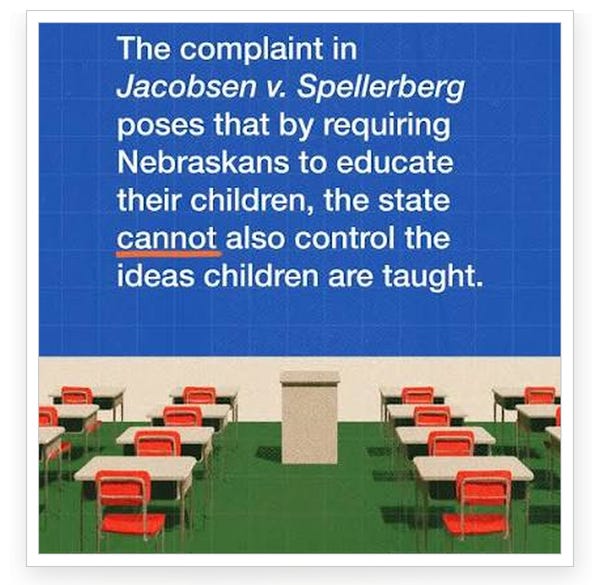
🔥 The complaint’s legal theory, as I understand it, is simple enough that even I can explain it, which should worry the state. Like most states, Nebraska requires you to educate your child. If you do not, you can get a Class III misdemeanor, which isn’t exactly the death penalty, but includes up to a year in jail. Then Nebraska offers you more than $19,000 a year to provide the educating, but only if the child sits in a government building and hears the government lesson.
If you would prefer a different lesson, you may have one. You just have to pay for it yourself, after you have already paid for the first one in your property taxes. This is what we lawyers call an “unconstitutional condition.” You might call it “the printer-ink model of citizenship.” The printer is ‘free’— but you have to use their ink cartridges.
The two Lincoln families got tired of this arrangement, especially in light of the rudeness lessons, and sued. They are not asking the judge to lock up the school and give the band uniforms to a charter. They are asking him to admit that a “free” education —only free when you accept the official viewpoint— is not, technically, free. They would also like a check for the per-pupil amount until the kids turn 19, which is a very polite way of saying, “You already collected the money. We would like the education it was collected for.”
If they win, Nebraska will have to stop pretending the public school is a public utility, and start treating it like a restaurant. You may still eat there. You may even like the dill fries. You just cannot be arrested for cooking at home, and you cannot be charged twice for the same Nashville hot chicken sandwich.
If this educational earthquake strikes Nebraska, other states will notice. Teachers’ unions will issue a statement saying this is the end of democracy, the way they do whenever the faculty lounge copier jams. Rural districts will say they cannot run a football team if the money can leave. That may be true. It is also how every other monopoly talks when the customers discover competition.
Nebraska is a curious place for this war to break out. It is the state that once tried to ban the teaching of German and lost in the Supreme Court. A hundred years later they are in court again, not for banning a language, but for making the alternative so expensive that only a stubborn parent would try it.
WaPo reader comments were hysterical. One blurted, “The heritage foundation wants to destroy the public school system.” (So far as I could tell, Heritage as an organization was not on the scene.) Reader Herman Mays quipped, “The post and Bezos have really gone overboard in bowing to the right on these opinion pieces.” (So much for Free Speech.) Another insisted that Republicans want “the sort of freedom which undermines, in a small way, what binds us together into a nation.” Meaning, the taxes that bind.
🔥 To say the lawsuit faces steep odds is an understatement. One bad omen is that there are several older Supreme Court cases —from the 1980’s through 2020— that basically say that, while the government can’t force you to engage in unwanted speech, it also doesn’t have to subsidize your preferred speech. That’s a problem. But more encouragingly, last June, in Mahmoud v. Taylor, the Court held 6-3 that a Maryland district burdened parents’ free exercise (of religion) by refusing opt-outs from storybook instruction.
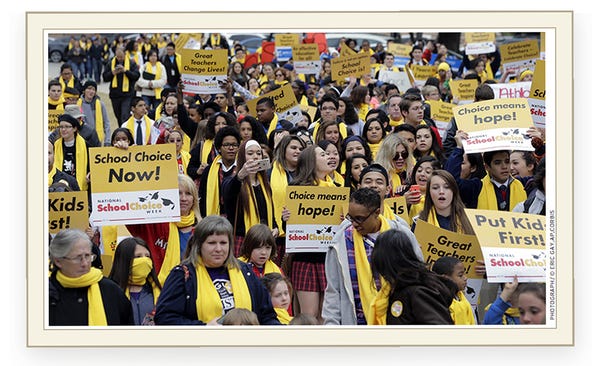
Mahmoud v. Taylor is the tiny crack in the schoolhouse door the NLCA is surely relying on. Free exercise is different from free speech, but not sodifferent. The Lincoln case faces other problems, like a Nebraska state constitutional provision that bars the state from providing funds to any non-government school, regardless of religious or ideological persuasion. So: tough legal sledding.
But public sentiment seems to be shifting about public education. (I wonder whether the pandemic had anything to do with it?) If the court agrees with the NCLA’s straightforward argument, Nebraska will have to start paying public-school funds back to private and home-school parents. This isn’t a completely crazy idea.
Three years back, Florida already did it.
Since 2023, whenever Florida parents choose to keep their kids out of government classrooms, the state does not label that “tough luck.” It floats the parent a scholarship through a raft of state-sponsored options. Private-school families use the Florida Tax Credit Scholarship or the Family Empowerment Scholarship for Educational Options. Homeschool and other parent-directed families use the Personalized Education Program, an education savings account under the tax-credit program with no income cap, to cover curriculum, tutoring, part-time tuition, and other items on the approved list.
Step Up For Students puts the average at about $8,000 per child for 2026-27. The legislature sets the number every year by county and grade. Here in Alachua County, it is $8,320 for K-3, $7,736 for 4-8, and $7,545 for 9-12. PEP can fund up to 140,000 students this year. That is not the full public-school pile. But it is also not a misdemeanor with a sarcastic sneer.
Meanwhile, Nebraska spends more than $19,000 on each child who sits in the approved building and zero on the child who does not. Florida spends less, and the money can leave the building. In Florida, it is a scholarship. In Nebraska, it’s a lawsuit.
🔥 Whatever the Nebraska lawsuit’s chance of winning might be— that is not the real story.
The real story is that the Washington Post published it straight. No rebuttal. No hand-wringing sidebar from an education professor. No headline hedging. A Heritage fellow was given the floor and made the case that the public school system violates the First Amendment, in the paper that considers itself the last lamp in the republic— and the only pushback came from the comment section, where it was enthusiastically delivered by scores of unpaid and poorly informed amateurs.
Two years ago this argument was fringe. This morning it’s an op-ed. That doesn’t mean it wins in Lancaster County. It means the fight has moved, and the people who spent forty years assuming the ground under public education was bedrock have just watched a national newspaper describe it as an open question.
Somebody slapped a rainbow sticker on a classroom door in Lincoln, Nebraska. Two families read it, did the arithmetic, paid the exit fee, and hired a Supreme Court litigation shop. I don’t want to oversell this, but as a daily culture researcher, I’d say the ice below public education is getting very thin.
Have a terrific Tuesday! Return tomorrow morning, for more essential news and caffeinated commentary.




Leave a Reply
You must be logged in to post a comment.