
Left Will Push For Mandatory Adult MMR Vaccination Due to Age-Shifting of Measles Case Occurrence Caused By the MMR Vaccination Program
November 17 | Posted by mrossol | CDC NIH, Mandates, Medicine, The Left, VaccineThe data are clear: Adult cases are predominating and infants are at higher risk in vaccinated mothers. The Left will push for mandatory adult MMR vaccination. Share this article.
| JAMES LYONS-WEILER, PHD NOV 17, 2026 |
By November 12, 2026, adults aged twenty or older accounted for 41.4% of confirmed U.S. cases and 56.2% of recorded hospitalizations. How can mandating school-aged children to take the MMR help if the majority of cases are in the adults? How is that ethical?
Are elected officials ready to mandate MMR vaccination for themselves?
We saw this coming and warned you about this. Asymptomatic transmission, lack of sterilizing immunity, mandates for adults. It’s COVID all over again. Data show Infants of vaccinated breastfeeding mothers are at 4 times the risk of measles infection if exposed compared to unvaccinated mothers who breastfeed. We bring the data. You share the article.
Popular Rationalism • November 17, 2026 • @James Lyons-Weiler
Roll Up Your Sleeve, Adult Americans
In the United States before routine measles immunization, exposure was nearly universal during childhood. By adulthood, nearly everyone had already experienced infection. Mothers, all of whom had natural measles immunity, passed protective passive immunity on to their children during breastfeeding.
Measles vaccination, introduced in 1963 and subsequently delivered through monovalent products, measles-mumps-rubella (MMR), and measles-mumps-rubella-varicella (MMRV) vaccines, changed both the number of infections and the ages at which susceptible people remain. That change is an observable reorganization of the population, not a mathematical artifact. We can distinguish the observation from the mechanisms that produced it.
An original CDC comparison is particularly instructive. In five U.S. reporting areas, persons aged 15 and older accounted for 3.4% of reported measles cases in 1960–1964 and 13.6% in 1971–1975. During the same periods, the CDC-reported measles case rate for this age group declined from 50.1 to 19.2 per 100,000. Adult representation increased fourfold while adult incidence declined by 61.7%. The 1960–1964 period straddles the introduction of vaccine in 1963; these are early historical comparison data, not an untouched pre-vaccine cohort. [1]
The adult share remained prominent in later surveillance: 21.3% among known-age cases in 1985–1995 using an age-20 cutoff, 29.5% in 1993–1995, and 33.4% among reported cases in 2001–2022. In 2026, adults aged 20 and older accounted for 2,240 of 5,412 U.S. cases through November 12, or 41.4%. That is the largest modern annual U.S. measles total since 1991, but the fraction is not an incidence rate. [2–5]
An adult case share can increase even as adult risk declines. It can also change rapidly when a large outbreak occurs in a community whose age composition differs from that of an earlier outbreak. Neither observation establishes the fraction of adult susceptibility caused by vaccine waning. The article therefore asks three separate questions: what changed in the age distribution, which biological mechanisms can explain it, and whether the change alters age-specific clinical outcomes.
The historical comparison
The CDC already recognized this problem in 1977. Its report noted a shift toward older age groups and, in the same discussion, reported lower measles incidence in every age group than in the early 1960s. The greatest reductions appeared among children aged one to nine years. This is the decisive distinction between compositional redistribution and increased individual risk. [1]
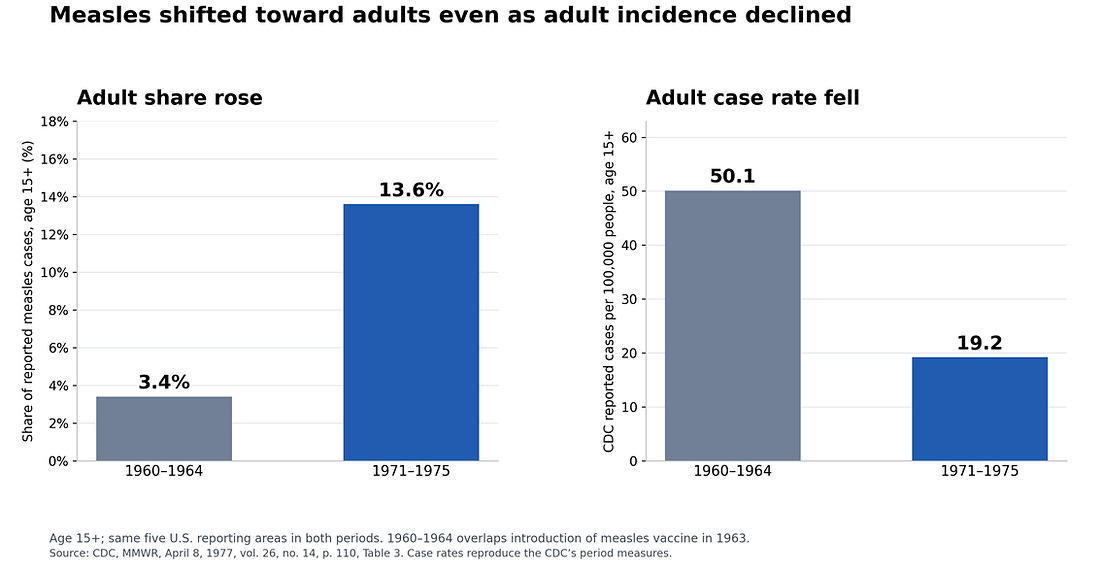
Figure 1. CDC surveillance in the same five reporting areas compared 1960–1964 with 1971–1975. People aged 15 or older increased from 3.4% to 13.6% of reported cases, while the reported case rate for that age group fell from 50.1 to 19.2 per 100,000 (61.7% lower). The areas were New York City; Illinois excluding Chicago; Chicago; Massachusetts; and the District of Columbia. The first period overlaps measles vaccine introduction in 1963. The CDC presented rates for the two multiyear periods; the columns are neither annual incidence estimates nor a national sample. Source: CDC, MMWR, April 8, 1977, Table 3. [1]
The same 1977 report recorded age-15-and-older shares of 10.3%, 13.5%, and 16.1% for 1973, 1974, and 1975. Those observations concern cases whose ages were known. Age was missing for 42.6%, 34.5%, and 37.2% of reported cases, respectively. The results could be biased if age missingness related to age itself, reporting geography, or outbreak setting. They should be read as historical surveillance observations, not high-precision national estimates. [1]
Miller and colleagues studied 75,204 U.S. cases of known age during 1985–1995. Adults older than 19 years represented 16,006 cases (21.3%), rising to 467 of 1,584 (29.5%) in 1993–1995. Yet incidence declined in all age groups, and the rate in persons younger than 19 was 9.6 times that in adults during the overall interval. Of 11,520 adult cases with a reported vaccination history, 8,055 (69.9%) had no prior measles vaccination. These data establish a substantial unvaccinated component of adult disease, not a numerical estimate of waning-induced adult susceptibility. [3]
Different surveillance windows cannot be plotted as independent consecutive annual observations. Clemmons and colleagues counted 809 adults aged 18 or older among 1,789 U.S.-resident cases in 2001–2015 (45.2%). Leung and colleagues counted 1,355 cases aged 20 or older among 4,056 cases in 2001–2022 (33.4%). The figures overlap chronologically but use different age cutoffs and inclusion definitions. They do not establish a fall from 45.2% to 33.4% or a monotonic national trajectory. [4,5]
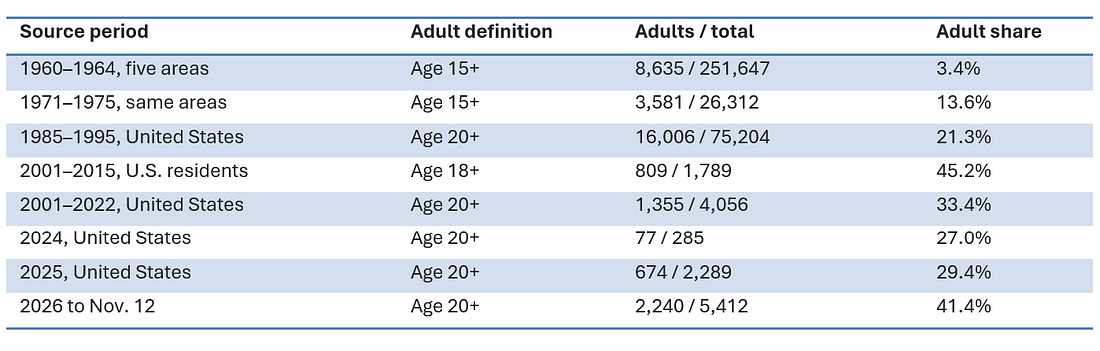
Table 1. Distinct, overlapping surveillance populations and age definitions. The 1960s–1970s comparison uses five reporting areas; contemporary CDC counts include reported U.S. cases, including international visitors. The 2001–2015 study restricted its analysis to residents. These rows are not an evenly sampled time series. Sources: [1–5].
Note the data points during the so-called “elimination period: From 2001–2015, U.S. residents especially: Age 18+ (809/1,789) 45.2%, and 2001–2022, United States Age 20+ (1,355/4,056) 33.4%, 2024, United States, Age 20+ 77/285, 27.0% 2025, United States, Age 20+ (674/2,289), 29.4%.
There was no “elimination period”. But we know that.
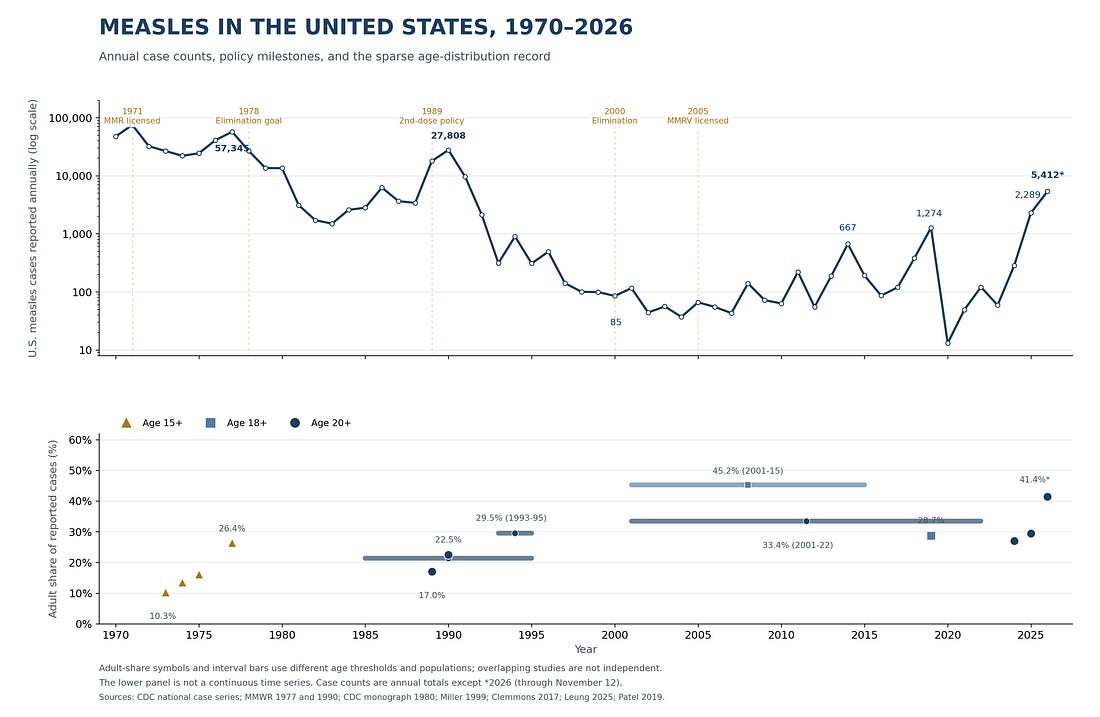
Figure 2. Historical U.S. measles timeline, 1970–2026. The upper panel contains the CDC’s annual reported case counts, presented on a logarithmic axis to preserve variation after elimination; 2026 is partial-year data through November 12, not a completed annual total. Vertical reference markers locate the 1971 MMR license, 1978 elimination initiative, 1989 second-dose recommendation, 2000 elimination declaration, and 2005 MMRV license. The lower panel displays selected observed adult shares using the source-defined thresholds (15+, 18+, or 20+); lines across multi-year periods indicate pooled estimates rather than interpolated annual values or uncertainty intervals. The pooled 2001–2015 and 2001–2022 studies overlap, and geographic and reporting definitions vary. Sources: CDC national measles series and historical vaccine references; CDC 1977 MMWR; CDC 1980 monograph; 1990 MMWR; Miller 1999; Clemmons 2017; Leung 2025; Patel 2019. [1–6,19–22]
They Will Cite Increased % and Push for MMR Mandates for Adults
The denominator in a case-share calculation is all cases, not all adults at risk. When vaccination suppresses diagnosed disease in children more effectively than in adults, the fraction of remaining cases occurring in adults can increase despite a decline in adult incidence. A population-level mechanism can therefore produce two superficially contradictory observations at the same time. [1,3]
The 2026 national case figures make a second point. Of 5,412 confirmed cases reported through November 12, 951 occurred in children younger than five, 2,183 in children aged five to nineteen, 2,240 in adults aged twenty or older, and 38 in people whose age was unknown. The adult share was 41.4%; adults nevertheless constituted a substantially larger fraction of the overall U.S. population. A comparison of shares alone cannot tell an individual adult whether their probability of measles exceeds that of an infant or school-aged child. That would require age-specific population denominators and preferably exposure-specific denominators. [2]
How can mandating school-aged children to take the MMR help if the majority of cases are in the adults? How is that ethical?
Hospitalization introduces a different denominator. In 2026 through November 12, the CDC reported 591 hospitalized cases: 160 of 951 patients younger than five (16.8%), 98 of 2,183 aged five to nineteen (4.5%), and 332 of 2,240 aged twenty or older (14.8%), plus one hospitalization among cases of unknown age. Adults thus represented 56.2% of recorded hospitalizations, compared with 41.4% of recorded cases. For 2025 the respective fractions were 32.8% and 29.4%; for 2024, 26.3% and 27.0%. [2]
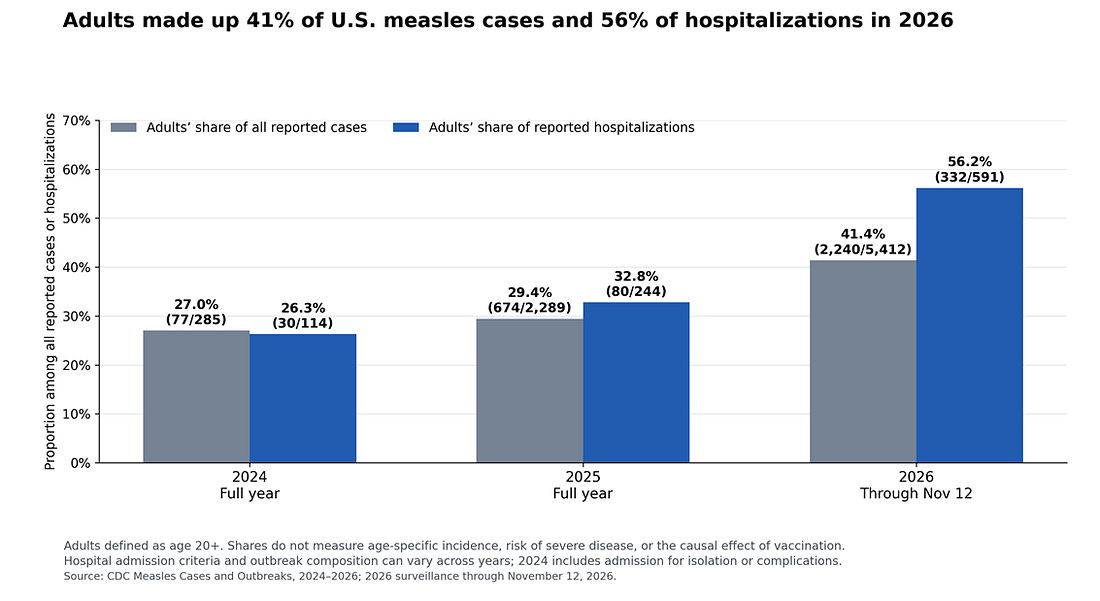
Figure 3. Adults aged 20 or older represented 77/285 (27.0%) cases and 30/114 (26.3%) hospitalizations in 2024; 674/2,289 (29.4%) cases and 80/244 (32.8%) hospitalizations in 2025; and 2,240/5,412 (41.4%) cases and 332/591 (56.2%) hospitalizations in 2026 through November 12. The years contain different outbreaks and population compositions; the bars do not represent longitudinal changes in a fixed cohort. CDC counted hospitalizations for isolation or management of complications in 2024. Accordingly, hospitalization share does not isolate clinical disease severity. Source: CDC measles surveillance, 2024–2026. [2]
This contemporary picture matters, but its interpretation requires discipline. Hospitalization is partly a clinical endpoint and partly an admission-policy endpoint. The CDC specifically explains that the 2024 count included hospitalizations for isolation or management of measles complications. Admission thresholds may vary by age, transmission setting, facility practice, and year. The 2026 figure supports a claim about the age distribution of recorded hospitalizations; it does not prove that the national severity-weighted burden is worsening over time. That claim requires consistently classified pneumonia, encephalitis, intensive-care admissions and death, not hospitalization share alone. [2]
Vaccination status: the unknown category
The strongest contemporary case-series evidence distinguishes confirmed nonvaccination from undocumented histories. In the U.S. 2001–2022 analysis, 2,799 of 4,056 cases (69.0%) were classified as unvaccinated, 475 (11.7%) had received at least one documented measles-containing vaccine dose, and 782 (19.3%) had unknown status. No valid analysis can convert that last category into either vaccine failures or confirmed nonvaccination without new records. [5]
Clemmons and colleagues separately recorded 230 vaccinated cases (12.9%), 1,243 unvaccinated cases (69.5%), and 316 with unknown status (17.7%) in 2001–2015. Among cases aged thirty or older, 48.1% had unknown vaccination status. An adult whose documentation has been lost is not evidence for, or against, waning. [4]
Still, 12.9% vaccinated cases means the MMR vaccine does not confer protection to adults.
They will use this to push mandates of MMR in adults.
The case-selection problem is equally important for people too young for routine vaccination. Mathis and colleagues reported 338 cases from January 2020 through March 28, 2024. Of 309 cases that were unvaccinated or of unknown status, 259 were age-eligible; forty were infants aged six to eleven months and ten were younger than six months. Excluding those fifty infants gives 29 documented vaccinated cases among 288 age-eligible cases, or 10.1%, compared with 8.6% before exclusion. This “does not qualify” adjustment must be done for accuracy; the “unvaccinated” status of infants in Pennsylvania was due to lack of age eligibility. These individuals cannot be used to impact any measure vaccine effectiveness, but they are nevertheless used to boost propaganda for mandates.
Eligibility can also differ for travel or outbreak recommendations. [7]
The CDC classified 96% of 2026 reported cases as unvaccinated or of unknown status and 4% as having one or two recorded MMR doses. The grouping obscures how many adults with unknown histories had actually received vaccine. It also cannot yield vaccine effectiveness without age-, cohort- and dose-specific vaccination coverage in the population at risk. [2]
What the vaccine changed
Infection-derived measles immunity ordinarily persists for life. Historical observations from epidemic islands provided early evidence, and long-term serology supports exceptional durability. Amanna and colleagues tracked antibody responses against several viral antigens in forty-five individuals for as long as twenty-six years and estimated an antibody half-life exceeding two centuries for measles. That model-derived half-life describes observed antibody durability, not the age at which immunity will necessarily fail, and it cannot independently compare all naturally infected and vaccinated cohorts. [15]
Vaccine-derived “immunity” protects most recipients from a diagnosis of measles infection (it does not prevent infection nor does it prevent transmission). This relative protection can also persist for decades. Yet vaccine-primed and infection-primed antibody trajectories are not identical. Seagle and colleagues followed 302 children after a second MMR dose given at ages four to six; 96% remained measles-seropositive during follow-up of up to twelve years. The one-month post-dose-two geometric mean titer was 3,892 mIU/mL; within a defined subgroup with less than a twofold post-dose response, modeled mean titers declined approximately 9.7% annually. That rate belongs to that subgroup and should not be applied universally. [12]
And seropositivity does not guarantee immunity to infection.
A 2022 systematic review by Bolotin and colleagues examined nine studies of people with infection-derived immunity and sixteen studies of vaccinated groups in elimination settings. Geometric mean measles antibody titers declined significantly after two doses, with the steepest estimated absolute decline in the first five years; the review did not identify a statistically significant decline in seropositivity proportions across the studied periods. The authors did not demonstrate that mean antibody levels crossed a clinical protective threshold in those observed intervals. Antibody concentration, seropositivity, and clinical protection are distinct outcomes. [10]
A 2025 review of eighteen studies covering 23,236 vaccinated individuals found pooled measles IgG seropositivity of 87.8% in the vaccinated, with extreme between-study heterogeneity (I² 97.9%). [11]
The 87.8% IgG positivity points to waning MMR efficacy.
Clinical “breakthrough” cases demonstrate that complete protection does not follow automatically from a documented dose. Among the 475 breakthrough cases in Leung and colleagues’ dataset, avidity testing was available for ninety-three (19.6%). Eleven had low-avidity IgG, consistent with primary vaccine failure, and seventy-six (81.7% of those tested) had high-avidity IgG, consistent with a secondary immune response. Sixty-one of those seventy-six high-avidity cases were aged twenty or older. The small, selected avidity-tested subset does not establish that 82% of all breakthrough cases, or 82% of adult cases, arose through waning. Avidity documents immune priming more directly than it documents the time course of its loss. [5]
Transmission after two documented doses has occurred. Rosen and colleagues investigated a 2011 New York City outbreak initiated by a twice-vaccinated patient, with four secondary patients who had two doses or previous positive measles IgG results. No tertiary cases appeared among 231 contacts of those secondary cases. In the Netherlands, Hahné and colleagues described eight infected healthcare workers, six of whom had received two doses; two twice-vaccinated cases had measured pre-illness neutralizing antibody levels above 120 mIU/mL. While they found no onward transmission from the twice-vaccinated cases and no severe illness in that subgroup, transmission could not be ruled out completely. Both investigations demonstrate biological facts without establishing their frequency across the vaccinated population. [13,14]
Five mechanisms make different empirical predictions
An age shift is an observation, not an explanation. The original Anderson–May models describe how reducing the force of infection can raise the average age at infection, sometimes increasing absolute case numbers in older strata under particular assumptions. The mathematical representation is not the biological cause. Its value is that it generates competing predictions to test against surveillance. [8,9]
First, suppressed childhood transmission permits an unvaccinated child to enter adulthood without infection-derived immunity. This mechanism predicts concentration among never-vaccinated adults and a relationship to childhood exposure history and vaccination coverage, not necessarily to elapsed time since the last dose. The Miller dataset, in which 69.9% of adults with known vaccination status reported no prior vaccination, directly supports its relevance. [3]
Second, immunization-policy transitions leave birth-cohort gaps. Adults may have missed vaccine, received only one dose, or received an older inactivated measles vaccine formulation before its discontinuation. The routine U.S. two-dose recommendation dates to 1989. If cohort gaps dominate, adult incidence should cluster by birth year and program history after adjusting for exposure and geography; a simple cross-sectional age tabulation will not identify that pattern. [5]
Third, secondary vaccine failure follows earlier immune priming. It predicts a relationship between documented vaccine history, time since dose, antibody avidity, neutralization measures, and breakthrough incidence. High-avidity responses in cases establish that this mechanism exists. The incidence of such failure among all vaccinated people still requires denominators for vaccinated individuals at risk, stratified by age, dose, time and outbreak exposure. [5,10–14]
Fourth, elimination of frequent wild-virus circulation may reduce opportunities for natural immune boosting. That is a plausible mechanism, not a quantified explanation of the U.S. adult case share. Testing it requires comparable cohorts with different historical exposure opportunities, serial quantitative antibody assays, and infection endpoints. A decline in vaccinated-cohort antibody titers alone cannot isolate loss of boosting from other mechanisms. [10–12]
Fifth, outbreak composition can alter the national case fraction even in the absence of any short-term change in individual immune status. A national fraction is a weighted average of outbreaks with different ages, vaccination histories, household structures and ascertainment patterns. The movement of the reported adult fraction during 2026 is compatible with changing outbreak composition; it cannot quantify that effect without outbreak-stratified records. One large adult-heavy outbreak could dominate the national percentage. [2]
These processes can operate together. The susceptible pool is structured by birth year, immune history, local coverage, exposure networks and time since vaccination. A robust account of age shifting must therefore identify which mechanisms explain observed cases and which primarily change serological markers, rather than substituting one mechanism for all others.
The separate infant problem: maternal antibody persistence
The other clinically important consequence involves the first months of life. Placental transfer supplies newborn infants with maternal measles IgG. The duration of detectable maternal antibody depends on the mother’s antibody concentration, transfer efficiency, the infant’s decay rate, and the assay used. Since routine U.S. MMR vaccination begins at twelve to fifteen months, falling maternal IgG creates a potential interval of susceptibility before routine infant immunization. [16–18]
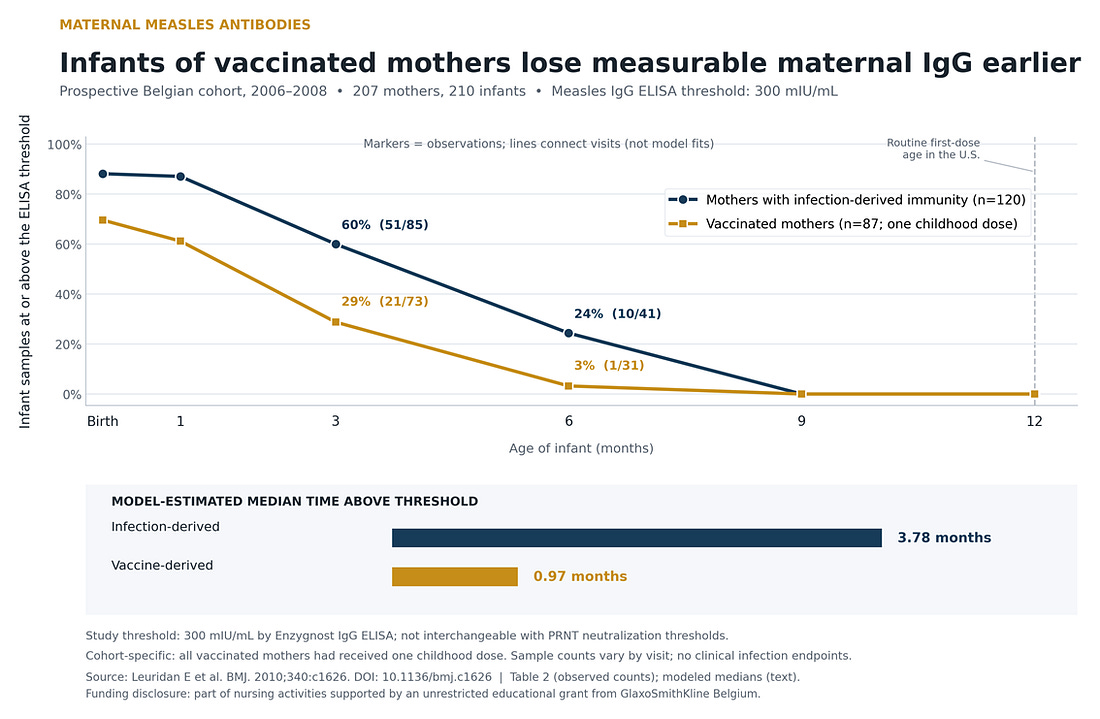
Figure 3. Directly observed percentages of infant samples meeting the study-specific Enzygnost measles IgG ELISA threshold (300 mIU/mL), by maternal immune history, at birth and visits through twelve months. Lines join measured visit percentages; they are not fitted survival curves. Above-threshold results at three months were 21/73 (29%) among infants of vaccinated mothers and 51/85 (60%) among infants of mothers with infection-derived immunity; at six months, 1/31 (3%) and 10/41 (24%). Separately, the authors’ model estimated median time above threshold at 0.97 and 3.78 months, respectively. All vaccine-immune mothers had received a single childhood dose. Assay threshold is not interchangeable with a plaque-reduction neutralization protection cutoff; the study did not measure infant measles infection rates. Nursing activities received partial support from an unrestricted GlaxoSmithKline Belgium educational grant. Source: Leuridan et al., BMJ, 2010. [16]
Leuridan and colleagues prospectively studied 210 infants born to 207 women in Belgium. Eighty-seven mothers had documented vaccine-derived immunity and 120 were classified as naturally immune from infection history. All vaccinated mothers in this cohort had received only one childhood measles vaccine dose, an important limitation for extrapolation to present-day two-dose U.S. cohorts. Maternal geometric mean measles IgG was 779 mIU/mL in vaccine-immune mothers and 2,687 mIU/mL in naturally immune mothers. [16]
At three months, 21 of 73 measured infants of vaccine-immune mothers (28.8%) were above the study’s enzyme-linked immunosorbent assay (ELISA) threshold, compared with 51 of 85 (60.0%) infants of naturally immune mothers. At six months the proportions were 1 of 31 (3.2%) and 10 of 41 (24.4%). The investigators separately modeled median times to crossing their threshold: 0.97 months and 3.78 months. These are assay-dependent, model-based estimates; they do not show exact times of clinical protection failure for individual infants. [16]
These data show that infants of vaccinated breastfeeding mothers are at 4 times the risk of measles infection if exposed compared to unvaccinated mothers who breastfeed.
An independent Dutch serological study found an estimated median protection duration against measles of 3.3 months among infants in the highly vaccinated general population and approximately two months longer in contrasting orthodox Protestant communities with different maternal infection histories. This comparison supports the possibility of a population-level difference in passive antibody persistence, but community-level contrasts also involve selection, age and exposure differences. A statistical study by Goeyvaerts and colleagues further modeled maternal antibody decay across several infections. Neither study measures a causal increase in infant measles incidence attributable to the difference in maternal vaccine history, but the studies were not designed to do that. [17,18]
The measurable outcome is therefore narrower and stronger than the original claim of a bimodal increase in disease: infants of vaccine-immune mothers in the studied populations often lost measurable maternal antibody earlier. The clinical importance depends on actual contact with measles virus and on how the laboratory threshold relates to protection. Clemmons and colleagues found the highest age-specific U.S. measles incidence in 2001–2015 among infants aged six to eleven months, a genuine surveillance observation, but it is not a valid pre-vaccine comparison of infant risk. [4,16]
The MMR vaccination program has placed infants at risk of infection – and now adults are at risk, as well.
Updated Surveillance – Including % Vaccine Type Rashes – Is Needed
From 2000-2025, measles surveillance has been outbreak-focused rather than comprehensive. A useful surveillance system should not ask the public to base policy on noisy measures like adult share, infer risk from reported case totals, or infer clinical susceptibility from an antibody threshold. It should produce age-specific rates, matched denominators, and separately reported outcomes. Those elements would allow the five mechanisms to compete as testable explanations rather than as mutually exclusive narratives.
Recommended Policy Updates
Policy Update #1: CDC Should Require States to Report % “Cases” That Were Actually “Measles-Like Rashes” from Vaccine Type. This is obviously necessary given the high percentage of cases that have been found in retrospect to not be measles cases after all.
Actual outbreak trends and vaccine effectiveness trends and pathogenic priming cannot be studied if the entity is unknown.
Roy et al. (2017), the authors cite unpublished CDC data (R. J. McNall) showing that 37.6% (73 of 194) of measles virus sequences obtained in the United States in 2015 from measles ‘cases’ were vaccine-strain sequences (genotype A). Unless physicians know whether their diagnosis mixed up the two types of measles rashes, public health cannot possible accurately count cases..
Roy et al., specifically stated that improving clinicians’ and health departments’ ability to quickly separate these look-alike vaccine rashes from true measles cases—without waiting days for genetic sequencing—was the primary motivation for developing the rapid RT-qPCR assay.
Policy Update #2: Vaccination Status. The administrative slop from the pre-Kennedy era of not knowing the vaccination status among cases must end.
Policy Update #3: Nationwide messaging on VitA therapy in the event of exposure or infection (not for use in pregnancy).
Policy Update #4: Detailed contextual reporting. For every verified case, the necessary cross-tabulation is age in narrow bands, birth year, outbreak identifier, documented vaccination status with zero, one, two or more doses, date of last dose, direct evidence of past infection, and status unknown.
The denominator must include local population counts by age and, where feasible, counts vaccinated by dose and cohort. Immune responses should be assessed with a prespecified protocol, because avidity and neutralization results have selection and timing dependencies. Researchers should report missingness by variable and use prespecified sensitivity analyses rather than reclassifying unknown histories. [2,4,5]
Severity needs an equally exact design. Per CDC recommendations, every case should be given two large doses of Vitamin A. And cases should not be vaccinated: there is no safety data on vaccination with MMR once infection is apparent.
Hospitalization should be disaggregated into isolation-only admissions, admissions for clinically defined complications, intensive care, pneumonia, encephalitis and death. These outcomes must retain the actual age and exposure denominators. This is essential before asserting that age redistribution has increased severity-weighted population burden.
For infants, the needed study would recruit pregnant women with confirmed infection-derived immunity, documented one-dose histories and documented two-dose histories; quantify maternal and infant antibody using calibrated ELISA and neutralization methods; measure transfer and decay prospectively; and follow infants for validated clinical measles outcomes while recording exposure. Such a design would distinguish antibody persistence from infection incidence and test whether the Belgian estimates transfer to contemporary U.S. mothers.
The effect of VitA dosing on congenital measles is established. Pregnant women should not take high VitA; it is considered to be teratogenic.
Post birth Vitamin A dosing in congenital measles infants is used as a supportive therapy to replenish depleted retinol stores and reduce the risk of severe complications, though specific clinical data on newborns is limited. While no large-scale clinical trials isolate the effects of vitamin A solely on congenital (in-utero or birth-acquired) measles, medical authorities recommend standard infant dosing alongside primary treatments like intravenous immunoglobulin (IVIG).
The principal study question should be prespecified as the contribution of cohort susceptibility, documented secondary vaccine failure and outbreak composition to the observed adult case share. Historical comparisons should identify their geography and adult-age cutoff. Overlapping time intervals must never be treated as independent trend points. These are requirements for causal identification, not optional graphical refinements.
Bottom line
Measles vaccination reshaped the age distribution of susceptibility while dramatically reducing measles incidence. The CDC documented that older people represented a larger fraction of cases even when their own reported case rates declined. By November 12, 2026, adults aged twenty or older accounted for 41.4% of confirmed U.S. cases and 56.2% of recorded hospitalizations, observations influenced by outbreak composition and admission practice. [1,2]
Several mechanisms deserve separate causal treatment. Reduced childhood exposure can leave never-vaccinated people susceptible into adulthood. Birth-cohort gaps matter. Secondary vaccine failure occurs, although its frequency among vaccinated people at risk and its contribution to the adult share remain incompletely identified. The antibody literature demonstrates differences between vaccine-derived and infection-derived humoral immunity, but serological waning does not establish clinical failure in every person with a declining titer. [3,5,10–14]
The strongest infant evidence concerns passive antibody persistence, not a demonstrated increase in infant measles incidence. The Belgian and Dutch studies show shorter persistence among infants born into vaccine-immune populations under their respective designs and laboratory definitions. That finding warrants serious surveillance and careful comparison with contemporary two-dose maternal cohorts. [16,17]
The shift is real. The young are at risk due to loss of maternal passive immunity, and adults are at risk due to waning of vaccine immunity.
The data are in. It’s time to get real about natural therapies for measles.
Dr. Ben Edwards has some information on that.
Popular Rationalism is reader-supported. A paid subscription supports independent, evidence-driven investigation. IPAK-EDU courses and webinars:
References and source notes
Research identifiers and journal metadata were checked against PubMed or the journal publisher; current case figures come directly from CDC reporting as of November 12, 2026. References retain their original study-specific populations and methods. The figures use the sources listed in their captions.
1. CDC. Measles — United States. Morbidity and Mortality Weekly Report. April 8, 1977;26(14):109–110. Tables 2–3. Source
2. CDC. Measles Cases and Outbreaks. Surveillance data for 2024, 2025 and 2026; 2026 snapshot as of November 12, 2026 (site updated November 13). Source
3. Miller M, Williams WW, Redd SC. Measles among adults, United States, 1985–1995. Am J Prev Med. 1999;17(2):114–119. DOI: 10.1016/S0749-3797(99)00058-6. Source
4. Clemmons NS, Wallace GS, Patel M, Gastañaduy PA. Incidence of measles in the United States, 2001–2015. JAMA. 2017;318:1279–1281. DOI: 10.1001/jama.2017.9984. Source
5. Leung J, Munir NA, Mathis AD, et al. The effects of vaccination status and age on clinical characteristics and severity of measles cases in the United States in the postelimination era, 2001–2022. Clin Infect Dis. 2025;80:663–672. DOI: 10.1093/cid/ciae470. Source
6. Patel M, Lee AD, Clemmons NS, et al. National update on measles cases and outbreaks — United States, January 1–October 1, 2019. MMWR. 2019;68:893–896. DOI: 10.15585/mmwr.mm6840e2. Source
7. Mathis AD, Raines K, Masters NB, et al. Measles — United States, January 1, 2020–March 28, 2024. MMWR. 2024;73:295–300. DOI: 10.15585/mmwr.mm7314a1. Source
8. Anderson RM, May RM. Vaccination against rubella and measles: quantitative investigations of different policies. J Hyg (Lond). 1983;90:259–325. DOI: 10.1017/S002217240002893X. Source
9. Anderson RM, May RM. Age-related changes in the rate of disease transmission: implications for the design of vaccination programmes. J Hyg (Lond). 1985;94:365–436. DOI: 10.1017/S002217240006160X. Source
10. Bolotin S, Osman S, Hughes SL, et al. In elimination settings, measles antibodies wane after vaccination but not after infection: a systematic review and meta-analysis. J Infect Dis. 2022;226:1127–1139. DOI: 10.1093/infdis/jiac039. Source
11. Mustafa M, Reznik AS, Uribe J, et al. Measles seropositivity in previously vaccinated individuals: a systematic review and meta-analysis. eClinicalMedicine. 2025;89:103564. DOI: 10.1016/j.eclinm.2025.103564. Source
12. Seagle EE, Bednarczyk RA, Hill T, et al. Measles, mumps, and rubella antibody patterns of persistence and rate of decline following the second dose of the MMR vaccine. Vaccine. 2018;36:818–826. DOI: 10.1016/j.vaccine.2017.12.075. Source
13. Rosen JB, Rota JS, Hickman CJ, et al. Outbreak of measles among persons with prior evidence of immunity, New York City, 2011. Clin Infect Dis. 2014;58:1205–1210. DOI: 10.1093/cid/ciu105. Source
14. Hahné SJM, Nic Lochlainn LM, van Burgel ND, et al. Measles outbreak among previously immunized healthcare workers, the Netherlands, 2014. J Infect Dis. 2016;214:1980–1986. DOI: 10.1093/infdis/jiw480. Source
15. Amanna IJ, Carlson NE, Slifka MK. Duration of humoral immunity to common viral and vaccine antigens. N Engl J Med. 2007;357:1903–1915. DOI: 10.1056/NEJMoa066092. Source
16. Leuridan E, Hens N, Hutse V, Ieven M, Aerts M, Van Damme P. Early waning of maternal measles antibodies in era of measles elimination: longitudinal study. BMJ. 2010;340:c1626. DOI: 10.1136/bmj.c1626. Source
17. Waaijenborg S, Hahné SJM, Mollema L, et al. Waning of maternal antibodies against measles, mumps, rubella, and varicella in communities with contrasting vaccination coverage. J Infect Dis. 2013;208:10–16. DOI: 10.1093/infdis/jit143. Source
18. Goeyvaerts N, Leuridan E, Faes C, Van Damme P, Hens N. Multi-disease analysis of maternal antibody decay using non-linear mixed models accounting for censoring. Stat Med. 2015;34:2858–2871. DOI: 10.1002/sim.6518. Source
Thank you for being a subscriber to Popular Rationalism. For the full experience, become a paying subscriber. And check out our awesome, in-depth, live full semester courses at IPAK-EDU. Hope to see you in class!



Leave a Reply
You must be logged in to post a comment.