
Alaska’s New Pipeline Will Power the Pacific
November 20 | Posted by mrossol | American Thought, Asia, Economics, Energy, Trump| ROD D. MARTIN NOV 20, 2026 |
👉 Upgrade to Premium or Inner Circle!
And where are you hearing about this? Not from the GOP, that’s for sure. mrossol
by Rod D. Martin
November 20, 2026
This week in Manila, President Trump said the United States had “just approved” the Alaska LNG pipeline, crediting an historic $200 billion investment from South Korea.
The Koreans, like the rest of our East Asian allies, need gas by the shipload. They have to get it from volatile Middle Eastern sources, subsidizing unfriendly powers in the process. Worse still, for decades, we’ve sent American sailors to protect our allies’ tankers all while somebody else got paid for the cargo and our trade deficit went up. It’s crazy.
For decades, the world built its energy system around Russia, the Persian Gulf, and vulnerable maritime routes that were protected almost entirely by the United States Navy. Europe bought from Moscow, then demanded America defend Europe from Moscow. Japan, South Korea, and Taiwan bought from the Middle East, sent their tankers past hostile shores, and relied on American sailors to make the voyage safe. China bought steeply discounted (and illicit) oil from Iran, Venezuela, and Russia, ran an enormous trade surplus with the United States, and yet still counted on the U.S. Navy to secure that commerce, the very commerce it used to finance its massive military buildup against us.
As in so many other things, America paid for the system. Everyone else profited from it. Donald Trump isn’t just railing against it. He’s replacing it.
The new order is simple: America will produce the energy, insure the shipping, protect the trade routes, and supply its friends. But not for free, and certainly not while those “friends” bankroll our enemies and run giant trade surpluses at our expense.
In September, Trump called the Alaska project “the biggest in the world.” In addition to the $54 billion earmarked for Alaska, the overall $200 billion deal covers a much larger Korean energy investment, including a $22.3 billion gas-fired power project in Texas and as much as $120 billion for eight nuclear reactors. Those are projects under the investment pledge Korea already made. Now there are places to build and customers to serve.
This is the very essence of Trump’s “commerce, not chaos.” Allies profit together, become stronger together, deter aggression and reduce risk together. South Korea will make money on this investment: a lot of money. But so will the United States, and it will do so without its Asian allies spending one extra penny on energy imports. That money was going somewhere anyway. It ought to go here.
The Short Route to Asia
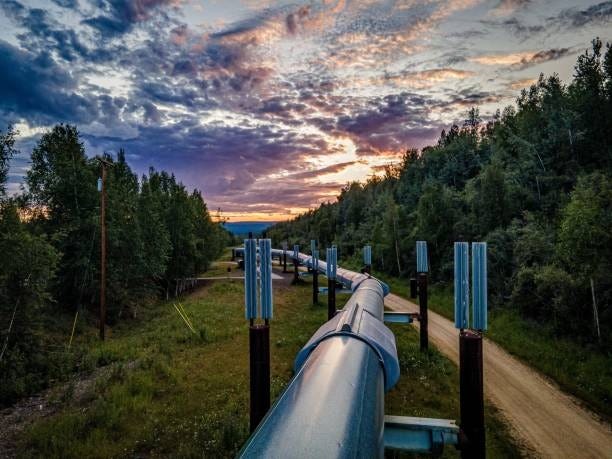
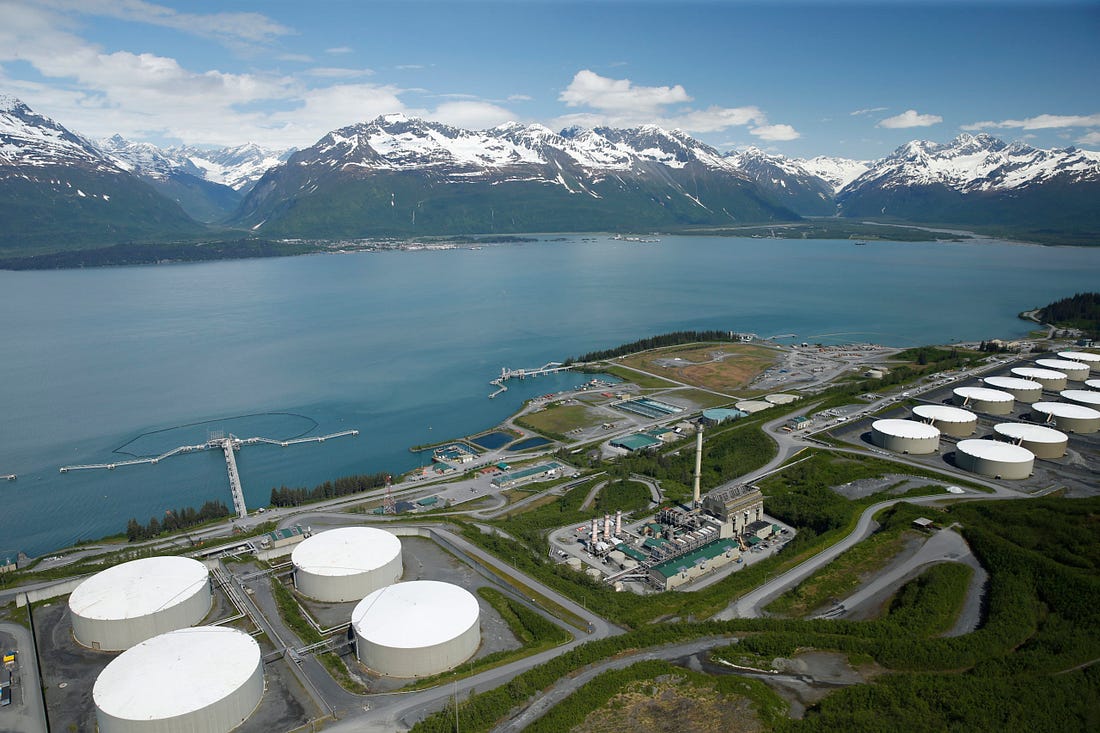
In 1977, the Trans Alaska Pipeline began carrying oil 800 miles from the North Slope to Valdez. It was an engineering marvel. At a cost of $9 billion, it stood then as the most expensive private construction project in American history. Running atop tundra, under mountains, through snow in winter and clouds of mosquitoes in summer, the Trans-Alaskan Pipeline pumped more than 2 million barrels of oil a day at its peak, helping America weather the 1979 oil shock and transforming the lives of Alaskans in the process.
For decades, Democrats have fought tooth and nail to restrict further development of Alaska’s immense energy reserves. Yet in addition to the oil — not just at Prudhoe Bay but across the North Slope — we’ve known about the region’s gas reserves for half a century. We just haven’t had any way to use them.
The proposed Alaska LNG project is therefore far more than a pipeline. It’s a strategic supply corridor connecting North Slope gas to a 20-million-ton-per-year export terminal at Nikiski on the Pacific. It is the only federally authorized LNG export project on the American Pacific coast. And it gives Japan, Korea, Taiwan, and other Asian buyers direct access to American energy without passing through Hormuz or the Panama Canal, and without depending on Russia.
In September, Interior Secretary Doug Burgum compared that journey’s 30 days from the Middle East to Japan or South Korea to the mere 8 days from Alaska. From Qatar, that’s about three weeks of ship and crew costs on a single crossing, all of which must be patrolled by the U.S. Navy. That costs money too, to defend supply from which we didn’t profit.
The foolishness of this arrangement is manifest in the seemingly perpetual U.S. trade deficit. America chronically imports more than it exports, from these same companies. Exporting oil and gas to them eliminates or reverses that, at no additional cost to the buyers (indeed, potentially less).
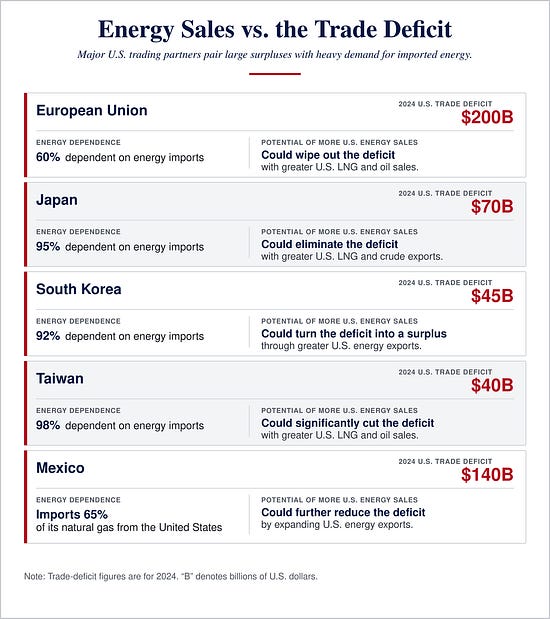
It’s an immense win-win that Democrats continue to fight. Joe Biden’s autopen froze new approvals to export LNG, in the middle of the Ukraine war just as Europe was trying to wean off Russian gas. Trump ended that freeze on his first day back in office. Yet the party that shipped America’s industrial jobs overseas remains hell-bent on keeping them there.
Nobody puts billions into pipe, plus an enormously expensive liquefaction plant, on the hope that somebody might someday send a tanker. But Trump’s trade deals have helped line up buyers in Japan, Korea, Taiwan, and Thailand who have already signed preliminary agreements for more than half the project’s planned volume. TotalEnergies has agreed in principle to buy two million tons a year for twenty years. Japanese utilities, Korea’s POSCO, Taiwan’s CPC, and Thailand’s PTT have all moved into the project’s orbit.
Finding a buyer willing to sign a 20-year supply contract means you have a stream of income that a lender can count on when you ask for the money to build. The South Korean investment Trump announced takes it a step further: the customer helps put up the money to build the line. The two governments still have to work out some of the terms, but the deal is done.
More sales mean more profit. More profit means more investment. More investment means more production. More production means prices fall. That’s the whole argument for what Trump calls “Energy Dominance”: improved security for the entire alliance, and with money flowing into America, not out of it.
Alaska LNG will help supply Alaskans, create thousands of American jobs, require enormous quantities of steel and equipment, and anchor a new Pacific energy system inside the alliance. With Jones Act relief (or better: repeal) it could also make a real dent in needlessly outrageous prices in California, Hawaii, and outlying U.S. territories like Guam.
It could do something else too.
After Trump met Xi Jinping in Beijing in May, Xi expressed interest in buying more American oil to reduce China’s dependence on Hormuz. Scott Bessent said American energy from Alaska would be a “natural” fit. Direct U.S. LNG cargoes soon began sailing for China.
China is permanently energy-poor. It can attempt to increase domestic production. It can buy more pipeline gas from Russia. It can spend fantastic sums building a navy capable of contesting American control from the Luzon Strait to Malacca and Hormuz.
Or it can buy from us. And we can all prosper together.
That would not make the CCP trustworthy, much less a friend. But it would make peace more profitable. A twenty-year American LNG contract is skin in the game. It reduces China’s trade surplus without requiring China to buy something it doesn’t need. It gives American workers income with which to buy Chinese goods, a desire that isn’t going away regardless of reindustrialization. And it gives Beijing one more immense financial reason not to start a war that would instantly sever the relationship.
Commerce does not eliminate national interest. It changes the incentives.
An American Supply Line
In 1969, a tanker called the Polar Alaska sailed out of Cook Inlet with the first LNG cargo Japan ever bought. Tokyo Gas was one of its customers. The same company is back at the table today, along with a host of others.
This year, when war stopped Qatar’s tankers from getting through Hormuz, it had to buy 33 cargoes of American LNG to meet its supply obligations to its customers in Asia, including Japan, South Korea, and Taiwan. Our friends wound up counting on American gas anyway. Why not cut out the middle man, and the risk?
Qatar’s purchase of American LNG tells us where all of this is going. The most secure energy in the world is increasingly American energy. Trump is turning that fact into lower trade deficits, stronger alliances, weaker enemies, a safer Pacific, and a Middle East in which commerce steadily displaces chaos.
Energy dominance is not a slogan. It is the operating system of the new American century.
The twentieth century was American because we armed and financed the free world, two things we will continue to do. But the twenty-first may be even more decisively ours because we can power it as well. And in so doing, most of the twentieth century’s needless conflicts and crises simply melt away.
The new Alaska LNG pipeline is a huge step in that direction.



Leave a Reply
You must be logged in to post a comment.