
C&C. SHARP AS A TACK BIDEN. MSM Narrative Management.
July 28 | Posted by mrossol | Biden, CDC NIH, Childers, Coronavirus, FDA, Liberal Press, Lockdowns, Mandates, Medicine| JEFF CHILDERS JUL 28, 2026 |
Good morning, C&C, it’s Tuesday! Our roundup focuses on all the new disclosures: the Biden audio tapes hit the internet, and I return with a more complete roundup of a story you cannot possibly have missed unless you are on a social media fast: the Fauci diaries, seen through the lens of one of the most nauseating Times articles yet. It’s time to start squashing cockroaches.
🌍🇺🇸 ESSENTIAL NEWS AND COMMENTARY🇺🇸🌍
🔥🔥🔥
It has truly been a banner week for disclosure fanatics. First, over the weekend, the world received the Fauci Files (more on that below), and now, this. Yesterday, CNN reported, “Newly released Biden audio recordings include references to ‘classified’ material and struggles with memory.”
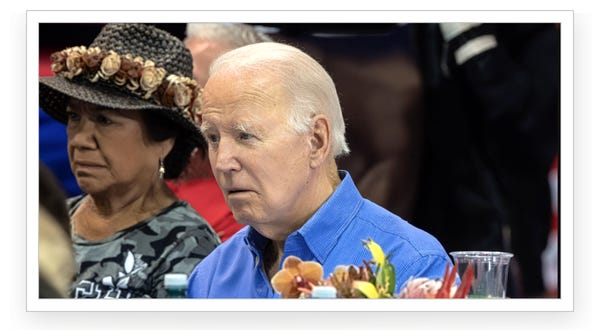
The tapes are roughly 70 hours of audio (plus transcripts) of Joe Biden’s rambling, semi-coherent interviews with his ghostwriter, Mark Lewis Zwonitzer, for 2017’s least-selling memoir Promise Me, Dad: A Year of Hope, Hardship, and Purpose— a book focused on the year of his son Beau’s illness and death, for which Biden received a very generous $8 million advance.
It’s good money if you can get it. (Spoiler: You can’t.)
Special Counsel Robert Hur’s office obtained the full audio during the 2023–24 classified-documents probe. The material that went public yesterday, after years of FOIA litigation by the Heritage Foundation’s Oversight Project, is a released subset with significant redactions of many classified disclosures.
It will probably not surprise you that Biden’s ghostwriter had no security clearance. Every time Biden told him something classified, it was a criminal act. So every redaction in the audio represents a separate federal crime.
There were multiple sessions. Reports document multiple interviews spanning late 2016 and into spring 2017, including both while Biden was still vice president and after he left office in January 2017. For example, he told Zwonitzer about Obama’s opinion that beating Hillary in the primary would be ”an uphill battle, but it was up to me.” Biden sat that one out.
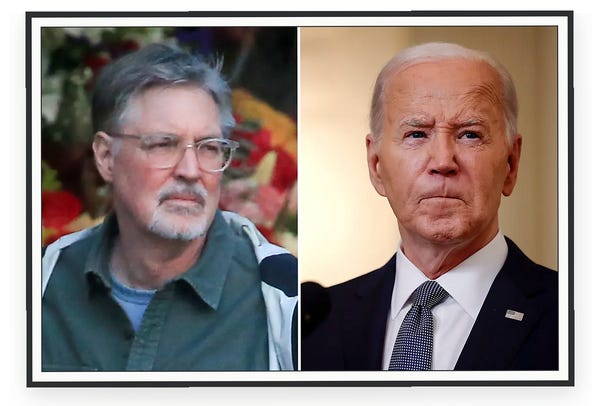
In substance, the audio is largely Biden and Zwonitzer doing memoir work: Biden leafing through his personal notebooks from the vice-presidential years, reading some passages aloud, flagging other things as ‘sensitive’ so they wouldn’t go in the book, and adding typical Biden colorful observations to the events recorded in his notes.
Based on his own comments admitting it, and on the number of redactions, the original audio includes plenty of classified material that Biden wasn’t even supposed to have, never mind disclose to his biographer.
In legal terminology, we’d call it all proof of guilt.
For example: “They didn’t even know I had this,” Biden “cavalierly” bragged at one point, while apparently showing the ghostwriter some old notes from a classified briefing. In another clip, Biden tells Zwonitzer that he had “just found” some more classified documents about the 2009 Afghanistan surge. “So this was – I, early on, in ’09 – I just found all of the classified stuff downstairs,” Biden semi-coherently mumbled. “And then — and then the next thing I have here is — this is classified,” Biden said at another point.
The audio is replete with long pauses, forgotten names and dates, Biden straining to read his own handwriting (“I can’t read my own writing”), and abandoned trains of thought —passages Hur would later call “painfully slow” and evidence of a “poor memory”— though some listeners have described it as a routine review of old notes, taking the common sense view that nobodywould perfectly recall things that happened years before. You can decide for yourself.
One can condemn special counsel Hur for failing to indict Biden, and many have. But Hur’s stated excuse —that Biden’s brain was too cabbage-like to make a prosecutable defendant— wreaked enormous political damage and handed President Trump a perfect foil for a selective prosecution defense.
Anyway, we remain in the hot takes phase and much of the audio remains to be released. We’ll return to this story soon, I’m sure. Meanwhile, the media coverage can best be described as “Republicans pounce”— but this story was not even close to the best example of that overused spinning tool.
No, corporate media’s best efforts were reserved for the Fauci Diaries.
🔥🔥🔥
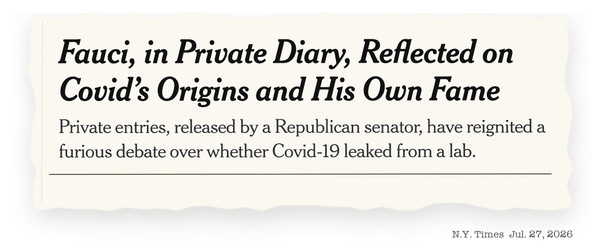
On Sunday, I reported the social media firestorm blazing over Senator Rand Paul’s successive document dumps of never-before-seen inside intel from the covid period, including Fauci’s and his team’s Slack messages and the Human Cockroach’s stomach-turning, so-called diaries. Yesterday the Times finally reported on it with a single story headlined, “Fauci, in Private Diary, Reflected on Covid’s Origins and His Own Fame.” (Non-paywalled gift link.)
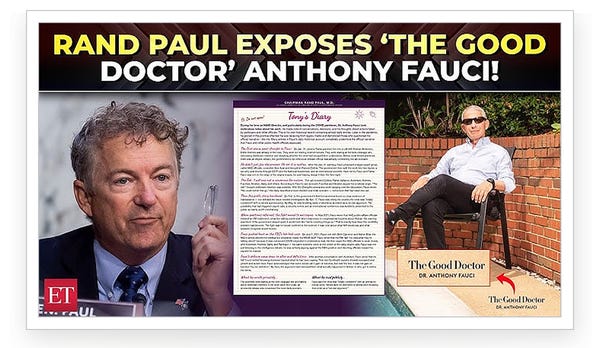
Over the weekend, Senator Rand Paul flipped the kitchen lights onto the human cockroach and a whole nest of fellow insects. And Fauci’s glorified image has begun deflating faster than a punctured Macy’s Thanksgiving Day parade float.
As you probably well know, the Kentucky Republican, who chairs the Senate Homeland Security Committee, dumped 1,141 pages of Dr. Anthony Fauci’s typewritten daily diary onto the internet, four days before the ‘good doctor’ was scheduled to testify under subpoena. Since the document dump on Saturday, conservative social media has been down on its hands and knees with a flashlight and a butter knife, prying up everything it is finding.
The findings have been downright skittery, and just as horrid as any exterminator might expect.
Take another quick gander at that Times headline. Reflected. The Times thinks Fauci’s diaries show reflection. Like a man in a charming cardigan on a dock at sunset, gazing across the misty water, thinking deep thoughts about the human condition and the tragic beauty of it all. Thoreau at Walden. Marcus Aurelius in the tent. That kind of thing.
And then we get the story’s grotesque subheadline, where the Times rolled up its ink-stained sleeves and really started to get down to work: “Private entries, released by a Republican senator, have reignited a furious debateover whether Covid-19 leaked from a lab.”
Oh, boy.
🔥 Note how the Times packaged its story. It’s not about the entries. It is about the debate the entries reignited —a debate that is “furious,” a word usually referring to a mob, not a Senate hearing— and the debate was set off by … “a Republican senator.” Not by the chairman of the committee holding the subpoena. Not by a physician. A Republican senator, phrased in the tonal register you’d use to describe “an unlicensed contractor.”
The Times had 1,141 pages of the most powerful bureaucrat in modern American history writing down what he actually thought about the most significant historical event in anyone living’s memory, and it filed a single story about the tone of the argument.
This is the whole trick. This is how they do it. Let’s turn the lights all the way up.
🔥 I’ll start with the single worst paragraph, because it best illuminates the Times’ gaslighting and narrative deflation techniques working in real time.
On February 1, 2020 —before most Americans had even heard the word “coronavirus” uttered out loud by anyone who wasn’t a white-coated insect— Fauci and NIH Director Francis Collins convened an emergency teleconference of the world’s top virologists to discuss whether this frankenvirus had been built.
Fauci diligently recorded what happened. Here is what “Doctor” Fauci actually wrote about that call:
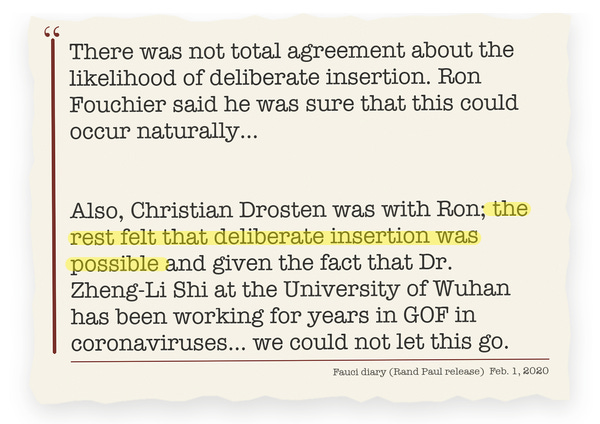
Now compare that to how the New York Times described the same quote:
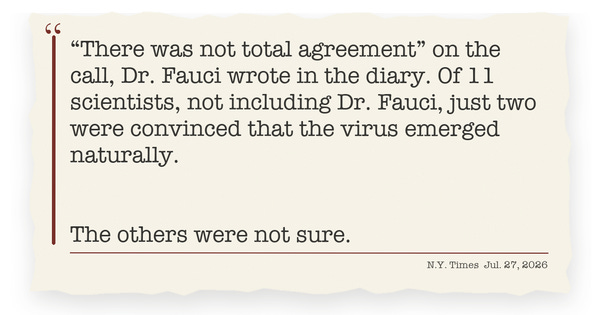
See what happened there? The Times quoted the first five words of Fauci’s sentence —the vague, throat-clearing part— and then, at the exact moment the sentence got radioactive, dropped out of quotation marks and paraphrased. “The rest felt that deliberate insertion was possible” got cut out, and shrunk down by Times editors to a paraphrased “The others were not sure.”
The others were not sure. Not sure! Like they’d been asked about the likelihood of inclement weather in Hoboken, New Jersey. Nine of the planet’s leading virologists sat on a conference call and concluded that somebody may have built the pandemic virus, and the paper of record translated that into the emotional register of a man trying to decide between ordering the French onion soup or the Caesar salad.
That downshift is the oldest move in the narrative exterminator’s playbook, and every homeowner in America instinctively knows it. You point at something enormous and glossy darting under the refrigerator, and the professional standing next to you calmly says, “that’s just a water bug.”
It was not a water bug.
🔥 To be fair to the Times —and let’s be fair, because fairness makes the rest of this worse— they had no good reason to obscure that quote. They had the explosive quote. It’s right on page one of Senator Paul’s package. The Times editors read it, thought about it, and decided their readers were better off with a summary.
Compare that editorial economy to another paragraph a little further down, where the Times made room to quote Fauci at generous length about the actress Julia Roberts, who’d just introduced him at an awards ceremony:
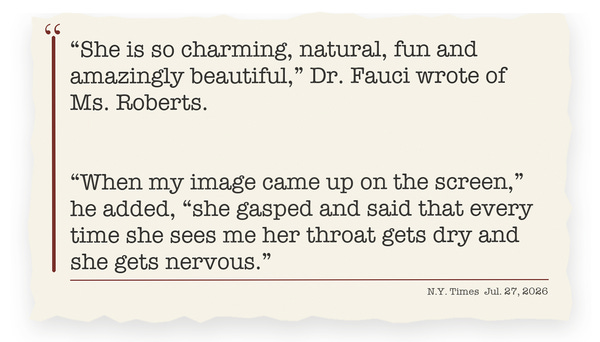
Nine virologists suspecting an engineered pandemic virus gets a space-saving paraphrase. Julia Roberts, on the other hand, gets the full verbatim treatment, plus a follow-up clause.
I am not making any of that up. Neither, unfortunately for him, was Fauci, since he sounds just like a narcissistic psychopath. It wasn’t a very good look for Julia Roberts, either.
🔥 And there’s another thing about cockroaches: when one insect appears in the daylight, it means there are thirty thousand more behind the wall. The Times preferred to focus on the one “water bug” on the counter. But here is a very partial list of a few important facts the Times either skipped entirely or sanded down till they were smooth.
The night before the call. On January 31, 2020, Jeremy Farrar of the Wellcome Trust patched Fauci into a second call, this one just with evolutionary biologists Kristian Andersen and Eddie Holmes. The men specifically discussed the ‘furin cleavage site’ (FCS)— the telltale structural feature of the virus with no previous parallel in known bat coronaviruses. Fauci typed:
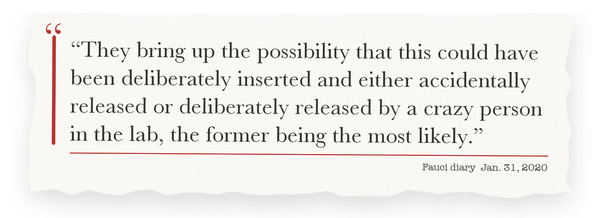
Deliberate Insertion would be a tremendous name for a rock band. It would be less tremendous to learn your government knew all about the FCS on January 31, 2020, and spent the next fifteen months calling it a conspiracy theory.
And then came the part that gave me projectile diarrhea. The Times did quote Fauci’s diary from January 31, 2020. But it ignored the smoking gun above. Instead, here’s the line the editors picked to share with readers:
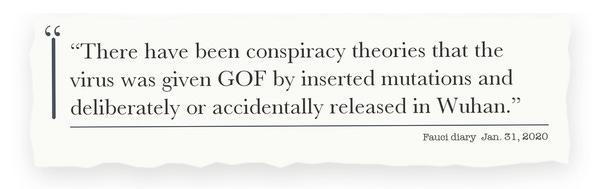
Same day, same diary, same man at the same keyboard. The Times reached into that long-ago Friday, reached right past the entry where the world’s virologists tell Fauci the FCS may have been deliberately inserted, and pulled out of context the entry where Fauci called deliberate release a conspiracy theory —right after his top virologists said that very thing— and then the Times printed conspiracy theory comment as an observation that ‘the establishment’ was dismissing the lab leak altogether.
That’s not sloppiness. Sloppiness is random. This was curated.
🔥 Then there’s what the good doctor thought of the FBI. Eighteen long months later, in July 2021, the Bureau “was convinced” that covid came from the lab. (Of course it did.) Fauci went into a SCIF at the Eisenhower Building to discuss the issue with National Security Council officials, came out, and wrote this:
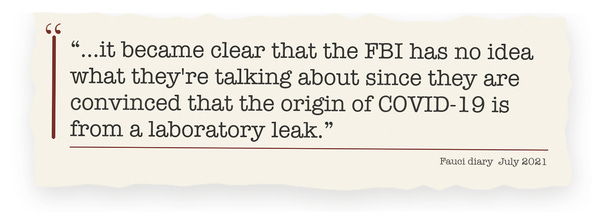
No idea what they’re talking about. The nation’s top insectious disease bureaucrat, who is not an intelligence officer, decided that the federal counterintelligence agents were the dim ones in the room. He then urged NSC officials to work closely with Andersen, Holmes, Garry, and Rambaut— four of the five co-authors of the Proximal Origin paper, i.e., the guys he already knew were on his side.
That is not a scientist following the evidence. He was stuffing the jury.
🔥 At the beginning, in February 2020, Andersen had privately written that a lab escape was “so friggin’ likely to have happened.” Fifteen months later —after coming around and co-authoring the paper declaring lab origin implausible— Andersen was back on the phone with Fauci, “very emphatic that the work that was done at the Wu Han Institute in Association with our grant was not gain of function.” Our grant. Ours.
Fauci’s diary, May 23, 2021, referring to Andersen coming around to his way of thinking:
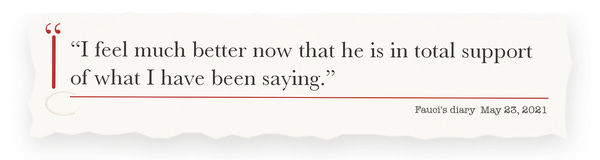
Fauci felt much better. Not “the evidence is stronger.” Not “he revised his analysis.” He felt better. These are the thoughts of a man who wanted comfort, went shopping for it, and found it at the grant-giving store that always carries his size.
🔥 Then there’s Scott Atlas. When Dr. Atlas arrived at the White House in August 2020 arguing that schools should reopen, Fauci’s diary had an allergic reaction, sizing Atlas up by résumé and cable-news affiliation rather than by the strength of his arguments— noting he was “a FOX News Commentator” whom “Trump has seen on FOX.”
Fauci gassed that “He (Atlas) is against everything we are saying,” and concluded: “This is going to be a real problem.” With Fauci’s behind-the-scenes help, Atlas was publicly torched for a year as a fringe crank. Don’t engage with colleagues’ arguments. Destroy them. When Atlas finally resigned under pressure, on December 1, 2020, Fauci wrote that the covid surges had “finally proven him (Atlas) to be incorrect on virtually everything that he has said” — before adding, quietly, one telling exception:
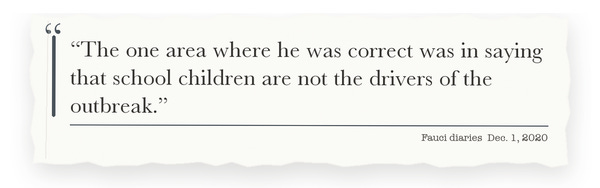
And there it was. In writing. In Fauci’s own words. In December of 2020. With most of the school year —and all of the next one— still ahead.
Generous of Fauci to credit Scott in his private diary, no? Not that it made a scrap of difference in his public messaging. And schools stayed closed.

🔥 For some reason, the Times entirely skipped the money issue, but it was perhaps the most revealing reframing fact. In February 2021, while millions of American children were still locked out of their classrooms, an Israeli foundation awarded Fauci the $1 million Dan David Prize. NIH ethics reviewers, clearly asleep at the wheel, cleared him to keep the cash: $899,960 (reduced by the prize’s mandatory scholarship carve-out).
And in a separate tranche of records Paul released the same day, we learned how these things got started. Here is Fauci in an October 2018 email to Duke’s Dr. Barton Haynes, shopping for awards:
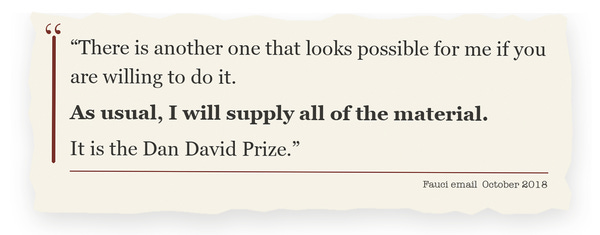
As usual. Two words, and a whole career falls into focus. He was not merely famous. He was monetizing— and he wrote his own nomination packets, which is the saddest detail in the entire release, and here I include Fauci butt-dialing Barbra Streisand. (Not made up.)
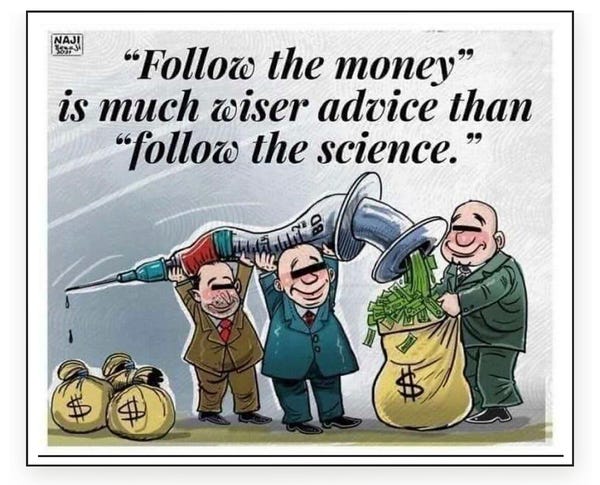
🔥 Now let’s discuss media malfeasance, because this isn’t only about Fauci. Fauci is a retired 85-year-old bureaucrat with a pension, a preemptive pardon, a shelf of self-portraits, and a very inconvenient subpoena. The potentially bigger point is the media trickery, and how you can spot it in the next story, the one after that, and so on.
The frame the Times used yesterday has a name. It’s called “Republicans pounce,” and it’s not a complaint invented by conservative talk radio. It’s a documented narrative construction strategy the Times has used for the better part of a century. The Washington Post’s own Aaron Blake, defending the media against the charge back in 2019, went and counted: he found at least twelve Times headlines literally featuring Republicans pouncing, including the 2019 classic “Ocasio-Cortez Team Flubs a Green New Deal Summary, and Republicans Pounce,” and 2016’s “Hillary Clinton Calls Many Trump Backers ‘Deplorables,’ and G.O.P. Pounces.”
Blake’s defense was that Democrats pounce in roughly equal numbers, which, sure. Nobody said cats only jump left. It’s just that doglike reporters never write stories in that direction.
Here’s the recipe, in a neat four-step checklist.
Step one: make the story about the reaction, not the document. The subhead told readers the news was a “furious debate,” not 1,141 pages of never-before-seen diary. Once the fight is the story, the evidence becomes incidental to the exciting pugilistic drama.

Step two: tell readers exactly what to think. From the story’s fourth paragraph, in the reporter’s own voice: “The diary does not provide the smoking gun the Senator is seeking.” That’s not evidence. That’s not even an anonymous source claiming it. That’s not a quote. That is the newspapertelling readers, before they’ve read a single entry, how a thousand pages of diary entries turned out.
And then, unloading the softest smothering pillow in journalism: the story said the diary merely showed Fauci “wrestling with a fast-moving crisis as scientists’ views evolved.” Evolution! In other words: here’s the excuse you can use for any inconvenient comments.
Step three: quote the harmless and paraphrase the harmful. See above. Julia Roberts gets a transcript, but deliberate insertion gets a smothering pillow.
Step four: bury the worst facts deep, and then end warm. This is where the journalistic knife slides between the readers’ ribs. In 2022, reflecting on fifty years of public service, Fauci assured ABC News he had “nothing to do” with school closures. But that 2022 claim was explicitly contradicted by his own diary, written at the time it was happening, on March 15, 2020.
Even with the benefit of both statements, the Times apparently couldn’t quiteconnect the dots on this egregious lie. In Fauci’s own 2020 words:
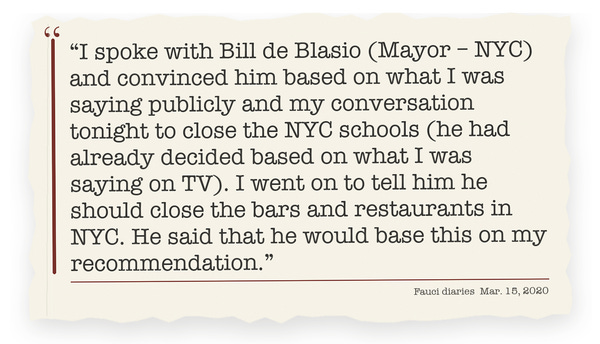
The lab-coated wonder then added that Gavin Newsom’s chief of staff had also called, to confirm that, based on Fauci’s TV appearances “today and yesterday,” the oleaginous governor had also decided to close California’s schools, bars, and restaurants too.
Read it again. Notice how Fauci claimed double credit in the same sentence— first, he personally convinced the mayor, but also the mayor had already been convinced by watching him on television. The man could not fit all of his massive influence into a single independent clause. (Or all of his ego into one pint-sized cranium.)
New York and California: Two of the largest school systems on the North American continent. Millions of children. Thousands of lost learning years that we are still, right now, paying the price for.
True, the Times printed that one. Partial credit where it’s due. They printed it in paragraphs 31 and 32 of a 34-paragraph story, introduced by the words “critics spent much of the past several days digging through the records for tidbits in which he appeared to contradict himself.”
Tidbits. Appeared. Critics! Who spent days digging to find an apparentcontradiction (not an obvious lie, no, never). Apparently, non-critics aren’t digging at all.
And then —showing artistic levels of gaslighting— the Times closed its sycophantic piece by noting that George W. Bush had once given Fauci the Presidential Medal of Freedom, and it quoted Bush’s ceremonial line about how Tony’s one flaw was how he always forgets to stop working, and how co-workers used to leave notes on his car windshield telling him to go home. My only failure was perfectionism.
That was the final fact in the article. Placed very carefully for readers who lasted that long. That was the taste they wanted left in readers’ mouths. A furin cleavage site, a split room of virologists, a ‘clueless’ FBI, a million-dollar prize, and a fabulous lie about who closed the nation’s school systems— and readers exited with a gloopy, gushing anecdote about Presidential awards and a workaholic’s windshield.

🔥 Corporate media almost never lies to us outright. Outright lying is dangerous; it gets corrected, it gets sued, it gets fact-checked and saved on hard drives. What media does instead is quiet housekeeping. It decides which sentences get tidy quotation marks and which get broomed by a paraphrase.
Media decides whether the news is the document or the argument about the document. It decides that the school closure ‘contradiction’ gets buried down in paragraph 31 while Julia Roberts’ pitter-pattering heart lands in paragraph 26. In isolation, each editorial choice is arguably defensible. But combined, they’re a whole extermination truck— for the story, not the actual pest.
Roaches don’t survive because they’re strong. They survive because they’re thigmotactic— they need cover, pressed tightly against their disgusting carapaces, and they need the dark. Turn on the lights, and they jump right out, unable to hide: glossy, repulsive, impossible to overlook, and easy to squish.
This weekend, in what can only be described as impeccable timing, Rand Paul switched on the lights. Yesterday the Times raced up with a dish towel and started stuffing it under the door.
Fauci testifies tomorrow morning. I hear line-sitters are already selling spots. Bring your own bottle of Raid.
Have a terrific Tuesday! Come back tomorrow morning, for a whole new coffee service of essential news and extra-bold commentary.




Leave a Reply
You must be logged in to post a comment.