
Being Evil is not Insanity
September 9 | Posted by mrossol | American Thought, Crazy, Law, Malone| DR. ROBERT W. MALONE SEP 9, 2026 ∙PAID |
This is painful to read. Almost cannot believe this is the state of where we (MA) are in American, 2026. mrossol

OK, this is a bit of a rant today. So bear with me.
Massachusetts has written into law something that most people probably STILL do not understand: a person can kill someone, successfully claim insanity, and never serve a prison sentence for the killing. Ever.
In Massachusetts, if the jury has reasonable doubt about whether the defendant was criminally responsible due to insanity, the verdict is not guilty by reason of lack of criminal responsibility.
The defendant can then be sent to a psychiatric hospital for an initial 40-day period of observation. After that, the state can seek to keep the person committed, initially for six months and then in renewable one-year periods. SO TECHNICALLY LINDSAY CLANCY COULD BE RELEASED 40 DAYS AFTER SENTENCING.
This is psychiatric confinement, not a prison sentence. Once the person no longer meets the requirements for involuntary commitment, they can be released. There is no murder sentence sitting there waiting to begin. There is no requirement that they spend 20 years, 30 years, or life behind bars because they took another person’s life.
Think about what Massachusetts has created. Someone can commit a horrific murder, avoid a guilty verdict because there was reasonable doubt about their sanity at the time of the crime, spend some period of time in a psychiatric hospital, and walk out the door in 40 days if they are later judged well enough to be released. The victims remain dead. The killer can go home and murder again.
That is not a minor technicality in Massachusetts law.
There is no mandatory 20-year sentence. There is no mandatory ten-year sentence. There isn’t even a mandatory five-year sentence. Once the state can no longer prove that the killer remains mentally ill and dangerous enough to justify involuntary commitment, the legal basis for holding that person disappears. The murder does not then send them to prison, because legally they were acquitted of it.
Even more remarkable, it is extraordinarily difficult to determine what happens to these people after release. The Boston Globe found that Massachusetts privacy laws and fragmented records make systematic follow-up nearly impossible.
So the Commonwealth has constructed a system capable of releasing people who have killed after only a few years, while making it remarkably difficult for the public to determine how often they subsequently commit crimes. That is not transparency. And it is certainly not reassuring.
So when you listen to the juror implying that the holdout juror must have had ulterior motives, such as simply wanting to see Clancy go to prison, she is putting words in his mouth. She can’t get inside his head.

Being evil, even being possessed by evil, does not make someone insane. It makes them a murderer. There was substantial evidence that Clancy’s crimes were premeditated and not brought on by drugs. The evidence showed that she went on and off medications and was not taking anything particularly likely to induce psychosis at the time.
But even if she was in a drug-induced psychosis, that does not mean she is insane or shouldn’t be held responsible.
A man who gets drunk or takes drugs and then rapes a woman does not get to claim that the alcohol or drugs made him do it. Intoxication may impair judgment, lower inhibitions, or make someone more violent, but it does not magically erase responsibility for the crime, nor does it prove insanity. Being under the influence is not the same thing as being legally insane.
Massachusetts did not arrive at this absurd system overnight. It is the product of more than a century of law, followed by a series of changes beginning in the 1960s that made an already unusual system considerably more consequential.
Massachusetts has held since at least 1905 that once insanity is legitimately raised, the defendant does not have to prove he was insane. The Commonwealth must prove beyond a reasonable doubt that he was criminally responsible. Then, in 1967, the Massachusetts Supreme Judicial Court broadened the definition of insanity, allowing a defendant to escape criminal responsibility not only because he could not appreciate the wrongfulness of what he was doing, but because mental illness left him without sufficient capacity to control his conduct.
In 1970, Massachusetts went further. It dismantled the old system under which someone acquitted of murder by reason of insanity could be committed indefinitely. Psychiatric confinement instead had to be justified by the killer’s current mental illness and dangerousness. Once those conditions no longer exist, the person can ultimately be released. The murder does not then send him to prison because, legally, he was never convicted of it.
Later court decisions made this combination even more consequential by allowing the insanity question to reach the jury on relatively limited evidence. Once it gets there, the burden remains on the prosecution to prove criminal responsibility beyond a reasonable doubt. That is an enormous burden when psychiatrists can disagree about what was happening inside someone’s head months or even years earlier.
So Massachusetts has created a system in which the question can shift away from the most obvious fact, that someone deliberately killed another human being, and toward competing psychiatric opinions about the killer’s state of mind. If that creates reasonable doubt, the killer can be acquitted, hospitalized rather than imprisoned, and eventually released.
Massachusetts did not invent the insanity defense or the possibility of release. What Massachusetts has done is combine an unusually defendant-friendly route to an insanity acquittal with a system in which there is no minimum prison sentence for the killing at all.
Once acquitted, the murderer is no longer being punished for murder. The question becomes whether psychiatrists and a court believe that person is still mentally ill and dangerous enough to confine.
The deeper problem is that this system rests on inherently subjective judgments. Psychiatrists can examine the same defendant, hear the same facts, and reach completely different conclusions about whether that person was insane. Definitions and diagnostic standards also change over time.
Yet these competing psychiatric opinions can determine whether someone who deliberately killed another human being goes to prison for life or is acquitted, hospitalized, and potentially released years later. When the consequences are that enormous, a system this dependent upon shifting definitions and individual psychiatric judgment begins to look disturbingly arbitrary
The Clancy case also exposes the sad state of women’s mental health care. We have built a system astonishingly quick to diagnose women, prescribe powerful psychiatric drugs, change those drugs, add another diagnosis, and then reinterpret almost every form of distress through an ever-expanding psychiatric vocabulary. Yet when something goes catastrophically wrong, the same profession often cannot agree on what happened, what caused it, whether the drugs contributed, whether the patient was actually psychotic, or even where mental illness ends, and personal responsibility begins. Yet, these very same people might be the ones determining whether Clancy is released soon after the verdict.
And this is a profession with a malignant history. Psychiatry once lobotomized disproportionately large numbers of women, subjected patients to crude forms of electroshock, and promoted theories blaming mothers, including the notorious “schizophrenogenic mother,” for their children’s schizophrenia. These were not fringe ideas practiced in somebody’s basement. They were promoted by respected physicians and major institutions as legitimate psychiatric medicine.
And modern psychiatry has another problem it rarely discusses: its political monoculture. Psychiatrists are overwhelmingly concentrated on the political left, with surveys and political-donation studies documenting a striking liberal/Democratic skew. When a profession entrusted with defining what constitutes normal and abnormal thought becomes politically homogeneous, the danger is obvious. Shared ideological assumptions can begin to look like objective clinical judgment precisely because there are too few dissenting voices in the room.
That is not the history of a mature science steadily marching from certainty to certainty. It is a field with enormous power over people’s lives that has repeatedly embraced theories and treatments later recognized as profoundly wrong, sometimes cruel, and sometimes extraordinarily dangerous.
This is what decades of Massachusetts judicial and legislative tinkering have produced: the victims get a permanent sentence, while the killer may very well get a get-out-of-jail-free card. Where is the justice in that?

Because don’t forget. There are real victims here.
The murder weapon Lindsay Clancy used to kill her three children was shown in court.
Look at it.
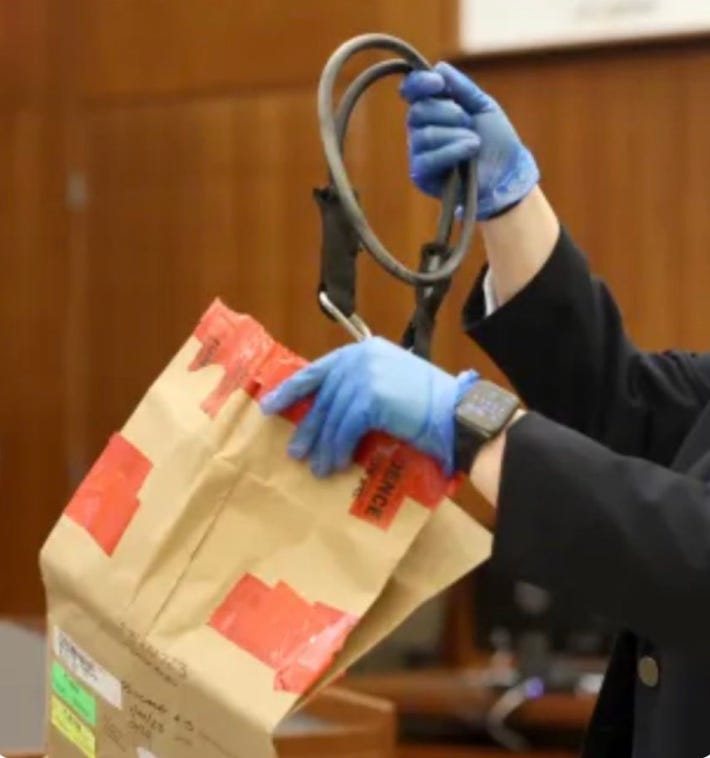
This is what she used to strangle her children, one by one, for minutes as they fought for their lives. Her eight-month-old baby had no chance. According to the prosecution’s account, the older children tried to get away from her. Their own mother pursued them, overpowered them, and killed them.
Think about that for a moment. These children knew their mother. They trusted their mother. And in their final moments, they were desperately trying to escape from her.
I keep hearing people search for words that somehow soften what Lindsay Clancy did. I cannot. Whatever arguments are made about her mental state, we should never allow them to erase what happened to Cora, Dawson, and Callan. Those children fought to live. Lindsay Clancy killed them.
Cora, Dawson, and Callan, little tiny children, fought to live, their father must live with the deaths and suffering for the rest of his life, and no psychiatric diagnosis, legal theory, or sympathetic retelling should ever be allowed to make us forget who took their lives or allow Lindsay to escape the justice she deserves.
By JGM/RWM
If you value independent reporting and commentary that is willing to go where the facts lead, even when those facts are uncomfortable, please consider becoming a paid subscriber.
This work takes time, research, and the willingness to say things that increasingly few people are willing to say out loud. Your subscriptions make that independence possible.




Leave a Reply
You must be logged in to post a comment.