
C&C. NOTICE. SCOTUS Fans on Mail-in Ballots.
September 15 | Posted by mrossol | Childers, DOJ, Election Issues, Fraud, Fraud, Illegal Aliens, Immigration| JEFF CHILDERS SEP 15, 2026 |
Good morning, C&C, it’s Tuesday! Your absolutely packed roundup today includes: the Supreme Court declines to rescue the mail-in ballot rule for the midterms, and we go digging through the pony pile for silver (three Justices, one “Hail Mary,” and a Republican secretary of state or seven); twenty-two blue states and Mayor Mamdani discover a Friday “emergency” in an immigration law Congress passed in 1882, and we read them the statute; Newsweek waters its hardiest perennial, the Trump Is Losing Smart People story, and we introduce it to two European leaders polling in the teens; and the SBA mails 870,000 pandemic-loan borrowers the most terrifying word in the English language, six years after an eight-minute application that doubled as a confession — plus the GOP lawmaker who found out first.
🌍🇺🇸 ESSENTIAL NEWS AND COMMENTARY🇺🇸🌍
⚖️⚖️⚖️
It looks like the last-minute legal show may now be over, and it wasn’t the buddy comedy ending we were hoping for. It’s ending more on the kind of upbeat note of its two stars holding hands and going over a cliff in a convertible. Late yesterday afternoon, the New York Times triumphantly reported, “Supreme Court Blocks Trump Administration Plan to Screen Mail-In Ballots.” Not great. But there’s a silver lining in the Times’s pony pile somewhere. Let’s start digging.
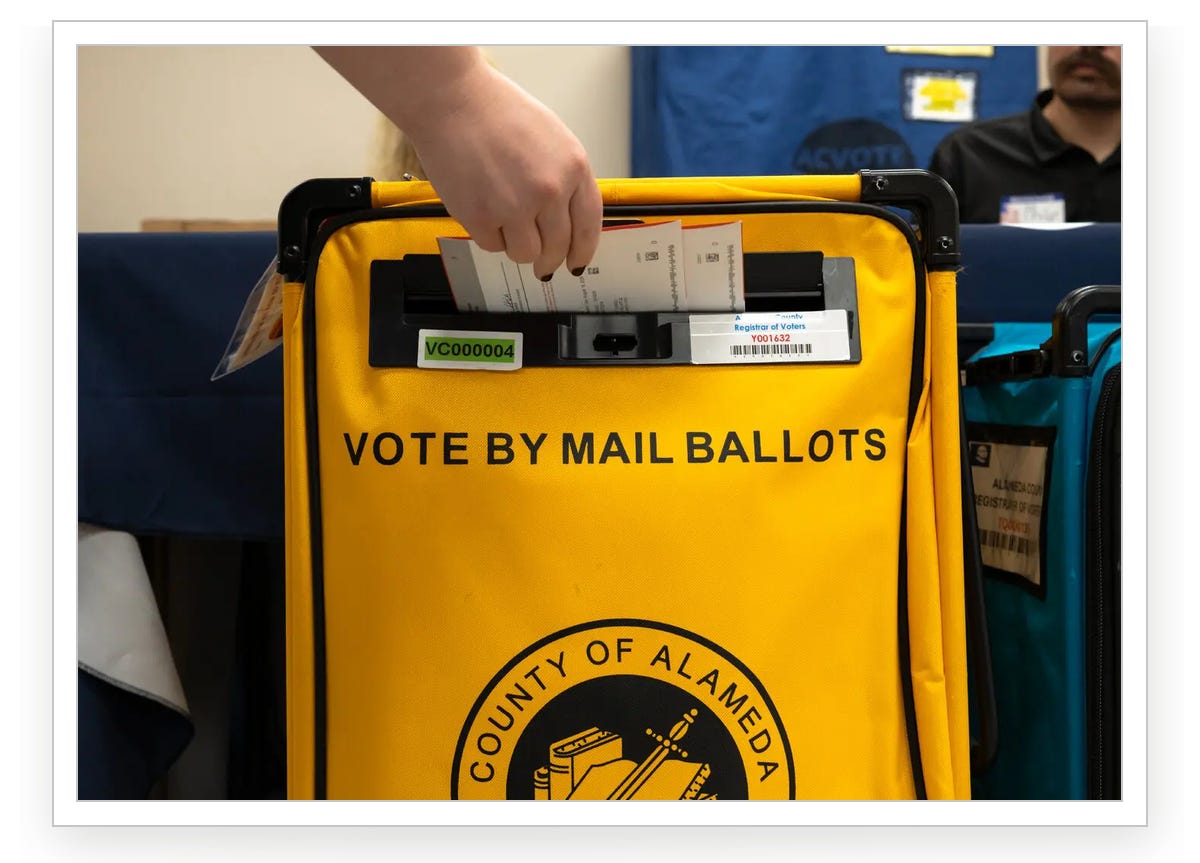
“The battle over the Trump administration’s plan to change mail-in voting has played out over the past few weeks in a dizzying series of legal developments,” the Times reported, “even as states began sending out ballots.” Yesterday —lamentably— the Supreme Court declined to stay Judge Talwani’s injunction blocking the Postal Service from activating the new ballot envelope standard.
The Times, sprinkling adjectives into its ‘straight news’ like beads off a Mardi Gras float, called it a “major loss” for the President and a “resounding win” for Democrats, who, it said, “had argued that the plan was unconstitutional and an existential threat to the democratic process.”
Which is what Democrats always say about everything they don’t like, including reflecting pools, but never mind. The Times unquestioningly reported the existential threat to democracy. This article was one of the best examples (meaning worst) of the Times’s increasingly obvious abandonment of even a pretense of journalistic integrity. They’re basically phoning it in now.
The Times described the “major loss”/“resounding win” as the Supreme Court “blocking” the USPS plan, as if it had body-checked the new rule. But the truth is, all the Court did was deny the Administration’s emergency request and leave Judge Talwani’s injunction in place while the litigation continues. The rest of the story was just as misleading. I won’t bother quoting Governor Newsom’s celebratory comments, except to note that he heroically worked the word “democracy” into a single sentence three times.
The unsigned order did not indicate any count or discuss the reasoning. It said little more than that the government “was not likely to succeed on the merits,” without explaining why. The Court did not say no. It said not yet, in writing, with a page cite.
But fortunately, Justices Alito and Kavanaugh wrote separately.
⚖️ Before we start aiming the rage machine at anyone, consider that Judge Talwani enjoyed one huge advantage: seven red states filed amicus briefs from their election officials swearing it would be impossible to comply in time for the midterms. It was a layup. The Supremes could impartially accept unrebutted arguments from the home team.
Justice Kavanaugh accepted that. He wrote a separate, also one-paragraph concurrence (the judicial equivalent of, “and another thing”). He explained that, while the rule was probably legal, it was just too late this time:
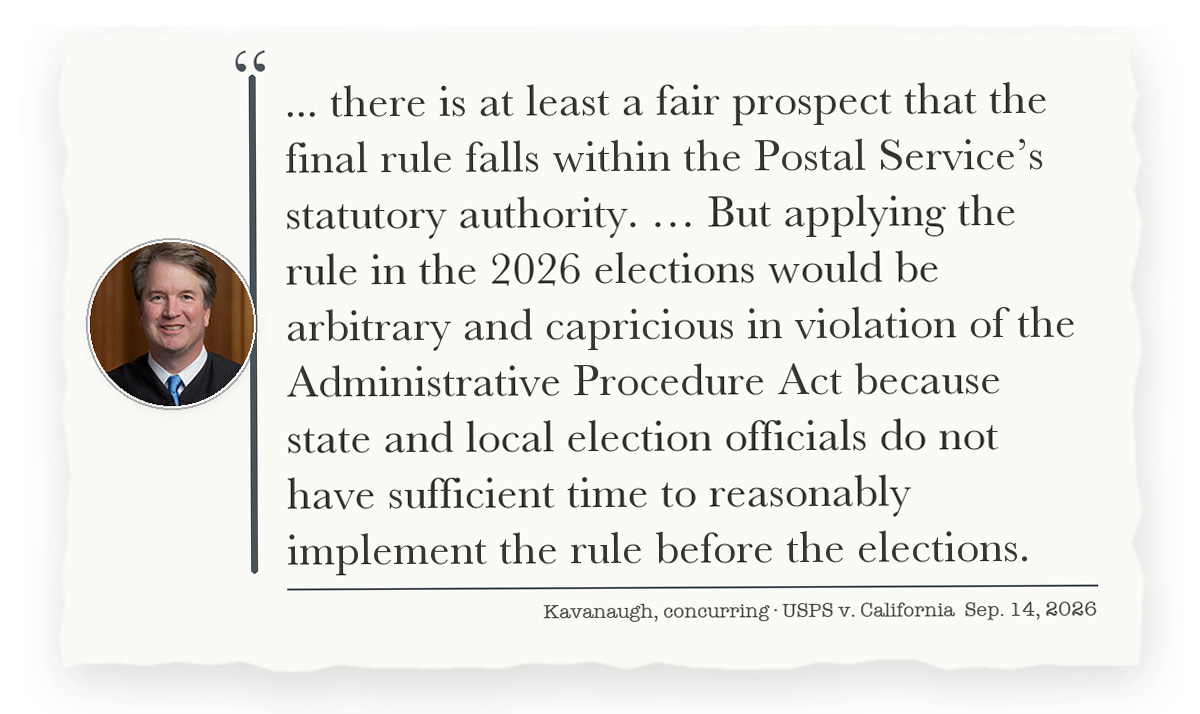
So mark the first sliver of silver in the lining. Kavanaugh is not prejudging —he only said it has a “fair prospect”— but he looks like one vote in favor of upholding the new standards whenever the case returns on the merits.
Next, Justice Alito, joined by Justice Thomas, filed a seven-page dissent saying he’d have allowed the rule to proceed even for the midterms. He went further than Kavanaugh. He helpfully explained why he thought the complaining states should lose. Get this: citing SCOTUS’s own precedent, he called their case a “Hail Mary pass”:
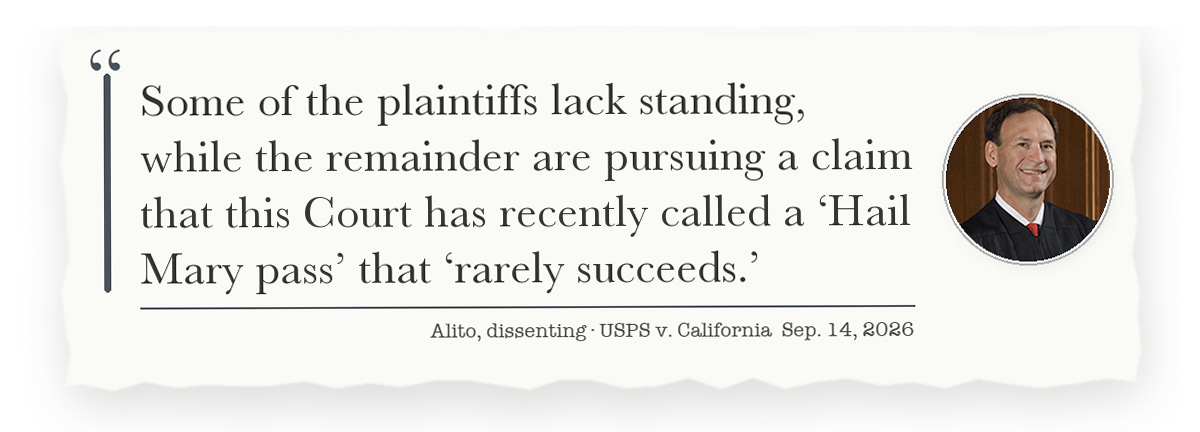
Not only that, he all but called it a lawfare operation. An NGO, he wrote, should not be able to “spend its way into standing simply by expending money to gather information and advocate against the defendant’s actions.” He was blunt: “Such cryptic filings cannot be used to show standing.” Lol, cryptic filings.
Justice Alito wasn’t buying the timing argument. He blamed the plaintiffs and the courts for the delay. “ The plaintiff States and the courts bear a substantial share of the blame for the rule’s timing,” he wrote bluntly.
So we can add two more Justices —Alito and Thomas— to the list supporting the rule. Granted, they are the most conservative robes on the high bench, but with Kavanaugh that makes three total, and we only need five.
⚖️ It’s misleading to call that a “major loss” for sanity and a “resounding win” for Democrats. Let’s count the silver. First, the drama of the lawfare and all the coverage has shoved the mail-in ballot issue front and center. The Times conceded this. “The weekslong legal tussle over the issue may have sown its own kind of confusion,” the article admitted, “a victory of sorts for Mr. Trump as he seeks to cast doubt on the integrity of the vote in an election his party might lose.”
Next, as I pointed out, the three Justices to say anything substantive all appeared to bless the rule, and Alito even offered the government helpful suggestions for how to win the larger lawsuit. The government’s lawyers can now cite the “Hail Mary” comment — and Judge Talwani can’t just wave it away.
We saw this same dynamic when Justice Thomas wrote an unsolicited opinion about how Special Counsel Jack Smith was unconstitutionally appointed, and South Florida Judge Aileen Cannon immediately adopted his reasoning and dismissed the case against President Trump.
There is a strong chance that the new rules will be settled law in time for the 2028 presidential election. So we must win the midterms the same way we won the 2024 elections in a red wave. The Democrats still face their polycrisis and a DSA civil war. Onwards, to plan E.
🔥🔥🔥
Speaking of self-created crises, twin choreographed immigration lawsuits landed in the Manhattan courts yesterday, filed more or less simultaneously. Twenty-two deep-blue states filed the first one, led by New York (Letitia James). The second was filed by six blue cities and counties, and one NGO, led by socialist champion and New York Mayor Mamdani, who announced it while characteristically grinning like a high chimpanzee. Reuters reported, “States, cities sue to block Trump immigration rule on public benefits.”You’re going to like this one.
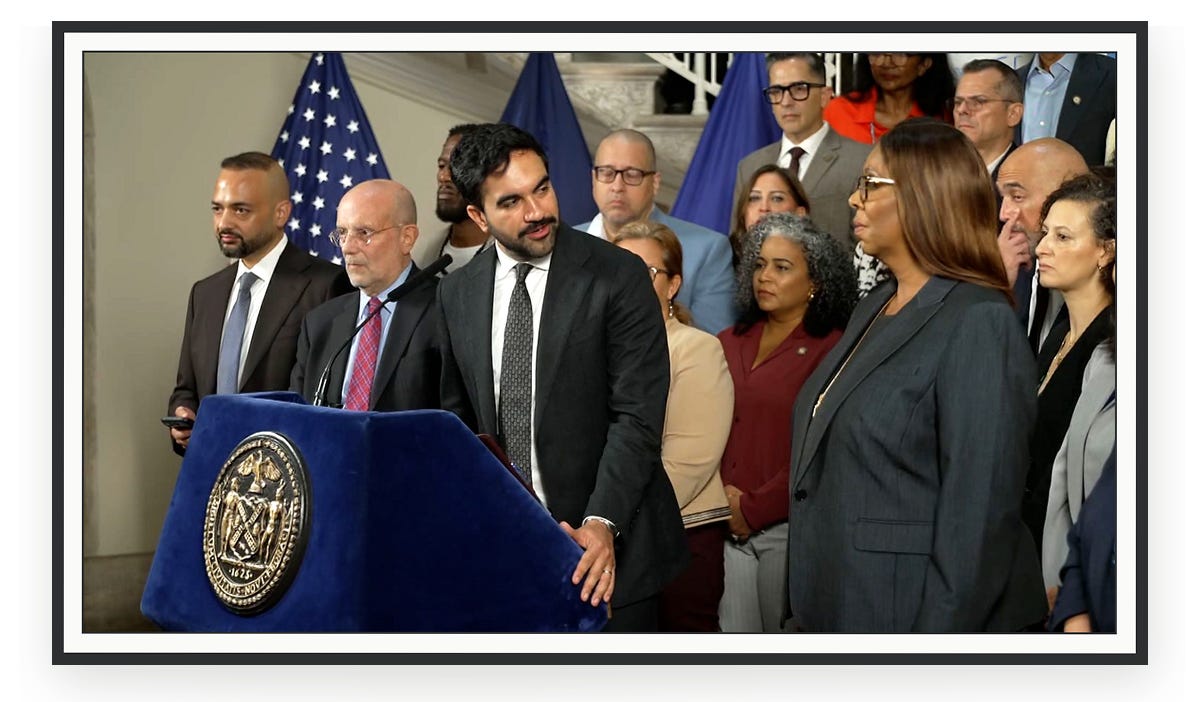
The two groups filed together, four days before the new immigration rule is scheduled to take effect (Friday), which allows using welfare status as an immigration test. The Democrats could have filed two months ago, back when the final rule was published on July 20th, but they waited till yesterday to create the conditions for an “emergency” injunction.
It’s the old saw about murdering your parents and then seeking sympathy for being an orphan. In other words, legally speaking, this is about as cynical as it gets, and a judge should shut it down, but, well, you know.
Wait till you hear the irreparable harm they’re claiming.
🔥 The new lawsuits seek to stop an ancient immigration law long on the books. It was originally passed by Congress in 1882, back before progressives got hold of the English language. Here’s the original 1882 “public charge” law, in all its plain-spoken glory:
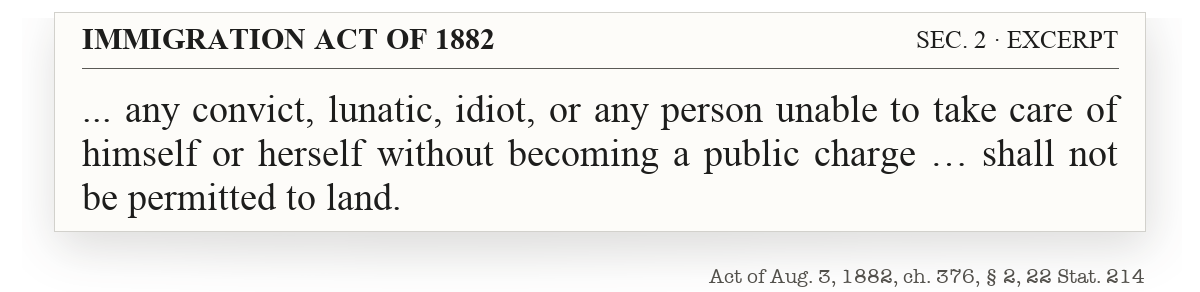
For no particular reason, I would like to point out that “convict, lunatic, idiot, or person unable to take care of himself or herself” accurately describes a disturbing number of members of a major U.S. political party, which shall remain nameless since this is a family blog, but I’m just saying.
That crystal-clear 1882 language offended snowflakes, so over time, they sanded it down. The law’s wording —but not its intended effect— was ‘updated’ over the years till its most modern form in 1996, which, for a variety of bad reasons, went largely unenforced until Trump 1.0. When Trump tried to bring it back into effective service in 2019, Democrat lawsuits blocked him, SCOTUS finally lifted the injunctions, and it ran for a short period. Then, in 2022, President Autopen issued a replacement rule basically ordering immigration officers to ignore it again. (Don’t tell the “No Kings” crowd, it will only confuse them.)
One of the greatest differences between Trump 1.0 and Trump 2.0 is that, during the first term, the President got almost no help from Republicans or the public, who were distracted by RussiaGate, serial impeachments, and mean tweets shaped like squirrels.
The current statute itself is simple, straightforward, and plainly written enough for a purple-haired transgender education major to understand. The law has two parts. Here is part “a”, which, despite all the diligent rhetorical sanding, is still about as blunt as you could ask for.
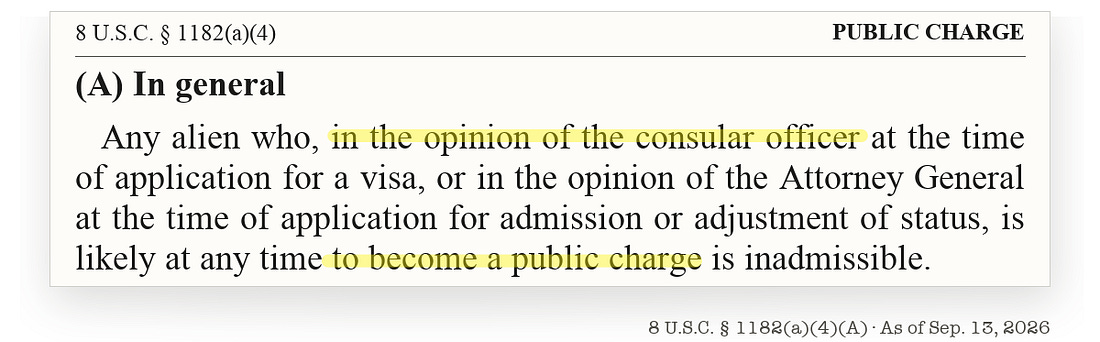
In short: “any alien who is likely at any time to become a public charge is inadmissible.” Period. The statute delegates that decision to the immigration officer, and part ‘b’ provides a little more guidance and a whole lot of discretion:
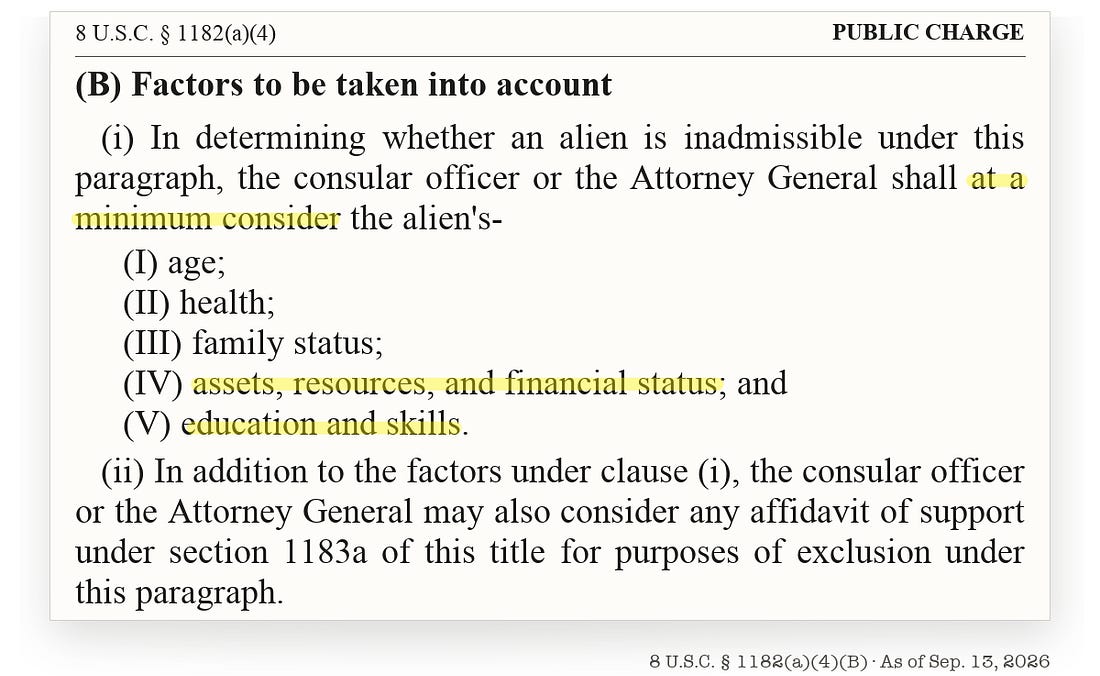
Summarized: “At a minimum, the immigration official shall consider age, health, family status, assets, resources, financial status, education, and skills.” So the official can consider more than these things, but must at least consider these things.
The weakness was that this statute never defined exactly what a “public charge” is. That allowed progressives —starting ages ago— to play their word games and narrowly define “public charge” as only people “primarilydependent on the government.” So immigrants could get in line for SNAP, WIC, Medicaid, free luxury hotel rooms, and other taxpayer gifts, and as long as the immigration officer could opine they wouldn’t be primarily dependent on the government, then they were fine. Here’s your green card and your food stamp application.
🔥 In 1996, Congress tried to strengthen the statute but wound up sanding it down some more. It allowed immigrants to overcome even primary dependence if they had an affidavit from a sponsor who ‘promised’ to be financially responsible for them. These affidavits are now on sale at most bodegas, and, of course, are never enforced. But helpfully, the statute only says the immigration official “may” consider the affidavit— not must.
Trump’s new rule strips progressives’ narrow definition of “public charge.” It just tells immigration officials to apply the plain language of the statute. But the new rule comes with guidance, and the guidance suggests that anyreceipt of means-tested benefits is “almost always…highly relevant” to the public charge decision. It offers helpful examples like housing, food stamps, healthcare, and college aid.
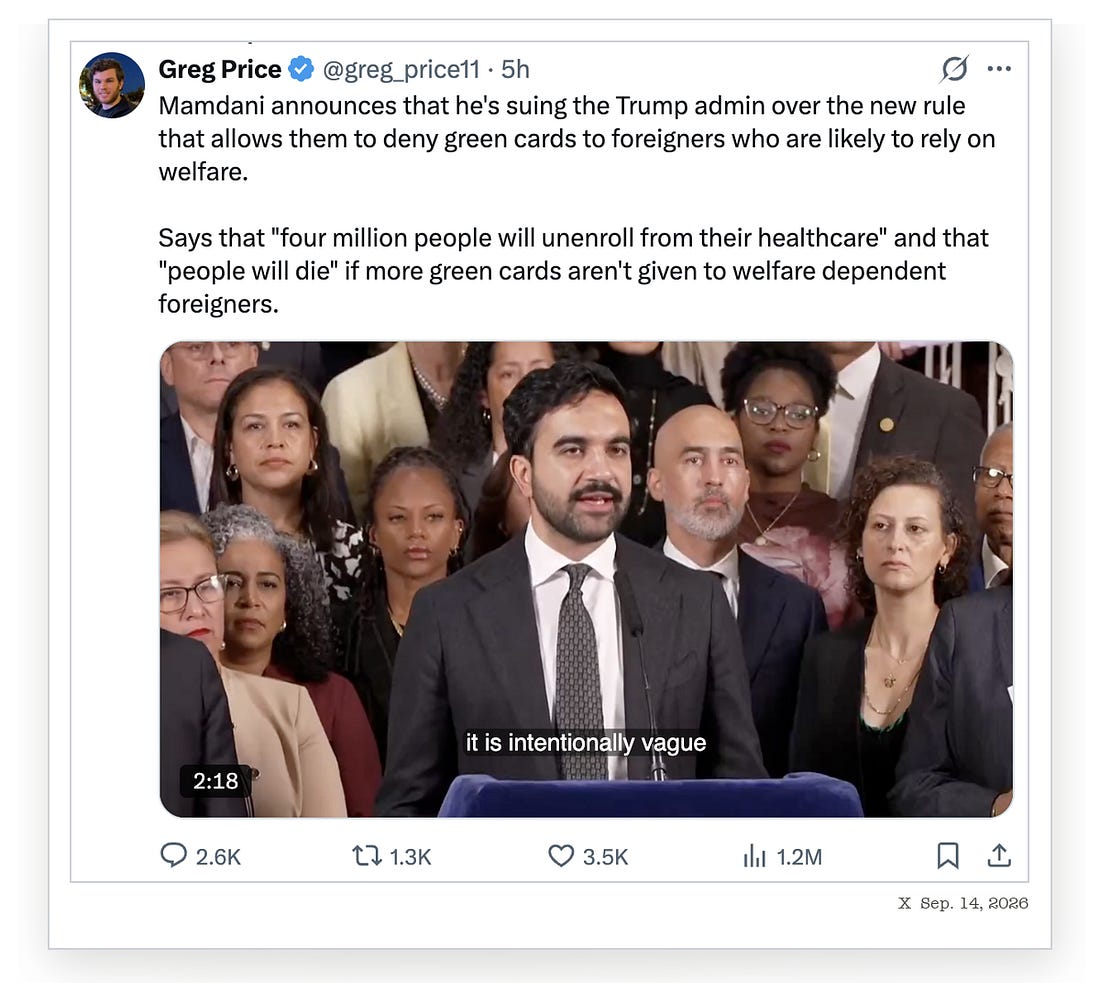
That’s driving Democrats crazy. They can’t stand the idea of not giving aliens visas, green cards, and citizenship— and signing them up for welfare on day one. New York City Mayor Zohran “The Magnificent” Mamdani complained that the murderous rule “seeks to push immigrant families away from the programs that have kept people fed and healthy for decades.” He warned darkly, without exaggerating, “people could die.”
Hardly. The new guidance says the official may not, in considering “family status,” consider the benefits received by other family members unless the alien’s own children would get benefits. Here’s where progressives stretch the truth like homemade taffy. Democrats insist that immigrants aren’t very smart. They get confused. They think any family benefits could prevent their overseas relatives from getting in too.
So, and this is the most terrifying part to Democrats, family members might voluntarily stop taking welfare. They focused on DHS’s own projection that a ‘chilling effect’ could result in about $13 billion a year in voluntarily reduced transfer payments. As if that were a bad thing.
“This rule preys on that fear and counts on families forfeiting the food assistance, healthcare coverage, and other public benefits to which they are legally entitled,” New York Attorney General Letitia James crowed.
Thus we see the “emergency” that the states and cities are using for standing. It’s not that the rule will actually strip benefits from resident aliens. They also worry that reductions in food stamps will hurt businesses that rely on them.
And, worst of all, it might discourage aliens with no jobs, no money, and no prospects from even applying for a visa. Senator Mike Lee (R-UT) put it simply:
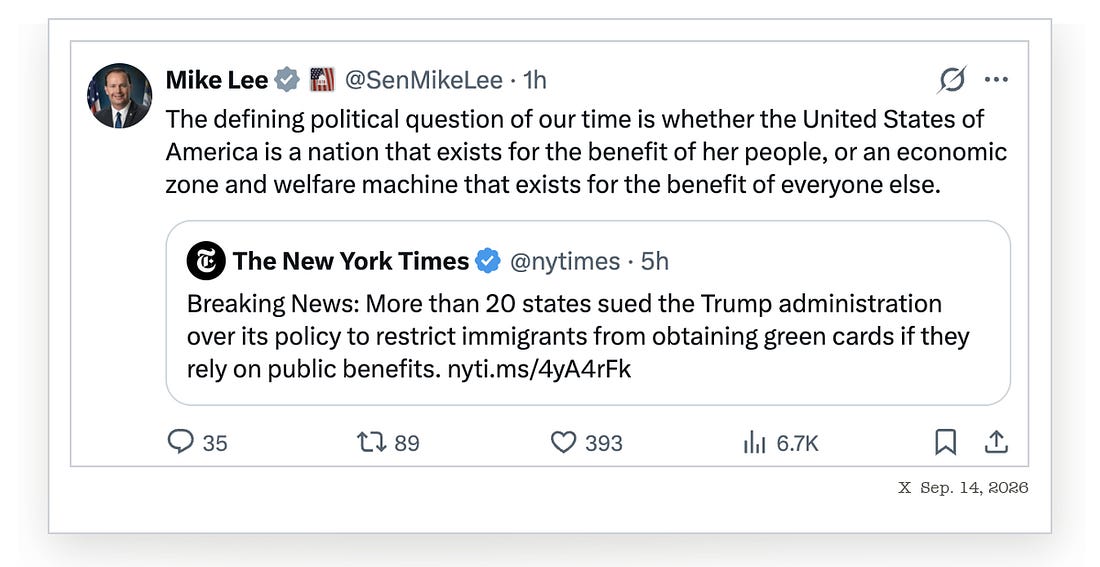
So Democrats want the court to throw out the new rule and guidance and return to Biden’s meaningless 2022 version. They want a judge to give them an emergency injunction to stop the new rule from taking effect. An emergency they created, by waiting till the last minute to file their lawsuit.
At this late date, I won’t even try handicapping what the Manhattan court might do. But the Trump Administration followed the rules to the letter. The original rule and request for comment were published last November. There is no emergency.
📉📉📉
Yesterday, Newsweek watered one of corporate media’s hardiest perennial stories, headlined, “Donald Trump’s Approval Rating Shifts With America’s Most Educated.” Ah, yes. The evergreen Trump Is Losing Smart People story. It flowers every few weeks, requires almost no sunlight, and can survive for years without producing any actual fruit.
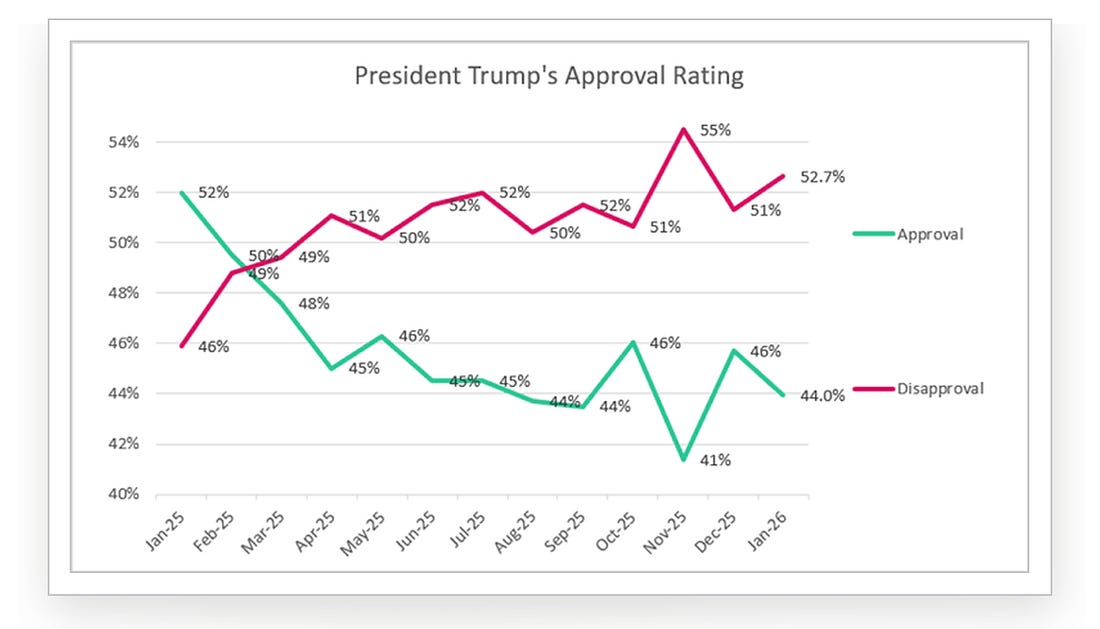
The exciting news was that Trump’s approval among college graduates fell from 34% in late August to 31% a week later, and then to 30% in early September. Newsweek described this four-point meander as having “fallen sharply,” which is the polling equivalent of describing a Roomba bumping into a sleeping Doberman as an exploding train derailment.
The first survey included a whopping 504 college graduates. The second expanded to 563. Newsweek reported that the polls’ overall margins of error were about 3.4 to 3.5 points. Then, several paragraphs after announcing the intellectual stampede, the story quietly admitted that the week-to-week movement “may fall within normal polling variation.” Um.
In plain English, that means Trump’s approval among college graduates may not have moved at all. But never mind.
Newsweek quickly recovered from this dangerous outbreak of statistical sobriety. The three readings, it said, “could be an ominous signal” for Republicans in November. So the same data may be meaningless noise, but it may also be the distant rumble of electoral doom. This is why professional journalism requires years of specialized education. An untrained person might recklessly conclude that nobody knows yet.
The story even conceded that polls have historically underestimated Trump’s popularity in three presidential campaigns. I am not making that up (like theydid). The instrument has misread the same patient three times, but when it twitches four points inside an unreported subgroup’s margin of error, well, everybody should strap on surgical masks and start buying toilet paper.
To be fair, college graduates are now an important Democratic constituency. They told pollsters they were highly motivated to vote, and that their congressional preference strongly favored Democrats. But that is not a new “shift.” It is the same coalitional alignment we have been watching for years, now repackaged as breaking news because the numbers went 34, 31, 30 — the political-science version of a microwave countdown.
Also, despite Newsweek’s arrogant framing, “college-educated” is not a synonym for “smart.” It means “has a diploma,” which can describe a neurosurgeon, a structural engineer, or somebody with $180,000 in student debt and a master’s thesis on gender expression in nineteenth-century Belgian puppetry. Meanwhile, the man repairing the transmission in your pickup may lack a four-year degree but somehow knows that a machine cannot run forever after you remove all the oil.
But the funniest part is the comparison corporate media never makes.
📉 In July, YouGov’s own European tracker found French President Emmanuel Macron at 20% favorable and German Chancellor Friedrich Merz at 16% favorable. Not just among the overeducated. Overall! Macron has since dropped to 16% popularity in a September Ipsos poll. And this week, Reuters reported that an eye-watering 78% of Germans do not think Merz should be chancellor — including a majority of voters (58%) from his own party.
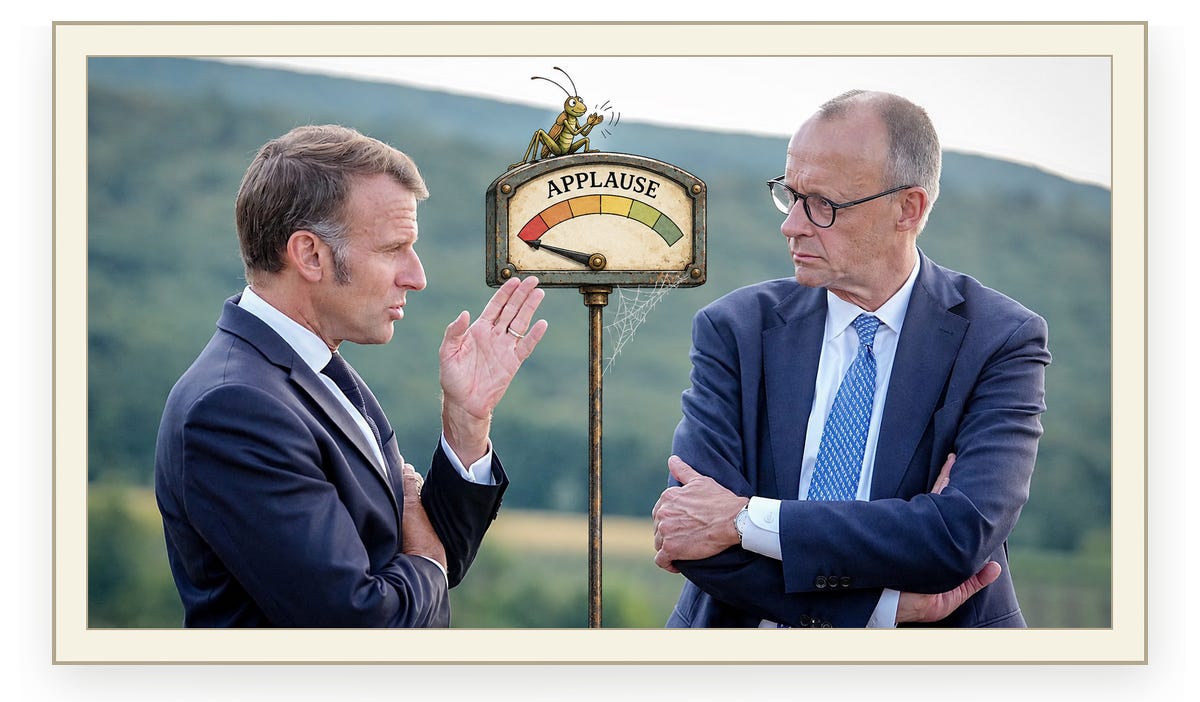
Yet both men remain in office, attending swanky summits, issuing gibberish in statements, bravely defending democracy, and being photographed striding gravely across expensive Kiev carpets as though 84% of the population had not just asked the government support chatbot whether there was a return policy.
Granted, favorability and job approval are not identical measurements. But they are close enough to expose the absurdity. When Trump draws 30% approval inside a microscopic subgroup already heavily aligned with Democrats, it is an “ominous signal” threatening control of Congress. When a European leader draws 16% support from his entire country, he is introduced as a respected statesman who will now explain to us how democracy is supposed to work.
Apparently European democracy operates under different software. In America, a president must maintain approval among every demographic category, including adjunct professors, artisanal pickle consultants, and people who describe NPR as “too centrist.” In Europe, a leader needs the support of roughly one citizen, two cabinet ministers, and a colorless granite building in Brussels.
This is the buried lede. The article is not really measuring Trump’s political durability. It is reassuring credentialed Democrats that the credentialed class still dislikes Trump— news roughly as surprising as a survey finding that golden retrievers remain broadly favorable toward tennis balls.
And the evergreen story never flowers because elections keep rudely interrupting the narrative. Trump loses the smart people. Then he wins more votes. The polls miss him. Then the next poll arrives, wearing a fresh lab coat and asking us to admire its precision.
So relax. The Trump Is Losing Educated Voters plant will keep growing back until Greenland becomes a state. It cannot die, because it does not depend on facts. It feeds entirely on wishful thinking, prestige anxiety, and a steady compost of people who are highly educated but apparently never learned to recognize the same story no matter how many times they shovel it out.
🔥🔥🔥
On Monday, Newsweek ran a very encouraging story headlined, “Map Shows Where 870,000 Borrowers Were Banned Over Alleged Pandemic Fraud.” The map is useful in case you were wondering which states contain people willing to invent a business to obtain free federal money. The answer is: yes.
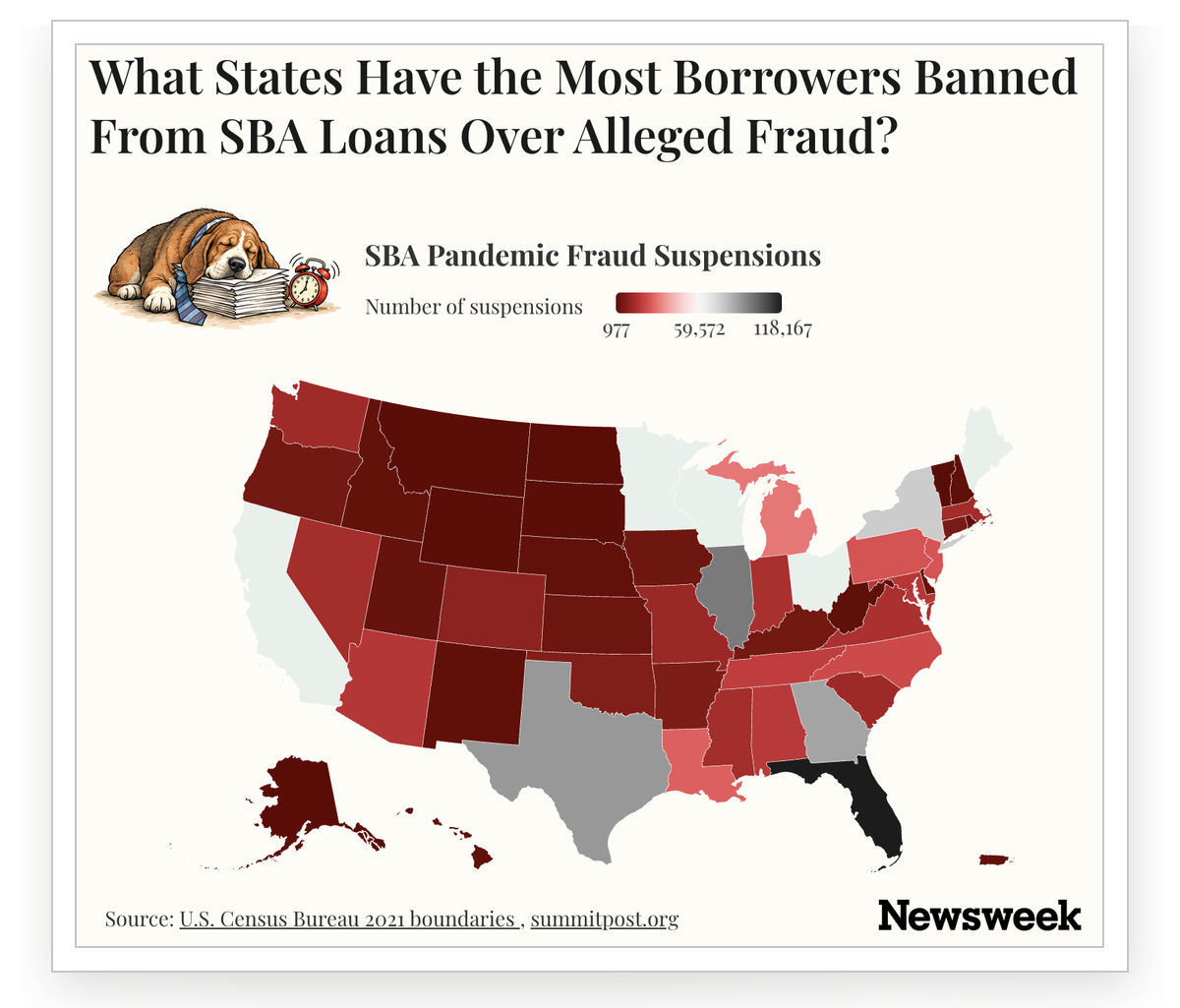
The SBA announced it has now suspended 870,000 borrowers connected to $39 billion in suspected fraudulent PPP and Covid emergency-loan shenanigans. That’s a lot. Added to earlier actions, the agency has now suspended more than a million borrowers nationwide tied to roughly $49 billion in suspected fraud. It is the largest enforcement action in American history, and it is still only one slice of the Inspector General’s estimated $200 billion pandemic-loan fraud banquet.
Behold, the honeypot.
Back in 2020, I warned clients to approach those loan applications like a sleeping alligator wearing a free-money sign. The programs were rolled out at warp speed during government lockdowns, the forms relied completely on self-certification, and applicants were being asked to make factual representations to the federal government under statutes carrying criminal penalties. That combination — easy money, an honor system, and signatures under penalty of perjury — was a moral hazard wrapped in DocuSign.
The government’s implicit sales pitch was, “Here is a nice big pile of cash. Now please tell us whether you qualify.” A surprising number of Americans responded, “Absolutely,” despite having no employees, no payroll, no operating business, and in certain ambitious cases, no discernible relationship with the Milky Way galaxy.
It looked easy because it was easy. The phrase “too good to be true” has often come to mind. Never in human history has getting hundreds of thousands of free dollars from the federal government been so convenient. The official PPP application itself estimated that completing it would only take eight minutes.
Those may have been the most legally consequential eight minutes since someone handed Richard Nixon a tape recorder.
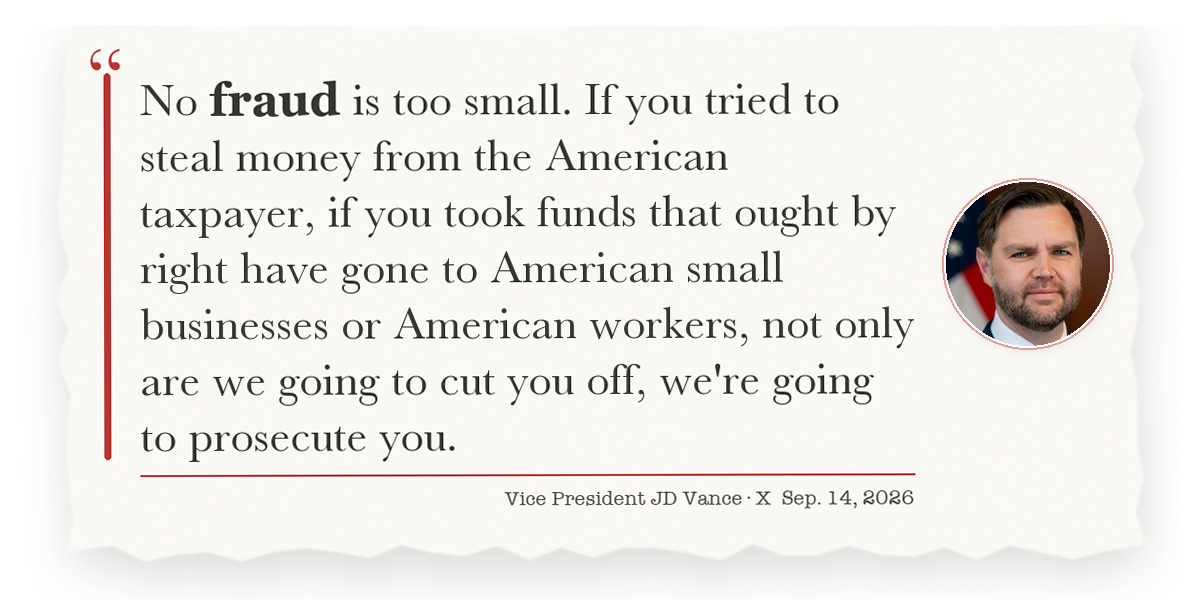
Before Vice President Vance fired up the Task Force, SBA’s policy was to only prosecute fraud if it was more than $1.5 million. Now, there is no floor.
🔥 The original Treasury application required applicants to certify that their businesses were operating on February 15, 2020; that economic uncertainty made the loan necessary; that the money would be used for authorized purposes; and that every material statement and supporting document was “true and accurate.” The form then explained —right above the signature line— that false statements could mean five years in prison and a $250,000 fine, or, when made to a federally insured institution, up to 30 years and a $1 million fine.
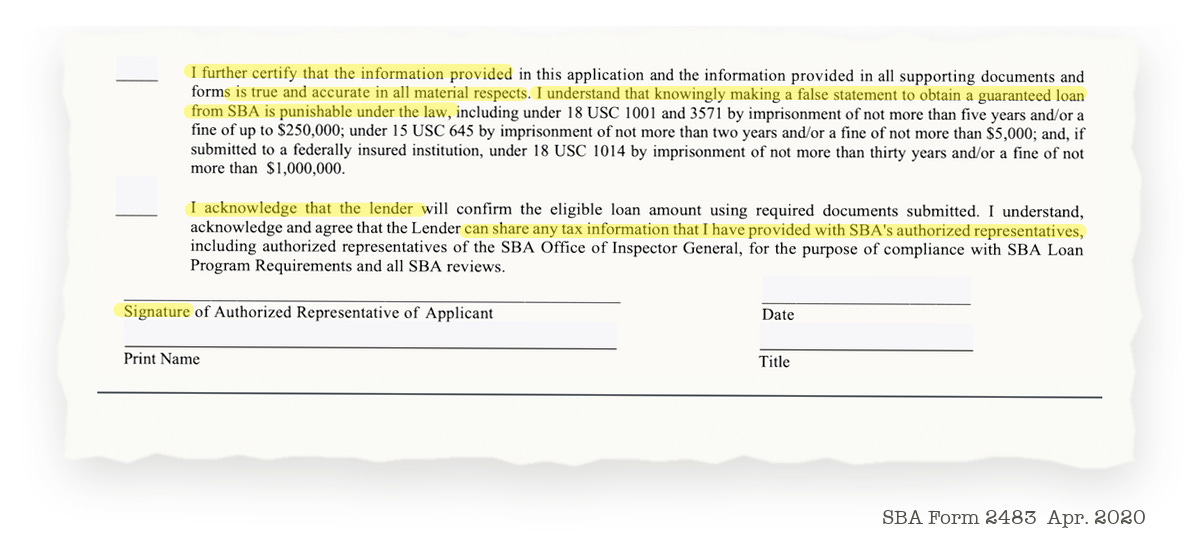
In other words, it was not in the fine print. It was in the medium-sized print, saying, Please do not fabricate a landscaping company unless you are comfortable discussing it later with federal prosecutors.
The same form also authorized lenders to share tax information with the SBA and its Inspector General, warned that financial records could be accessed, and explained that suspected violations could be referred to law enforcement. Thus, every dishonest applicant thoughtfully supplied the government with his name, Social Security or tax-identification number, bank, electronic signature, invented payroll, false certifications, and a convenient list of federal statutes under which he might someday be charged.
That was not merely an application. That was a fill-in-the-blanks prosecution memo.
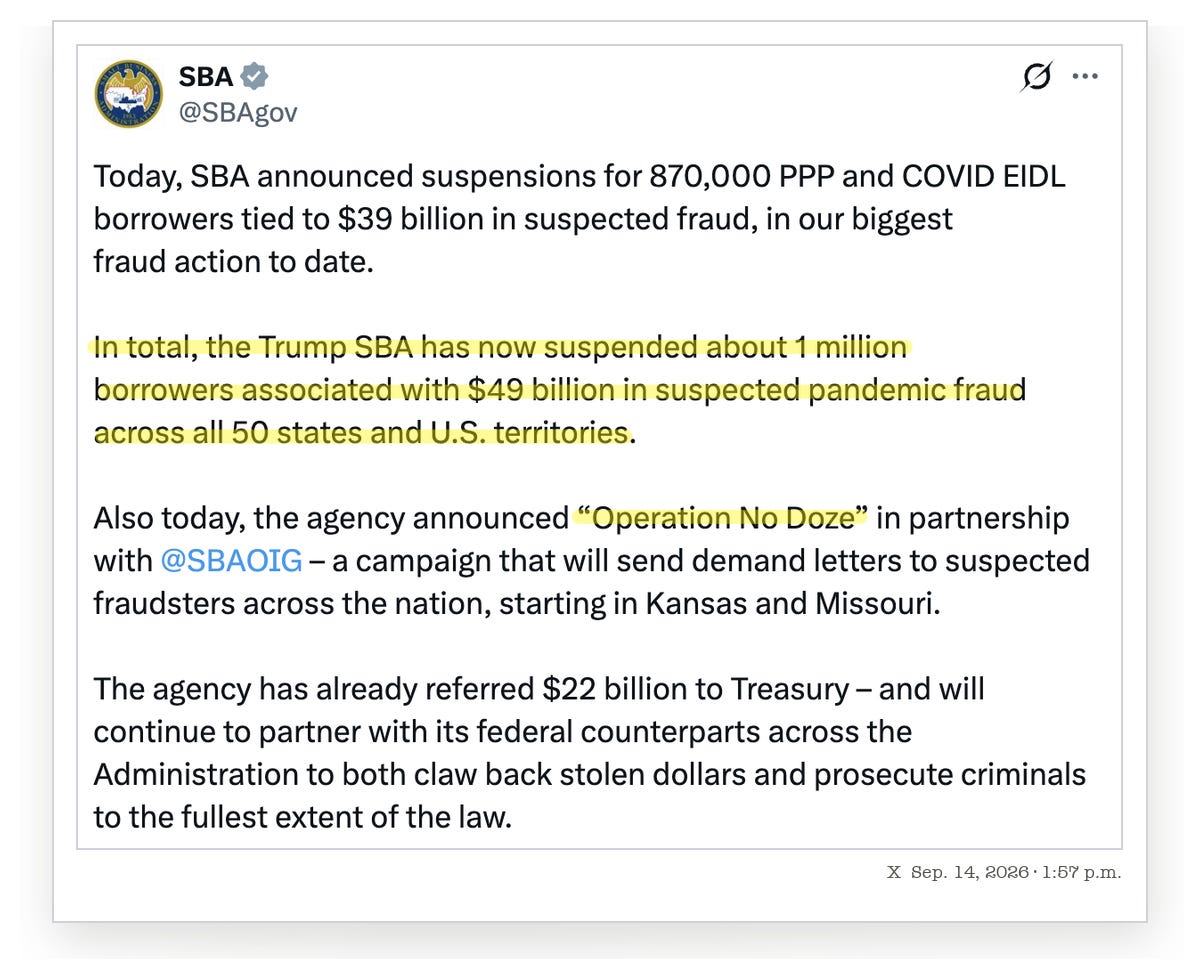
🔥 These 870,000 borrowers have been flagged as suspected fraud risks and cut off from future SBA loans and programs; they have not all been criminally charged, not yet, much less found guilty. Some legitimate borrowers may be ensnared in errors, bad data, or lost records, and they deserve due process. But that must be a very small group. The loan form wasn’t exactly complicated.
For the applicants who created phantom employees, counterfeit tax forms, and businesses that existed only in the hopeful province between their laptop and the federal Treasury, the daily trip to the mailbox is becoming, well, exciting.
Under its exquisitely named Operation No Doze, the SBA is beginning with about 8,000 final 30-day demand letters in Kansas and Missouri. Recipients must resolve or repay the flagged debt or face possible Justice Department referral, Treasury collection, liability of up to double the government’s damages, added collection costs of up to 28%, and offsets against tax refunds, federal salaries, contractor payments, Social Security, and other benefits. Whew.
You can picture the envelope. Heavy cream-colored government stationery. An eagle. A return address containing the words “United States.” The kind of letter that makes the family dog Bubbles stop barking and slink out of the room. NOTICE OF DEBT.
There is no word in the English language more terrifying than Notice. A political campaign sends you a brightly colored postcard. A federal agency sends you a Notice, which is a letter that has attended law school, carries handcuffs in its briefcase, is armed, and knows all your bank account numbers.
Vice President JD Vance summarized the new policy with the kind of plain-spoken simplicity common back in 1882: “If you screwed the American taxpayer, the federal government is now going to say you’re cut off, no more.” Meanwhile, the Justice Department’s summer surge produced enforcement actions involving more than 160 defendants and about $245 million in intended losses. Congress extended the limitations period for PPP and EIDL fraud to ten years, so the government can keep mailing its cream-colored thunderbolts through 2030 and 2031. (Absent further extension, that is.)
One featured defendant, Jamie Gray of Missouri, allegedly claimed to own dozens of pre-pandemic businesses. He was a veritable fraud factory, filing hundreds of loan applications. Prosecutors say nearly all were fictitious, while the one that actually existed — and I am not making this up — was a pet store called Fur Lives Matter, a Texas company that allegedly had no idea who he was.
Another defendant, Evie Zou of Texas, claimed 50 fake employees, used her daughter’s identity without permission, and spent the emergency loan proceeds on Austin real estate and brokerage investments. The government says those investments appreciated, so it now expects to recover more than she took. The stock market has joined the prosecution’s team. World wide:
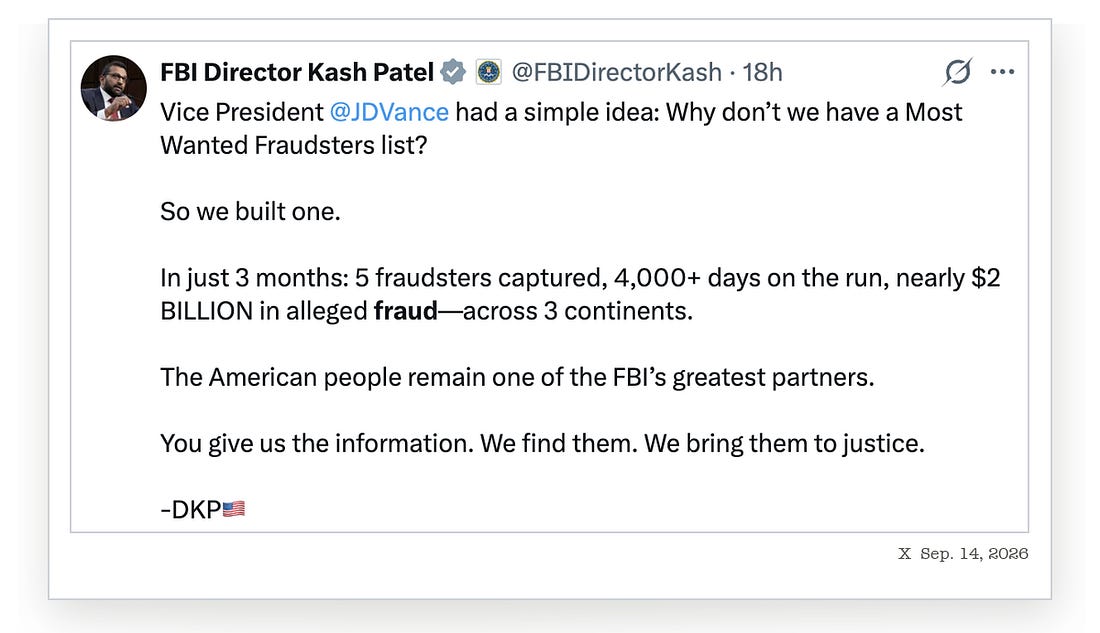
The institutional failures were spectacular. The SBA Inspector General foundthat officials weakened or removed normal controls in a “pay and chase” system, which also describes a certain type of gentleman’s normal evening out. The government sent out $1.2 trillion before performing the sort of basic checks that banks traditionally conduct prior to handing perfect strangers sacks of money.
At least 17% of all loans may have gone to potentially fraudulent actors. The government created the temptation, advertised the honor system, and postponed verification until after everybody had bought matching Maseratis. I’m not saying we shouldn’t trust Americans, but given the loose definition these days of “Americans,” maybe at least basic verification isn’t too much to ask.
One also imagines that, if one were in a certain demographic, say Republicans, one might have received the notice much, much earlier. I’m not completely speculating. President Autopen’s administration was able to find Republican lawmakers who fudged their covid loans. Remember former Florida State Rep. Joe Harding, who famously authored Florida’s so-called “Don’t Say Gay” law and was hated and reviled by the left? Headline from Conde Nast’s Them, an LGBT rag, dated October 2023:
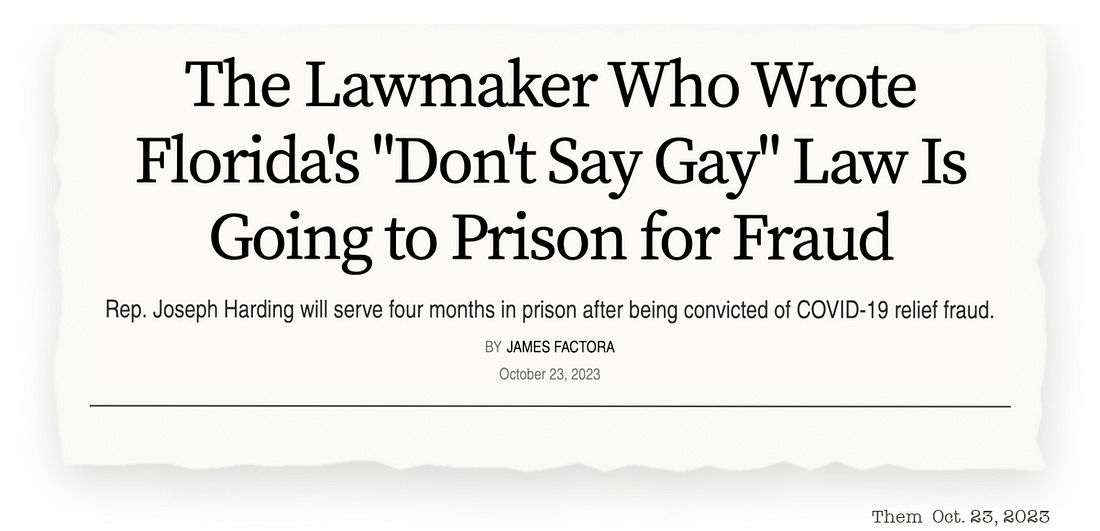
So. Payback, as they say, is something that rhymes with “witch.” Or maybe, fool around and so forth.
It’s been six years, which is long enough for fraudsters to start to breathe a little easier. But the delayed reckoning does not erase their signatures. That is the great 2026 reveal. What looked like a giveaway was also a database. What felt anonymous was indexed by Social Security number. What seemed forgiven was merely waiting for enough investigators, computing power, and prosecutorial attention.
The moral hazard has matured into a moral demand letter.
For six years, nearly a million Americans with flexible ethics may have believed they beat the system. Now the largest SBA fraud roundup in history is warming up, Todd Blanche says 500 federal prosecutors are now focused just on fraud, and Operation No Doze has five more years to work through all the names.
The free money was fast. The Notice took longer. And it knows where you live.
Have a terrific Tuesday! Coffee & Covid will be right back in the saddle tomorrow morning, with its saddlebags stuffed with more delicious essential news and caffeinated commentary.




Leave a Reply
You must be logged in to post a comment.