
The Carroll Case: Broken From the Start.
May 31 | Posted by mrossol | Law, Trump| ADA NESTORMAY 31 |
Deserves consideration. mrossol
The E. Jean Carroll civil case against Donald Trump will likely be remembered as one of the most procedurally aberrant episodes in the modern history of American civil litigation. Not because the accusation was implausible on its face. Not because civil courts are the wrong venue for claims of sexual misconduct. But because the foundational prerequisites of a fair proceeding were absent from the beginning, and the case was allowed to proceed anyway, until it produced a verdict that a significant portion of the country is being asked to treat as settled truth.
It is not settled truth. It is a product of broken process. And the distinction matters enormously.
When Did It Happen?
Start with what should have been the fatal problem.
Carroll could not tell the court when the alleged assault occurred. Not the month. Not the season, with any reliability. Not even the year, only a range spanning several years in the mid-1990s. Her own account placed the incident somewhere across a window wide enough to swallow an entire presidential term.
This is not a minor procedural gap to paper over. It is the load-bearing wall of any accusation. The question when is not a formality. It is the mechanism by which an accused person exercises the most basic right available to him: the alibi. It is how an innocent man, or any man, innocent or guilty, because the law does not presuppose the answer, says: I was somewhere else. Here is my proof.
Trump, for all his many documented flaws, is a man who has kept records. Calendars, assistants, staff logs, media appearances, building security footage, the infrastructure of accountability that attaches to any prominent New York real estate developer and public figure across three decades. That infrastructure exists precisely because time is trackable. Dates can be verified. Locations can be confirmed.
The absence of a date didn’t level the playing field. It annihilated it. It stripped the defendant of the one defense mechanism no legal system that takes due process seriously can ethically deny him.
That should have ended the case. A judge with the nerve to say so could have ended it there.
The case continued.
The Dress That Wasn’t
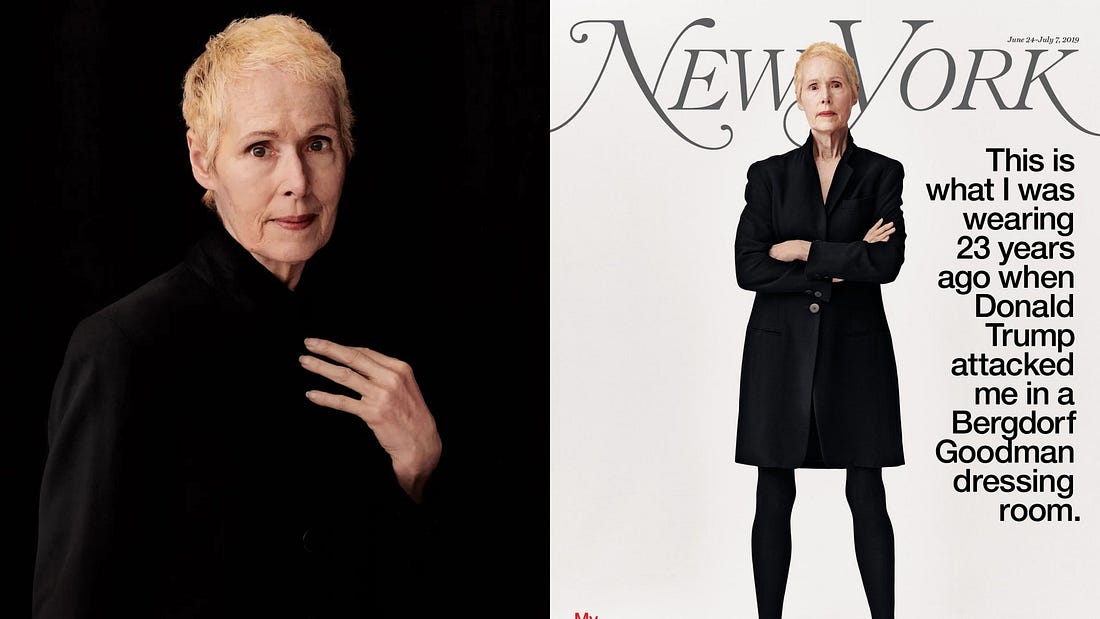
Absence of a date is a procedural problem. What came next was evidentiary.
Carroll produced a dress. The dress, she claimed, that she had been wearing during the assault. Physical evidence. Corroboration. The thing that makes allegations something more than one person’s word against another’s.
Except the dress was subsequently established to have been designed after the period in which the alleged incident would have had to occur. The garment that was presented as confirmation of Carroll’s account could not have existed during the timeframe her own testimony described.
Read that again carefully if you need to. It took me a minute to fully grasp that detail myself, years ago.
The sole piece of physical evidence offered to corroborate the account did not corroborate the account. It contradicted it. It falsified the timeline Carroll herself had put forward.
In a functioning adversarial proceeding, that is not recoverable. That is the moment a jury is instructed to weigh the credibility of the entire claim against the fact that the only physical evidence presented is impossible on its own terms. Juries have acquitted on far less.
The case continued.
Punished for Pleading Innocent
Then came the defamation suit, a legal architecture so circular it would be almost elegant if it weren’t so troubling.
Trump denied the allegation. This is, in a free country with a Fifth Amendment and a presumption of innocence, his absolute right. It is, in fact, something close to his obligation as a man maintaining his own innocence. The idea that a denial of wrongdoing constitutes actionable defamation of the accuser is a legal theory that should give every civil libertarian in the country, left and right, serious pause.
But the deeper problem was the procedural stranglehold. Because the Carroll claim had already been adjudicated, however defectively, Trump was barred from relitigating the underlying facts in the defamation proceeding. The verdict of the first, flawed case became the fixed premise of the second. He could not challenge what he was being punished for because a court had already decided he was not allowed to challenge it.
This is collateral estoppel weaponized as a trap door. He denied what had been legally declared true. He was penalized for the denial. He was prevented from contesting the declaration.
The practical result: a man was fined tens of millions of dollars, in part, for insisting on his own innocence, and denied any meaningful opportunity to prove it.
The Counsel Problem
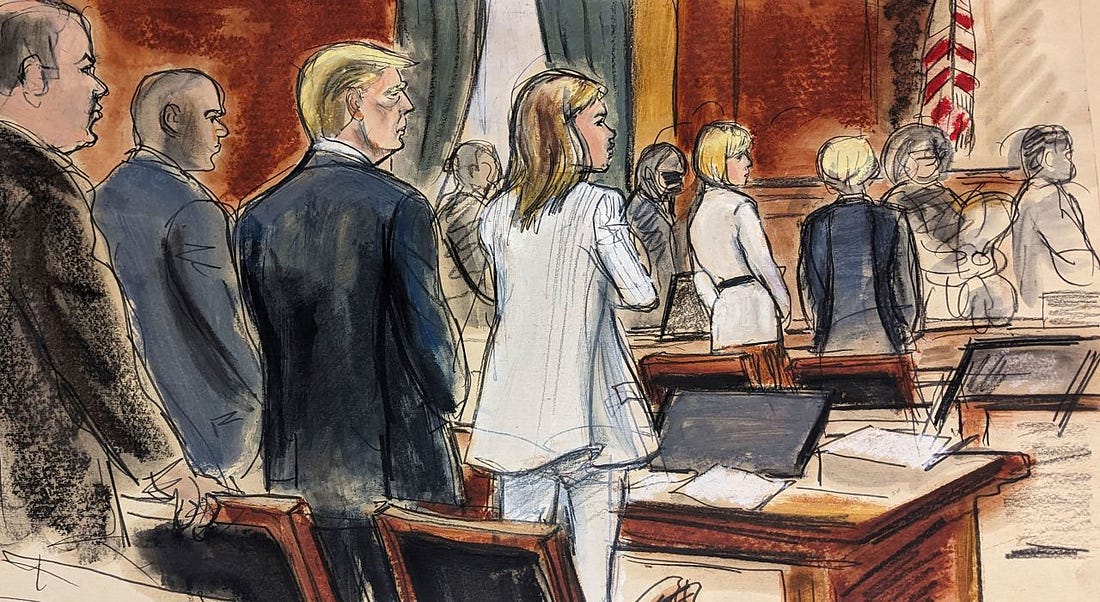
Alongside all of this ran something uglier and less discussed.
The coordinated professional pressure, and in some documented cases, physical threat, against attorneys willing to represent Trump across his various legal battles was real, sustained, and consequential. Lawyers declined representation not because the cases were without merit as legal matters, but because taking the client meant absorbing reputational and personal risk that no fee could offset. Law firms caved. Individual attorneys walked away. The message to the broader bar was clear.
The Sixth Amendment guarantee of counsel of choice is, strictly speaking, a criminal law protection. But the principle it encodes, that a defendant must have genuine, uncoerced access to competent representation, is not merely a constitutional technicality. It is the connective tissue of a legitimate adversarial system. When that tissue is deliberately torn, the proceeding that follows is not a trial in any meaningful sense. It is a performance of justice with the substance removed.
What Legitimate Authority Looks Like
Let us be precise about what this column is not arguing.
It is not arguing that Trump is definitively innocent of what Carroll alleged. Guilt and innocence in cases like this are genuinely difficult to establish, which is exactly why procedure matters so much. Process is not a technicality that guilty people hide behind. Process is what prevents the law from becoming a weapon anyone can pick up and aim at anyone they dislike.
What this column is arguing is this: the Carroll proceedings failed the basic tests of legitimacy. No temporal anchor. Physical evidence that contradicted the account. A defamation verdict constructed on the locked foundation of the first verdict. Access to counsel systematically compromised. These are not partisan talking points. They are procedural facts that any honest mind, regardless of political sympathies, should be troubled by.
A verdict produced under these conditions carries no legitimate authority, whatever its formal legal status.
The Investigation That Is Owed
Which brings us to the present.
It is not only appropriate to investigate Carroll. It is appropriate to investigate every party with a hand in constructing this case, the attorneys who shaped the legal strategy, the individuals who advised on the evidentiary presentation, anyone involved in the pressure campaign against Trump’s counsel. Let the sunlight in, fully and without favor.
If the evidence of how this case was assembled is as bad as the public record already suggests, the consequences should not stop at political embarrassment. There are people who may belong in prison for their roles in this, for obstruction, for fraud upon the court, for the sustained and deliberate effort to deny a defendant the process that American law promises every accused person regardless of how despicable or beloved he may be.
And Trump is owed serious damages. Not as a political gesture. Not as partisan payback. But because that is what the law provides for when process is corrupted and a man is publicly destroyed by proceedings that should never have reached a verdict.
Thanks for reading My Reflections From The Edge! This post is public so please share it.
Why I Am Writing This
I am a rape survivor. I put my rapist in prison.
I say that not for sympathy, and not to establish credentials as though suffering were a currency. I say it because it is the truth that sits underneath every word of this column, and you deserve to know it.
I know what it looks like when the system works. I know the weight of being believed, the grueling patience of real process, the specific and hard-won relief of an arrest, hearings and sentence that was earned. I know what it cost to get there, the cross-examination, the doubt, the exposure, all of it, and I would do it again, because that process is the only thing that makes the outcome mean something.
Which is exactly why false accusations, and the corrupt proceedings that sustain them, make me furious in a way that purely legal arguments never fully capture.
Every fabricated claim is a theft. It steals from the next woman who walks into a police station with shaking hands and a true story. It steals from prosecutors who have to fight harder to be believed. It steals from juries who have been burned before. It hands defense attorneys a weapon and teaches the public to hesitate. The damage is not abstract. It is direct, it is measurable, and it falls hardest on the most vulnerable people, the ones whose cases are already the most difficult to prove.
I did not write this column because I have any particular interest in defending Donald Trump. I wrote it because I have an absolute interest in defending the process that put my rapist away, the same process that was systematically dismantled in this case. When that process is corrupted for any defendant, it is weakened for every victim.
That is not a partisan position. It is the position of anyone who has ever actually needed the system to work.
An allegation is not evidence.
Process without substance is not law.
And a country that forgets the difference between verdicts and justice, because the target was someone it was fashionable to despise, has surrendered something it will find very hard to recover.
I want to take a moment to say thank you. Genuinely. Every subscriber to My Reflections From The Edge makes this work possible, and I do not take that lightly.
A quick reminder. Starting tomorrow, June 1st, the subscription price will increase– $8/month or $80/year. If you have been on the fence, today is the last day to lock in the current rate for the next year. If you wait to June 1st and subscribe for the full year, you get two months free!
But more thank anything, thank you. For reading. For sharing. For caring enough about honest, independent commentary to invest in. It means everything.




Leave a Reply
You must be logged in to post a comment.