
AUS War Against Fenbendazole
June 2 | Posted by mrossol | 1st Amendment, Australia, Censorship, Losing Freedom, Medicine, PharmaBEN FEN
JUN 01, 2026
Fenbendazole Can Cure Cancer presents Case Reports of people who have treated their own cancers along with other articles to help understand how fenbendazole works to treat cancer. Previous articles covering other cancers are in the Archives link. This Substack is one of several sources that aggregate Case Reports from those that are self-treating their cancers with repurposed antiparasitics including fenbendazole, mebendazole and ivermectin.
I received a disturbing report this week from a reader in Sydney. She ordered Cancer Is a Parasite on Amazon. It never arrived. Australian customs blocked it at the border.
I want to be transparent: this is an anecdotal report and I cannot independently confirm the precise grounds for the seizure. What I can do is tell you what Australia’s own published regulatory records show — and place that action alongside something that happened in the medical literature just weeks earlier — because together, they reveal a coordinated institutional response to the fenbendazole movement that goes well beyond coincidence.
Front One: Australia Moves Against the Cancer is a Parasite Book
In October 2025, Australia’s Therapeutic Goods Administration (TGA) formally amended the national Poisons Standard to reclassify fenbendazole — for the first time — as a Schedule 4 substance: prescription only medicine, with a narrow exception for veterinary use.
This was not quiet administrative housekeeping. The TGA’s own notice of final decision reveals the scale of enforcement that preceded it:
In the twelve months from September 2024 to September 2025 alone, Australian Border Force referrals involving fenbendazole totaled over 44,300 units.
Approximately 34,500 of those units were seized.
For comparison, in the entire preceding period from late 2020 through September 2024 — nearly four years — the total was just over 3,000 units.
That is roughly a 15-fold surge in seizures in a single year.
The TGA’s explicit rationale for the Schedule 4 reclassification was to provide “increased efficacy of compliance and investigation of importation.” In plain language: they moved to make fenbendazole legally impossible to import without a prescription, then massively escalated border enforcement to back it up. The TGA also separately pursued enforcement action against at least one domestic eBay seller who was marketing fenbendazole capsules labeled, among other uses, “for cancer treatment,” forcing that seller to sign an enforceable undertaking.
I field questions constantly like “Where can I get fenbendazole in Australia,” and of late, similar questions are coming from readers in Canada.
Share Fenbendazole Can Cure Cancer
Leave a comment
Front Two: The Retraction of the Most Important Peer-Reviewed Paper in Fenbendazole History
At almost the same moment Australia was seizing the book, something happened in the medical literature that I must address directly here, because it is the other blade of the same scissors.
In May 2025, Case Reports in Oncology published a paper by Makis, Baghli, and Martinez documenting three patients with Stage IV cancers — breast, prostate, and melanoma — who achieved dramatic and durable remissions after incorporating fenbendazole into their treatment regimens. Two achieved complete remission. One near-complete. All three tolerated fenbendazole without any reported adverse effects. All three remained in remission through the follow-up period — ranging, as of March 2026, from two to five years.
I take this retraction personally. I supplied all of the case report data that comprised the paper — drawn from independently verified hospital and medical records provided by the patients themselves. These are real people with real records who submitted their information faithfully to help others. That contribution was stolen from them.
The paper was retracted in early 2026. The reason given: the lead author, Dr. William Makis, had an undeclared financial interest — specifically, that he treats cancer patients with fenbendazole.
Read that carefully. The supposed conflict of interest is that a physician helps patients with an off-patent, over-the-counter veterinary drug that costs pennies per dose. Fenbendazole cannot be monetized. No one holds the patent. No one profits handsomely from its use. As Nguyen et al. (2024) documented in Anticancer Research, fenbendazole’s patent expired in the early 1990s, making it available as a generic accessible through animal supply stores and online platforms. The “financial interest” alleged against Dr. Makis is not just weak. It is nonsensical.
The Real Conflict of Interest
The retraction was ordered by the journal’s Editor-in-Chief, Dr. Maurie Markman — President of Medicine and Science at City of Hope, a multi-billion-dollar cancer treatment enterprise. City of Hope generates its revenue from expensive, patent-protected cancer treatment: chemotherapy, immunotherapy, targeted biologics — treatments that cost hundreds of thousands of dollars per patient per year, that are frequently toxic, that often extend life by only weeks to months, and that have been shown to stimulate and expand the cancer stem cells that drive relapse and metastasis (Tu et al., 2024). This is not just me stating these failures, it is a paper in the journal Cancers, a peer-reviewed scientific paper (Tu et al, 2024).
Dr. Markman approved the Makis paper for publication. It passed peer review. He read it. He accepted it. It entered the literature. And then it gained enormous public attention — because it documented exactly what tens of thousands of patients around the world already know: fenbendazole works.
Then it was retracted.
The financial conflict of interest in this story is not Dr. Makis’s. It belongs to the institution whose economic survival depends on patients remaining dependent on expensive treatments that fenbendazole — a 48-cent drug — threatens to render obsolete.
The irony of “City of Hope” is almost too rich to bear.
The Hypocrisy Applied Consistently
If we apply Dr. Markman’s standard uniformly across oncology research — scrutinizing every paper by investigators receiving pharmaceutical speaking fees, consulting payments, and clinical trial enrollment compensation — no paper would survive. The entire infrastructure of modern oncology research is saturated with financial conflicts of interest that make Dr. Makis’s alleged infraction look like a parking ticket.
Here is what is true: because Dr. Makis uses a cheap, off-patent drug with no commercial value, his paper is the onlypaper in this field that would pass a genuinely rigorous financial conflict-of-interest review. The retraction inverts reality. It punishes the one researcher who has no financial incentive to lie.
The Same Playbook, Two Theaters
Step back and look at what happened in the span of roughly six months:
Australia reclassifies fenbendazole, surges border enforcement to a 15-fold increase in seizures, and blocks a book about it at the border.
A journal editor with a multi-billion-dollar institutional stake in conventional cancer treatment retracts the most important clinical case series in fenbendazole history.
These actions may not have been coordinated in any direct sense. They don’t need to be. They reflect the same institutional reflex: when a cheap, unpatentable treatment begins gaining serious traction — documented cases, peer-reviewed publication, mainstream public awareness — the system responds by closing off the channels through which information and access flow. Seize the pills. Retract the paper. Block the book.
What the system cannot do is unseize the 34,500 units it failed to intercept before October 2025. It cannot un-read this Substack, which reaches hundreds of thousands of people. It cannot erase the 800+ documented case reports of fenbendazole, ivermectin, and mebendazole compiled by OneDayMD.com, Fenbendazole Can Cure Cancer and others as of March 2026.
The Science That Keeps Growing
The retraction did not delete the underlying science. It simply moved one document out of the indexed literature. The mechanistic and clinical evidence for fenbendazole continues to accumulate.
In a 2025 publication in Molecules, Lei et al. demonstrated that fenbendazole dose-dependently inhibited proliferation and triggered apoptosis in both conventional cervical cancer cells and cervical cancer stem cells — including the CD133+CD44+ stem cell population that drives therapy resistance and metastasis. The mechanism involved disruption of cyclin B1, cdc25C, Wee1, and CDK1 — a multi-target disruption of the cell cycle machinery in the very cells that survive standard treatment.
The broader anticancer mechanisms of fenbendazole — p53 activation, GLUT1 inhibition, hexokinase suppression, glucose uptake reduction, microtubule disruption, and proteasomal impairment — are comprehensively reviewed in Nguyen et al. (2024). Antiparasitic drugs are entering the clinical trial pipeline regardless: at the 2025 ASCO Annual Meeting, Bitar et al. reported Phase I/II results combining ivermectin with the checkpoint inhibitor balstilimab in metastatic triple-negative breast cancer, showing a 37.5% clinical benefit rate in heavily pretreated patients with no dose-limiting toxicities.
And at the population level: the 123 nations that conduct mass drug administration programs — giving antiparasitic drugs including benzimidazoles to their populations at scale — have approximately half the cancer incidence of wealthy nations that do not. This is WHO-documented population-level data that the current cancer research apparatus has no interest in exploring, because exploring it leads directly to fenbendazole.
The Information Cannot Be Stopped
Here is what Australian customs cannot block: a Kindle. A PDF. An audiobook. Cancer Is a Parasite is available in all three formats. If you are in Australia and want to read the book, you can do so right now through the Kindle or Audible editions. No border agent can intercept a digital file. Yet.
If the print edition blockage is confirmed and sustained, it will prove to be one of the more consequential strategic errors the cancer establishment has made. Nothing validates a book’s message faster than a government trying to suppress it.
I will be attempting to verify the specific grounds for the Sydney seizure through the publisher. If you are in Australia and have had a similar experience ordering this book, please contact me. Documentation matters.
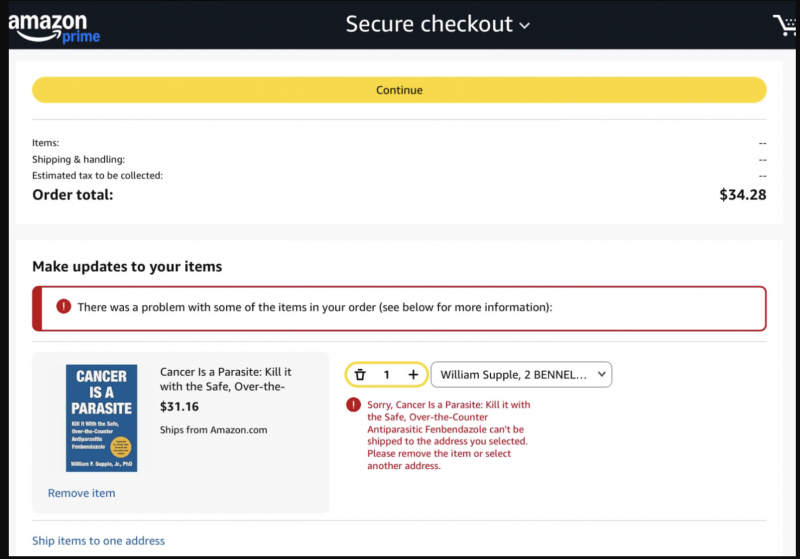
As an exercise, I did try to order my book to be shipped to an Australian address (Sydney Opera House) and received the following message: (see image below).
So it does appear that the book cannot be shipped to addresses within Australia.
What Must Happen Now
The safety question for antiparasitic drugs in cancer has been answered by billions of annual doses administered across 123 countries in the management of parasitic infections. The mechanistic case is established. The clinical evidence — including from the case reports that were my contribution to this field and that an institutional editor tried to erase — is real and documented and will not disappear.
What is needed now is a committed, government-directed, independent research program into antiparasitics as cancer treatments — a moon-shot effort to systematically optimize administration, bioavailability, dosing, and distribution of drugs we already have, for an indication that has been hiding in plain sight for decades.
That program should be housed within the Department of Health and Human Services and conducted without the corrupting influence of the pharmaceutical industry and the institutional cancer establishment. The retraction of the Case Reports in Oncology paper proves that the standard cancer research apparatus cannot be trusted to conduct this work honestly. They showed us exactly who they are.
Secretary Kennedy and HHS now have both the opportunity and the obligation to act.
The MAHA mandate is precisely this.
Maybe this type of research cannot be done at all in the United States due to corrupt infiltration. In my readings, I would say that most of the interesting research on antiparasitics and cancer is being done in China, India, Vietnam, places that already are familiar with these drugs and use these drugs at scale.
The evidence is in. Many thousands of cancer patients are alive and thriving today who might not otherwise be. And the forces that tried to erase them from the medical record — and block the book that tells their story at an Australian customs barrier — have a combined institutional conflict of interest that dwarfs anything they have accused anyone else of.
It is time to act.
The TGA’s October 2025 final decision notice is publicly available on the TGA website. The Australian Classification Board’s National Classification Database is publicly searchable at classification.gov.au.
Thanks for reading Fenbendazole Can Cure Cancer! This post is public so feel free to share it with someone who could benefit.
Share
References
Bitar, J. S., et al. (2025). A phase I/II study evaluating the safety and efficacy of ivermectin in combination with balstilimab in patients with metastatic triple negative breast cancer. Journal of Clinical Oncology, 43(16_suppl), e13146. https://doi.org/10.1200/JCO.2025.43.16_suppl.e13146
Lei, X., et al. (2025). Fenbendazole exhibits antitumor activity against cervical cancer through dual targeting of cancer cells and cancer stem cells. Molecules, 30(11), 2377. https://doi.org/10.3390/molecules30112377
Makis, W., Baghli, I., & Martinez, P. (2025). Fenbendazole as an anticancer agent? A case series of self-administration in three patients [Retracted]. Case Reports in Oncology, 18(1), 856–863. https://doi.org/10.1159/000546362 Case Reports in Oncology. (2026). Retraction statement: Makis et al., “Fenbendazole as an Anticancer Agent? A Case Series of Self-Administration in Three Patients.” Case Reports in Oncology, 19(1), 169. https://doi.org/10.1159/000549387
Nguyen, J., et al. (2024). Oral fenbendazole for cancer therapy in humans and animals. Anticancer Research, 44(9), 3725–3735. https://doi.org/10.21873/anticanres.17197
OneDayMD.com. (2026). Fenbendazole, ivermectin and mebendazole cancer success stories: 590 case reports compilation. https://www.onedaymd.com/2024/02/fenbendazole-cancer-success-stories.html
Supple, W. F., Jr. (2026). Cancer is a Parasite: Kill it with the Safe, Over-the-Counter Antiparasitic Fenbendazole. Skyhorse/MAHA Books.
Tu, S.-M., et al. (2024). Stem cell origin of cancer: Clinical implications beyond immunotherapy for drug versus therapy development in cancer care. Cancers, 16(6), 1151. https://doi.org/10.3390/cancers16061151
William F. Supple, Jr., PhD is the author of Cancer Is a Parasite: Kill It with the Safe, Over-the-Counter Antiparasitic Fenbendazole (Skyhorse/MAHA Books, 2026) and Founding Editor-in-Chief Translational Antiparasitic Medicine.
Cancer is a Parasite Book Notes
Cancer is a Parasite is the #1 book in many Amazon categories like breast, lung and prostate cancer! If you buy it on Amazon, please post your reactions and review on Amazon – a few words is all it takes. I think you can post comments on Amazon even if you obtained the book elsewhere. I would also ask that you comment here as well and as always, ask any questions that arise.
We are truly at a moment in time where a legitimate cure for cancer is about to enter the mainstream. The stars are aligned and the time is ripe for a real cure like fenbendazole. The ball is now in the court of the revamped Health and Human Services public health infrastructure. It is my hope that the shackles impeding progress from entrenched interests have been loosened enough to find the political will and courage to act in humanity’s best interests. It is truly a great time to be alive!
Thanks for reading Fenbendazole Can Cure Cancer! Feel free to share this article with someone who could benefit.
Share
Items Included in All Posts
Fenbendazole vs. Mebendazole vs. Albendazole vs. Flubendazole: The benzimidazoles are very similar chemically and they have very similar mechanisms of action with respect to disrupting microtubule function, specifically defined as binding to the colchicine-sensitive site of the beta subunit of helminithic (parasite) tubulin thereby disrupting binding of that beta unit with the alpha unit of tubulin which blocks intracellular transport and glucose absorption (Guerini et al., 2019). If someone asks you how fenbendazole kills the cancer cells, the answer is in italics in the previous sentence.
The class of drugs known as benzimidazoles includes fenbendazole, mebendazole, albendazole and flubendazole. Mebendazole is the form that is approved for human use while fenbendazole is approved for veterinary use. The main difference is the cost. Mebendazole is expensive ~$555 per 100 mg pill, while fenbendazole is inexpensive ~48 cents per 222 mg free powder dose (Williams, 2019). As you may recall, albendazole is the form used to treat intestinal parasites in India and these cost 2 cents per pill. FYI, to illustrate how Americans are screwed by Big Pharma, two pills of mebendazole cost just $4 in the UK, 27 cents per 100 mg pill in India and $555 per 100 mg pill in the US.
While most of the pre-clinical research uses mebendazole, probably because it is the FDA-approved-for-humans form of fenbendazole, virtually all of the self-treating clinical reports involve the use of fenbendazole. Because the pre-clinical cancer studies use mebendazole (ironically the human form of fenbendazole) and humans self-treat their cancers with fenbendazole (the animal form of mebendazole) it is very reasonable to assume that mebendazole and fenbendazole are functional equivalents with respect to cancer. It would be helpful if future pre-clinical and clinical investigations simply used fenbendazole as a practical matter. For the purposes of this Substack, fenbendazole, mebendazole and albendazole are used interchangably.
Where to get fenbendazole
In our experience and the experiences of those that write in, it appears that the three readily available brands of fenbendazole (Panacur-C, FenBen Labs, Happy Healing Labs) are equally effective. Panacur-C can be obtained locally in pet stores, while they all can be obtained from Amazon. The article on Questions & Answers discusses the brands of fenbendazole in detail and shows photos of the various brands referenced.
If you would like to report your experiences with fenbendazole you can do so privately by email myfenbendazole@proton.me or more publicly in the Comments section in any of the articles. Also, if you know of people who’ve tried fenbendazole, and it didn’t work, we’d be especially interested in hearing from you now. Understanding the conditions and factors that enhance or impede the success of fenbendazole in treating cancer are valuable.
Disclaimer:
Statements on this website have not been evaluated by the Food and Drug Administration. The contents of this website is for educational and informational purposes only and is not intended to be a substitute for professional medical advice, diagnosis or treatment. This website does not provide any kind of health or medical advice of any kind. Always seek the advice of your physician or other qualified health provider with any questions you may have regarding a medical condition. The case reports presented reflect the real-life experiences and opinions of other readers or users of the website. The experiences of those readers or users are personal to those particular readers/users and may not necessarily be representative of all readers/users. We do not claim, and you should not assume, that all other readers/users will have the same experiences. Do you own research, consult with relevant medical professionals before attempting to self-treat for any condition.




Leave a Reply
You must be logged in to post a comment.