
C&C. BRIEF AND SUDDEN ILLNESS. NYT Subpoenaed.
July 13 | Posted by mrossol | 1st Amendment, Childers, Crazy, Liberal Press, SADS| JEFF CHILDERS JUL 13, 2026 |
Good morning, C&C, it’s Monday! Your traveling roundup (I’m hotel-blogging from Atlanta) includes: Even more on Senator Lindsay Graham’s death, as more holes open in the official narrative, deceptive vocabulary is deployed, and what sure looks like a federal investigation begins; in other words, it is quickly become a mystery; hot takes are off the charts; we are reminded of the tit-for-tat industrial and infrastructure strikes from 2022-2024 that media said were just figments of our imagination; New York Times wants us to support it against federal subpoenas to testify against a treasonous leaker who risked the President’s life; the Times has no legal legs to stand on but of course, misleads everyone on the law.
🌍🇺🇸 ESSENTIAL NEWS AND COMMENTARY🇺🇸🌍
🔥🔥🔥
I covered the sudden and unexpected death of Senator Lindsay Graham yesterday, along with its political implications. But then, a mystery opened up, and cracks began to appear in the narrative. Naturally, hot takes cropped up on social media thicker than ticks on a deer. It started with four words.
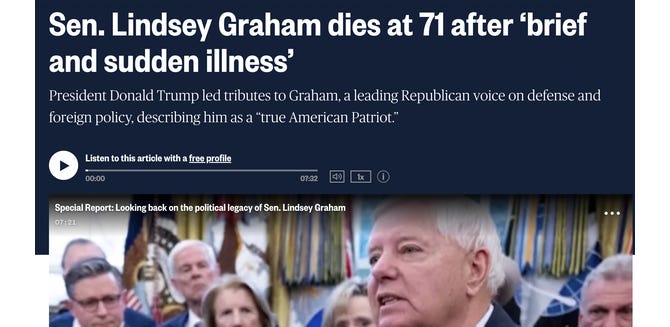
From the moment of Graham’s death, officials delivered an all-too-common line, a familiar, moronic media shibboleth from the covid era, which was that Graham drew his last breath at home on Saturday night following a quote-unquote “brief and sudden illness.”
Later in the evening, the Washington Post analyzed EMS chatter and confirmed that Graham’s “brief and sudden illness” was extremely brief— some form of cardiac arrest. Last evening, the Washington Post confirmed, “Lindsey Graham died of aortic dissection, preliminary medical report says”
A heart attack is, indeed, a very brief illness. Virtually instantaneous, making the phrase itself nonsensical. As we often observed during 2021-23, “brief and sudden illness” is an oxymoron, like “jumbo shrimp,” “military intelligence, or “seriously funny.” And what does the word ‘sudden’ add to ‘brief’ anyway? Aren’t the two words inherently contradictory? In other words, was it brief— or was it sudden? Pick a lane.
Do you remember Grant Wahl, 49, the famous sports journalist whose wife, Dr. Céline Grounder, was an infectious disease expert and jab-pusher? Grant died suddenly on screen on December 9, 2022, during the World Cup in Qatar. Like Lindsay Graham, Grant was posthumously diagnosed with an ‘aortic dissection,’ although he had no history of heart disease and was only 49.
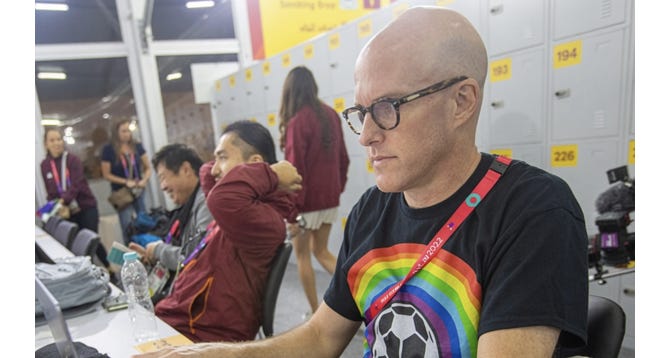
Grant Wahl was one of the most well-known American sports journalists of his generation. He died suddenly, on international television, at the world’s most-watched sporting event, less than 50 years old.
Under any normal standard of journalistic curiosity, Wahl’s death would have generated months of follow-up reporting — independent medical analysis, requests for autopsy records, and close scrutiny of the conflict of interest inherent in his wife serving as the sole source for the cause of death.
None of that happened. The story closed firmly within a week, on the authority of a single statement from a person with a direct professional stake in the answer.
🔥 Here’s the thing: Media used the exact same phrase to describe both Lindsay Graham’s and Grant Wahl’s deaths— both followed a “brief and sudden illness.”
I’m not claiming it proves Lindsay Graham joins the list of vaccine victims. 💉 The point is, calling heart attacks “brief illnesses” is not only dumb as rocks, but that phrase has always been deployed as a cover-up. During 2021-2023, those four words covered up thousands of people dying suddenly from jabs.
Nowadays, those words are less associated with the jabs, but they still signal some sort of cover-up.
🔥 So naturally, hot takes were inevitable from the moment the suspicious slogan “brief and sudden illness” was first printed. On top of that, the facts seem to have a few cheesy holes.
President Trump told the media he’d spoken to Graham “hours after he got back from Ukraine” and “sounded fine.” Graham’s media team had posted plenty of pictures from his trip to Ukraine, and in every one, Graham lookedperfectly fine. Even peppy. He was all set to appear on Meet the Press first thing Sunday morning.
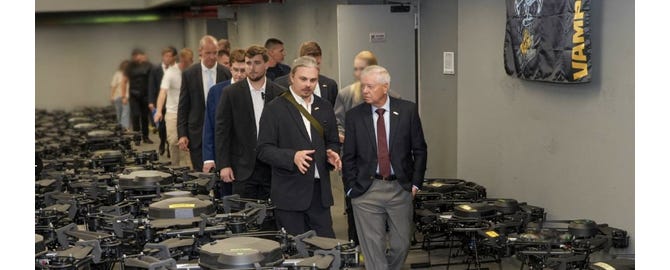
Here is the picture of Graham, taken the day before his death, touring a top-secret Ukrainian drone factory. Doesn’t he seem chipper? Not heart-attacky at all.
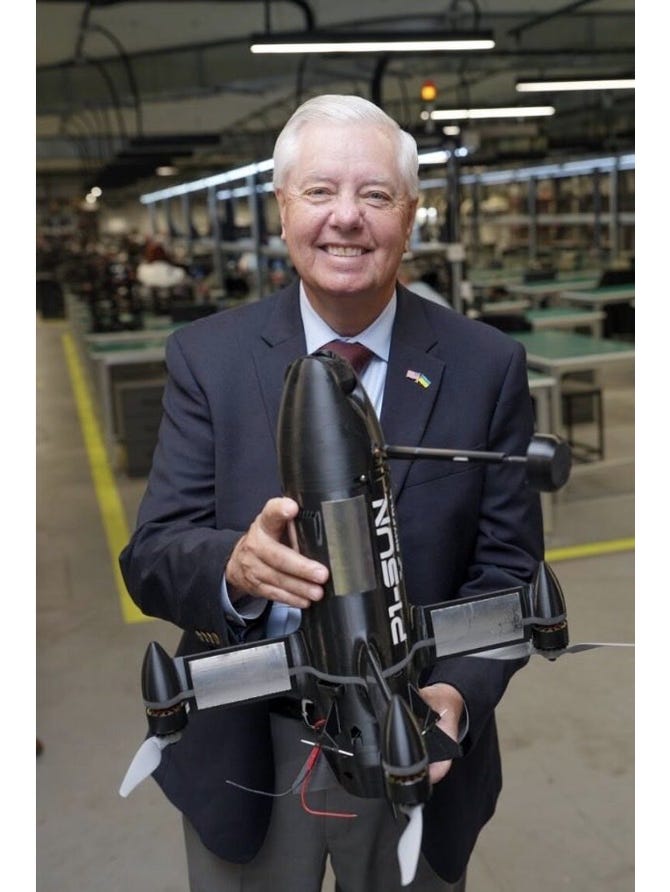
This disjuncture —the smiling Senator clambering through Ukrainian manufacturing shops with a spring in his step— doesn’t jive with a man sick enough to keel over right as he was resting (rather than exerting himself). I’m not saying it can’t happen. It’s just weird, like a healthy 49-year-old sports journalist dying on screen. It’s odd. It’s inconsistent.
But Graham’s death is more consistent with another rare option that might be slightly less rare for a public official who’s just returned from a war zone: top-tier assassination. For example, a potassium chloride injection —undetectable after death— induces a normal-looking heart attack. Others have mentioned microwave weapons, like improved versions of the ones used against US diplomats in Havana.
You could even read President Trump’s comments as sounding skeptical about the heart attack story. Trump told reporters, “He said, ‘I feel good, but I’m tired.’ He was fine. I knew him well. He would let you know if he wasn’t feeling well. He had days when he didn’t feel so well, and he’d let you know about it.”
Trump seemed to be suggesting if Lindsay felt sick, he’d have said something. But he didn’t. So.
By this point, the evidence for foul play was curious, but it wasn’t quite there. Too thin. Too speculative. Which is why I was ready to close the case when this happened. Several hours after Graham’s death, FBI Director Kash Patel tweeted that the Bureau was “assisting local authorities.” Assisting them with what? Checking for a pulse? Moving the body?
This was the weirdest clue of all. A federal counterintelligence investigation is totally inconsistent with a “brief and sudden illness.” And it sounded like somebody agrees. Somebody that got 4.6 million views:
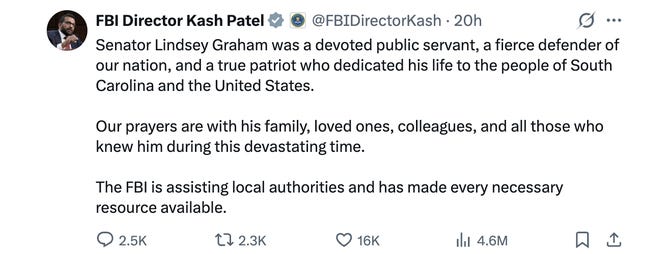
The “brief and sudden illness” narrative and the FBI’s involvement cannot both be true in the same story. They are mutually exclusive framings. Either it was a natural death —in which case the FBI has no business being there— or it wasn’t, in which case “brief and sudden illness” is covering up a potentially thermonuclear mystery.
So, while we don’t know what, it seems likely there is more to Graham’s death than meets the eye. Who was Patel signaling to when he announced FBI involvement? The public? Foreign intelligence services? Somebody else? We may never know.
🔥 If we were playing “Senatorial Clue,” we’d have a long list of potential suspects. And we are just 48 hours into the story. Here are just a few of the theories I stumbled upon during my research this morning. Maybe…:
- …the Russians assassinated Graham because he was a loud Putin critic who was “helping” Ukraine and for tit-for-tat reasons (more on that in a moment). Or…
- …the Ukrainians assassinated Graham, since Graham secretly helped the Russians by bringing his iPhone into the drone factory— which the Russians blew up later the same day. Or…
- …the Iranians assassinated Graham. During the widely covered funeral for the late Ayatollah, many protest signs included Graham’s face in crosshairs. They hated him and publicly swore revenge. Or…
- …the Israelis assassinated Graham. Honestly, I couldn’t make much sense of the complicated argument, but it’s out there. Something about Graham blocking a plane deal. Or…
- …the Chinese assassinated Graham because he was a Taiwan hawk and was recently pushing for stronger chip export controls. Or…
- …the Drug Cartels assassinated Graham, because he was on the Judiciary Committee, and he has been going after them like crazy lately and taking the war on drugs to Central and South America. Or…
- …his own heart assassinated Lindsay Graham. (Maybe with an mRNA assist.) All things considered, it’s still probably the most likely explanation and is included in the list for completeness.
Every option except #7 is consistent with FBI involvement, since the crime would have been committed on US soil. Presumably on US soil. I forgot one.
One additional line of conspiracy hot-takes has Graham being accidentally killed in Ukraine— unintended collateral damage in the Russian missile strike on the Kiev drone factory.
If this did happen, and if the public found out, then Senator Graham’s death would also kill any potential peace deal, not to mention vastly escalating tensions with a nuclear superpower. So, this theory goes, the powers that be are pretending he died just after getting home. In this scenario, the FBI’s role would be to control information and keep tabs on local investigators.
🔥 It’s fair to say the Senator Graham conspiracy-theory-zone is completely flooded. Which itself is a potential clue; flooding the zone with conspiracy theories is exactly what the deep state does when it’s covering its own tracks. The CIA has a documented strategy of ensuring that so many competing explanations circulate simultaneously that no single credible version can gain traction. When everything is a conspiracy theory, nothing is.
Put differently, guilty parties hide most effectively in a crowd of suspects. So, add the deep state to the list.
To this point, suspicions about Graham’s death can be located only in the chaos of social media. Skepticism hasn’t penetrated corporate media, which is still running “brief and sudden illness.” I wouldn’t expect much closure.
If a foreign power did assassinate a sitting U.S. Senator, the response would likely be handled, ahem, outside normal channels. Covert style. Black ops.
🔥 Remember the long series of tit-for-tat fires at manufacturing plants and refineries a few years back? AFP’s ‘fact check,’ 2022:

I showed you the pattern: how Ukraine would hit Russia (using US targeting data), then a few days later, some plant or chicken processing facility in the US would suffer a mysterious overnight fire. Then, while Ukraine obsessively targeted Russia’s Kerch bridge using our missiles, we lost the Francis Scott Key bridge, following a ‘mysterious navigation malfunction’ and a cascade of increasingly improbable failures.
Those kinds of stories and rumors have all died down and nearly vanished. We are no longer annoyed by corporate media fact-checkers assuring us how commonplace such events are, and how they were totally not signs of an escalating world war. Just accidents, nothing to see here, stop spreading misinformation.
🔥 But there’s another angle. Between 2024 and 2026, Ukraine has assassinated at least five Russian Lt. Generals in Moscow: Igor Kirillov (who accused Ukraine and the US of building bioweapons), Yaroslav Moskalik, Fanil Sarvarov, Vladimir Alexeyev, and Damir Davydov. Then, last month, Ukraine assassinated a top Russian defense contractor, Mikhail Chatski.
The Russian government’s position, stated explicitly and repeatedly at the official level, is that these assassinations were joint Ukrainian-American operations. That is not totally unreasonable. In 2022, the New York Times even bragged about the US helping Kiev specifically target high-ranking Russians:
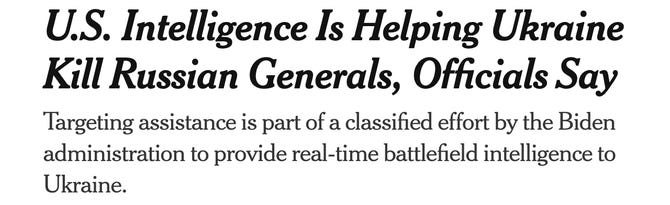
Biden’s White House called this report “irresponsible.” It didn’t deny it. Just the opposite, if you look closely. Draw a line from that 2022 story right through this Forbes article, published only about three weeks ago:

“The bombings and covert operations that have killed senior Russian military officials in recent years,” said Forbes, “are the visible result of a decade-long effort, supported by the CIA, to rebuild Ukrainian intelligence.” To give you an idea of just how close the agencies are, the head of Ukraine’s intelligence agency, Kyrylo Budanov, is treated at Walter Reed Hospital when sick or injured.
The assassinations are often tied to significant events for NATO or the US— sending messages, in other words. Gen. Igor Kirillov, for example, who led the effort to prove US bioweapons development in Ukraine, was killed by a scooter bomb one day after the UK sanctioned him for allegedly directing chemical weapons use. The timing was not subtle.
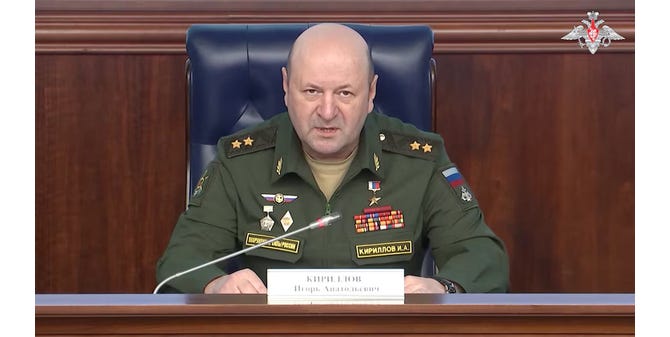
The Alexeyev killing in February of this year was also interesting. Gen. Alexeyev was the head of Russia’s GRU (like the CIA). He was shot to death in his apartment one day after a round of US-brokered peace talks ended without a deal. This time, the US did not even bother denying involvement. It just refused to comment.
The United States officially insists that it is “not at war with Russia.” This is, from Moscow’s point of view, merely a convenient legal fiction that provides cover for ongoing lethal operations against Russian personnel.
Senator Graham was the most visible American political face and the loudest voice of U.S. support. He visited Ukraine ten times. He was photographed grinning in a kamikaze drone factory the day before he died. In Moscow’s accounting, Graham was not a neutral civilian. They would see him as a combatant.
To be clear: this is wild speculation. There’s no way to prove it. But if you believe, as I do, that Russia traded nonlethal tit-for-tat strikes on American infrastructure during 2023-2024, then it is not inconceivable that Moscow might have reached its limit on the lethal assassinations of its high officials, and has now tatted a tit, or titted a tat, or however it goes. Struck back, if you follow me.
Don’t hold your breath waiting for a final answer. We’ll probably never know the truth.
🔥🔥🔥
Friends, the delicate flowers at the New York Times seek our sympathy. Prepare to open your hearts. On Saturday, CBS reported, “Several New York Times journalists issued subpoenas after Air Force One reporting.” The Times called the subpoenas a “brazen act” threatening to shred the overstretched fabric of democracy itself. In other words, it’s Monday.
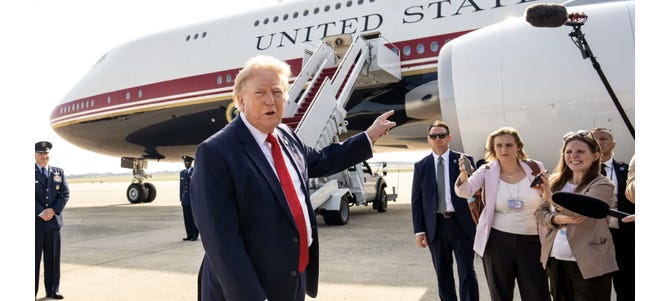
On Friday, the DOJ subpoenaed several New York Times reporters to appear and testify before a criminal grand jury investigating a leak of top-secret classified details about the security technology on Air Force One.
Federal agents showed up at the reporters’ homes to personally deliver the subpoenas— what the Times called an “unusually aggressive step.” Or, personal service was a prudent move, if you want to make sure it was properly effected. Depends on which side of the door jamb you’re standing on, I suppose.
The Times was outraged. This is where they called for our support and understanding. The Times, after all, is on our side. “Our journalists report the facts and advance the American public’s right to know how their government is operating and how their taxpayer dollars are being used,” said David McCraw, the Times’s top staff lawyer.
McCraw was trying to smuggle a traitorous leak of highly sensitive defensive capabilities into the same moral box as exposing, say, a no‑bid reflecting pool contract. When, in reality, those are pretty radically different categories of “how our government is operating.”
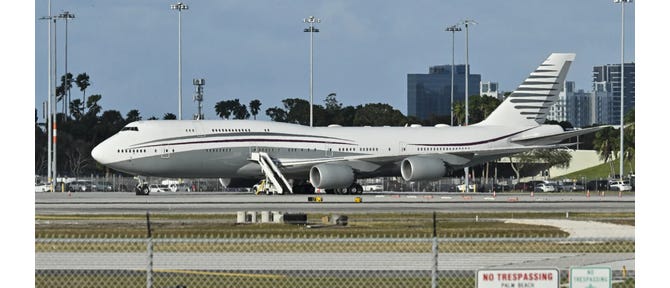
On Thursday, after the Administration asked it not to, the Times ran a story about the President’s brand-new Air Force One —the Qatari-donated Boeing 747-8— which apparently lacks some of the advanced security features of the older aircraft. Including, specifically, an anti-missile system. (The article did not report on who got what contract or how much it cost, despite its lawyer’s silly protests.)
The truth is, the Times yearned to dunk on the Qatari, and score off the Administration. So, it essentially briefed every U.S. enemy on exactly how to shoot down Air Force One— including downing the contents of said aircraft. It did so wilfully. “Before the Wednesday article was published,” the Times explained, “a senior official at the FBI contacted a reporter and a senior editor at The Times to ask that the article be held, calling it an issue of national security.”
The Grey Lady blamed the FBI. “The F.B.I. official,” it said, “declined to explain the security issue.” In other words, without the feds walking Times editors through it step by step, it was impossible for them to understand how disclosing AF1’s security shortfalls could possibly affect the president’s physical safety, the integrity of defensive systems, or the government’s unquestioned interest in not advertising which platform is easier to shoot down.
Right now, some of you are probably thinking that the best and fairest solution might lie in exercising the constitutional right to confrontation: just chuck the four reporters into Air Force One’s starboard engine, one by one, until one of them talks. (After a fair trial, of course.)
Regretfully, the reporters are not themselves targets of the DOJ’s probe. They are only expected to testify as witnesses against the leaker. Still, even though his reporters are in no danger, the Times’s top lawyer called it a brazen act.
🔥 We can argue about how “brazen” it was. But note what the Times’s lawyer didn’t say. He didn’t call it illegal or unconstitutional. There’s a reason. He didn’t forget to say it. No, it was because the Times is protesting on razor-thin legal ice. CRAACK!
The Supreme Court settled the constitutional question over fifty years ago. In Branzburg v. Hayes, a 5-4 Court held that the First Amendment creates noconstitutional privilege allowing reporters to refuse to testify before a federal grand jury. Justice Byron White, writing for the majority, was blunt: “The sole issue before us is the obligation of reporters to respond to grand jury subpoenas as other citizens do and answer questions relevant to an investigation into the commission of a crime.”
Lower courts in some federal circuits, including the DC Circuit where this grand jury sits, have tried to craft narrow exceptions. For instance, in DC, courts can quash civil subpoenas to reporters when the information sought is ‘nonessential’ to the case or can be obtained some other way.
But DC courts have never applied a “balancing test” to criminal subpoenas for grand jury testimony.
Even the generous civil standard frequently fails. Independent journalist Catherine Herridge was threatened with jail in 2024 and charged an $ 800-a-day fine for refusing a civil subpoena to testify in a private lawsuit. The Supreme Court declined to intervene in her case.
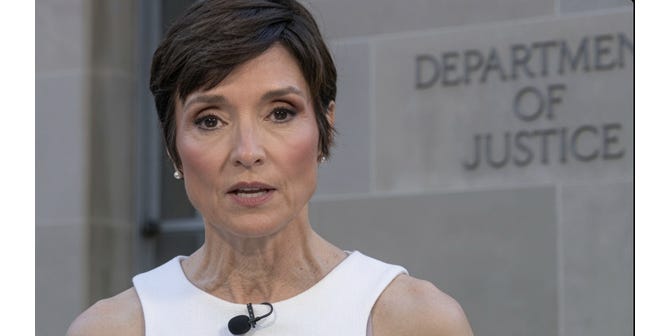
The NYT’s four reporters are being subpoenaed before a federal grand jury in the circuit with the most hostile grand jury doctrine for reporter’s privilege claims. The DC Circuit has never recognized any reporter privilege in criminal court.
In Branzburg, SCOTUS held there is no constitutional right to refuse. There is no federal journalist shield law. The DOJ’s internal media guidelines are just policies, not law, and can be waived by the current Administration for national security investigations.
Unsurprisingly, the Times neglected to mention any of the laws related to reporter subpoenas. The story makes the perfectly legal subpoenas soundillegal or somehow shady. The Grey Lady is trying to influence public opinion, to get its own reporters off the hook for naming the criminal who leaked classified security details about Air Force One.
It won’t work. I wouldn’t be surprised if the DC Circuit tries to help them somehow. But the law is clear. Even using the civil standard, there is an obvious national security need, which defeats claims that it’s non-essential. And there is no other way for the DOJ to get the information.
Prepare to testify, Times, or go to jail. And sorry, there’s no sympathy for you here.
Have a marvelous Monday! I’ll be getting home tonight, and back at HQ for tomorrow’s roundup of essential news and caffeinated commentary.
Don’t race off! We cannot do it alone. Consider joining up with C&C to help move the nation’s needle and change minds. I could sure use your help getting the truth out and spreading optimism and hope, if you can:☕ Learn How to Get Involved 🦠




Leave a Reply
You must be logged in to post a comment.